.png)
A renter-friendly balcony setup needs to address both escape risks and the limits of your lease. Before choosing mesh, panels, or a freestanding enclosure, check what your landlord permits and whether the complete setup can keep your cat safely contained. This guide helps you compare those constraints before making changes.
Balconies contain movement, noise and places to climb. Plan for a startled or curious cat, not just a calm cat sitting beside you. No-drill describes an installation method, not a safety certification.
Cat Safe Balcony Renter Quick Answer
Start with written building approval and a complete enclosure suitable for the location. Railing panels, furniture spacing and a harness do not replace full containment. If a suitable enclosure cannot be installed, keep your cat indoors rather than experimenting at an open edge.
Cats Protection’s balcony advice recommends floor-to-ceiling protection, removal of hazards and supervision. It also warns about gaps and entanglement in poorly secured netting. A cat should be able to retreat indoors; restrict access if the cat becomes frustrated or tries to escape.
-1024x576.png)
Why Balcony Falls Happen Even to Careful Cats
A righting reflex does not prevent impact injuries. Do not rely on a cat’s previous caution, or on your ability to catch a sudden jump.
Why Standard Screens Are Not Safety Devices
Do not assume an ordinary insect screen can contain a cat. Check the intended use, frame, fixings and complete installation, not just the mesh. Our renter-friendly window catio guide covers the separate problem of window access and structural support.
The Railing Gap Problem
Assess openings below, beside and above the railing. Closing vertical gaps alone leaves the top accessible. Do not use a generic skull-width number or a human building-code dimension as a cat-containment test.
Building Permission for Renters
Read your actual lease and building rules. Removable equipment is not automatically permitted, and landlord permission does not certify an enclosure’s safety. Ask the relevant building manager about the proposed product and installation before buying.
What to Ask About
- Drilling, adhesives, pressure-mounted supports and contact with railings.
- Visible changes to the building exterior.
- Access for maintenance, drainage and emergency exits.
- Removal requirements and responsibility for damage.
Send photos and dimensions with your request and keep the written response. See our renting with a cat guide for organizing that conversation.
HOA and Local Requirements
Check whether separate HOA, management or local approvals apply. This guide does not establish a legal right to install netting or an exemption for a no-drill system. Obtain local advice if the requirements are unclear.
5 Renter-Friendly Options and Their Limits
1. Tension-Pole Mesh Systems
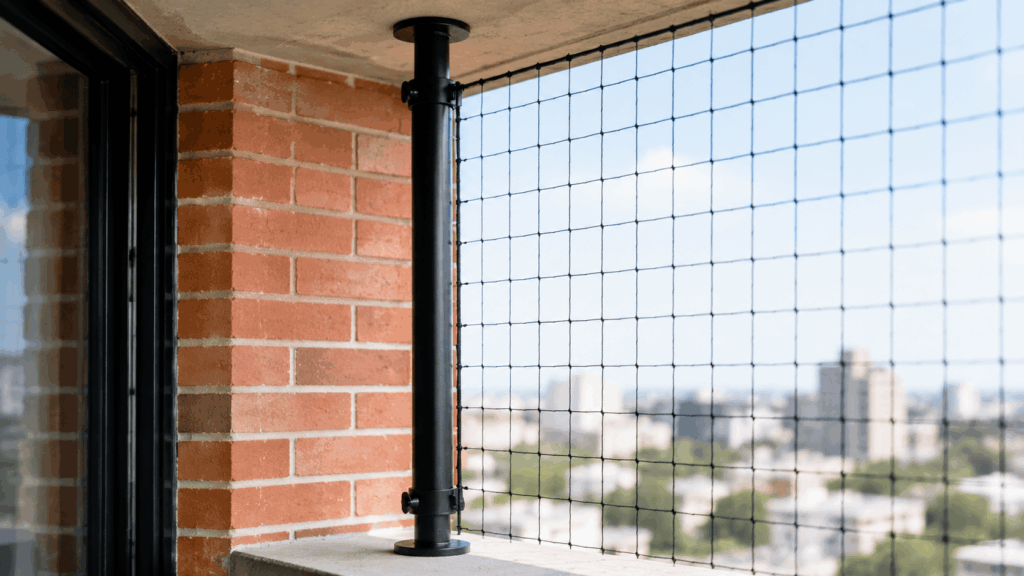
A removable frame may be worth evaluating where the building permits it, but generic tension poles are not a certified enclosure. Ask the supplier whether the complete system is designed for cats, outdoor exposure, your supporting surfaces and your balcony dimensions.
Use the specified fixings and inspection instructions. Do not substitute a universal end-cap diameter or a monthly check for the manufacturer’s requirements. If the system’s suitability or attachment security cannot be established, do not give your cat access.
2. Portable Enclosures
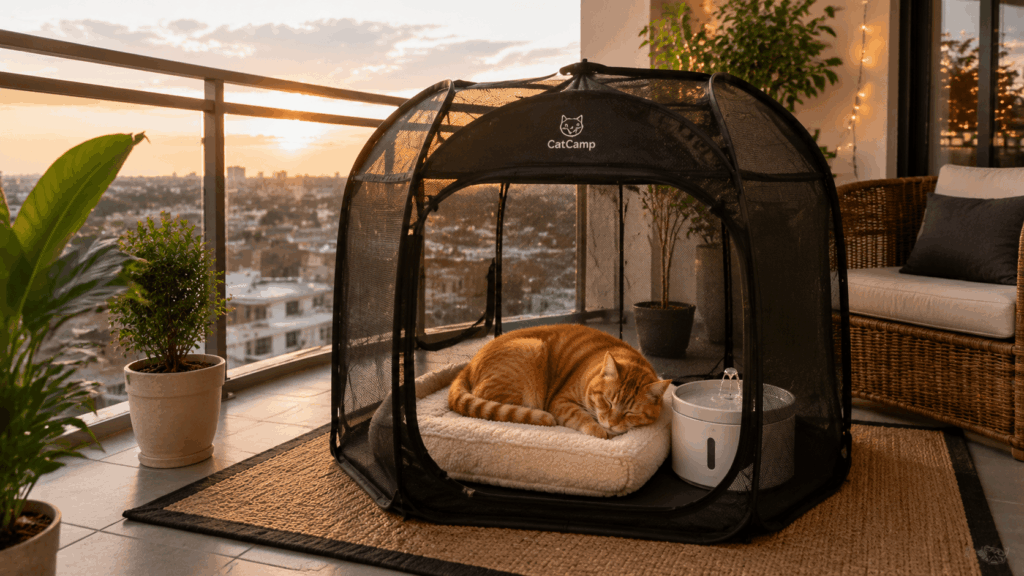
Portability is useful when moving, but a lightweight pet tent is not automatically suitable for an elevated, windy balcony. Review the floor, seams, closures, escape resistance and the manufacturer’s placement and anchoring restrictions.
An indoor introduction can reveal distress or escape attempts, but cannot certify wind stability. Do not add a guessed amount of ballast and assume the enclosure is secure. If the supplier does not support the intended use, choose an indoor location.
3. Railing Gap Panels
Panels may close particular gaps as part of a complete system. They do not prevent a cat going over the top. Confirm material, edge protection, fixings and exposure requirements with the supplier and building manager.
Do not intentionally leave a one-inch opening based on a generic cutting rule. Expansion allowances and attachments must follow the specific product design without introducing an escape gap. Transparency also does not guarantee building approval.
4. Furniture Management
Keep chairs, boxes and plant stands from creating routes to the enclosure boundary. This is a supporting precaution, not containment. There is no universal furniture-to-railing distance that makes an open balcony safe.
Do not alter building equipment or obstruct exits. Keep climbing furniture indoors if its placement would create an escape route outside.
5. Harness Limits and Indoor Alternatives
Do not tether a cat to balcony furniture or treat a harness as fall-arrest equipment. This guide does not recommend open-balcony access when full containment is unavailable. An indoor viewing area is the alternative, not a calculated tether length.
For training in an appropriate setting away from unprotected drops, see our cat harness and leash guide. That is separate from making a balcony secure.
Heat, Insects, Plants and Emergency Access
Heat Management
Provide fresh water, shade and access to a cooler indoor space. Keep cats indoors during extreme heat. Neither a cooling mat nor a fountain makes a hot enclosure safe, and this guide does not prescribe a universal temperature or session-length limit.
Cornell’s feline heat guidance lists excessive panting, drooling, vomiting, diarrhea and weakness or collapse as warning signs. Move the cat to a cool, ventilated area, gently wet the fur with cool rather than very cold water, and contact a veterinarian immediately. Do not delay care to see whether a timer or temperature threshold has been reached.
Bee and Wasp Stings
Check for insect activity before access and keep your cat away from nests. Contact your veterinarian for advice after a sting; breathing difficulty, collapse or rapidly worsening swelling needs emergency veterinary care.
Do not prepare or administer a human antihistamine dose from this article. A veterinarian must determine whether medication is appropriate and specify the product and dose. Keep the emergency clinic’s contact details accessible. See VCA’s cat-specific sting guidance.
Identify Plants by Scientific Name
Verify each species rather than relying on labels such as “marigold” or “cat-friendly.” ASPCA lists Calendula officinalis as non-toxic to cats, but that does not identify every plant sold under a similar common name.
Catnip is not completely harmless: ASPCA’s catnip entry notes that it can cause vomiting and diarrhea.
If toxic exposure is suspected, contact a veterinarian or animal poison service immediately; keep the plant label or a photo available. Do not induce vomiting unless instructed. Cornell’s hazard guidance explains why prompt advice matters, especially for lily exposure.
Keep required exits clear and review your apartment cat emergency evacuation plan. An enclosure must not block the building’s designated escape route. Do not leave your cat in a catio during an emergency.
Frequently Asked Questions
Can a Renter Install Balcony Netting?
It depends on the property and applicable requirements. Ask for written approval of the specific setup; temporary or removable does not automatically mean permitted.
Are Railing Guards Enough?
No. They address only part of the boundary. Examine the top, bottom, sides, doors and attachment points as a complete enclosure.
How Should I Choose Balcony Plants?
Confirm the scientific name and feline toxicity information before purchase. Also check growing products and treatments, and keep plants out of reach if identification is uncertain.
Final Thoughts
Before each use, inspect closures, gaps, attachments and damage; consider weather, heat and your cat’s behavior. Stop access if anything is uncertain. A landlord-approved product still needs a suitable installation, and a secure-looking setup still needs supervision.
Sources and Scope
Linked welfare, veterinary and poison-information sources were checked on October 2, 2026. This is an educational guide, not a structural certification, veterinary treatment plan, legal opinion or account of personal clinical experience. Product-specific installation decisions require qualified advice.