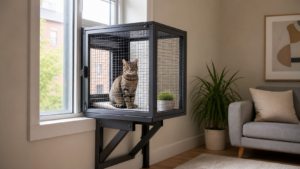
It happened at 9:47 on a Tuesday evening. I know the time because I checked my phone three seconds before I looked up and saw Oliver — all 12 pounds of him — balanced on the outermost edge of my 12th-floor balcony railing, both front paws extended toward a moth that was doing absolutely nothing to deserve the attention. My heart didn’t just stop. It inverted. I crossed that balcony in two steps, scooped him up with hands that were shaking, and stood there in the dark holding a purring cat who had absolutely no idea what he’d just put me through.
That moment permanently changed how I think about outdoor cat access — and as a vet tech who has worked emergency cases involving High-Rise Syndrome, I can tell you that finding a genuine cat safe balcony renter solution is not a weekend project you get around to eventually. It is an urgent, non-negotiable safety priority that must be structurally sound, behaviorally appropriate, and — critically for renters — completely lease-compliant.
Cat Safe Balcony Renter (Quick Answer)
A cat safe balcony renter setup should prevent falls without drilling, gluing, or permanently changing the building. The safest options usually combine no-drill mesh barriers, tension poles, acrylic railing guards, portable catios, supervised harness use, and careful heat, plant, and insect management.
-1024x576.png)
Table of Contents
The High-Rise Syndrome Reality: Why Screens Fail
High-Rise Syndrome is the clinical term veterinary professionals use to describe the constellation of traumatic injuries sustained by cats who fall from elevated windows, balconies, and terraces. It is not a rare occurrence. A landmark study by Whitney and Mehlhaff published in the Journal of the American Veterinary Medical Association documented 132 cases of cats presenting after high-rise falls, with thoracic trauma, pneumothorax, and shattered hard palates among the most frequently documented injuries. ¹
The persistent cultural myth — that cats always land safely because of their righting reflex — is one of the most dangerous pieces of misinformation I encounter as a vet tech. The righting reflex is a genuine physiological adaptation, but it addresses rotational correction during a fall. It does not eliminate impact force. From a 12th floor, the physics are simply not survivable in many cases, and the cases that are survivable often result in months of intensive, expensive rehabilitation.
Why Standard Screens Are Not Safety Devices
This point cannot be overstated: window and door screens are insect barriers, not cat containment systems. They are constructed from lightweight aluminum or fiberglass mesh, held in a friction-track frame, and rated for zero lateral load. The force of a 12-pound cat launching off the frame toward a moth — or a pigeon, or a leaf, or nothing at all — is sufficient to pop that screen completely free of its track. I have seen the aftermath in the clinic. I have held those cats. Please do not rely on a screen.
The Railing Gap Problem
Standard apartment balcony railings present a secondary hazard that many owners overlook entirely. Building codes in most jurisdictions require railing balusters to be spaced no more than 4 inches apart — a measurement designed to prevent toddlers from falling through. A cat’s skull — which is their widest fixed point — averages 3.5 to 4 inches in diameter at its broadest measurement. This means a standard code-compliant railing may be just barely insufficient to contain a cat who is motivated enough to push through. A cat safe balcony renter system must address both the top of the railing and the vertical gaps.
The Legality of Netting: Renters vs. HOAs
Before you spend a dollar on any balcony safety system, you need to understand the legal and contractual landscape — because the wrong installation choice can cost you your security deposit, trigger a lease violation, or conflict with HOA architectural guidelines.
What Leases Typically Prohibit
Most standard residential lease agreements prohibit:
- Drilling, screwing, or bolting into exterior walls, concrete ceilings, or glass railing panels
- Adhesive attachment of any structure to building surfaces
- Modifications to the building’s exterior appearance visible from public areas
- Structural alterations to balcony railings or floor surfaces
The critical insight for renters is that most of these prohibitions target permanent modifications. A truly freestanding or Tension-Mounting system — one that touches the building only via padded pressure contact — typically falls outside the definition of a prohibited modification. It is furniture, not construction.
Choosing removable, no-drill options is the key strategy when negotiating pet policies with your landlord. For lease communication and documentation, see our guide to renting with a cat. When I approached my property manager about Oliver’s balcony setup, I brought printed photos of the specific tension-pole system I planned to use, pointed out the padded contact points, and offered to demonstrate that installation and removal left zero marks. I got written approval via email the same day.
HOA Considerations
Homeowners associations add a layer of complexity beyond the lease itself. Many HOAs have architectural guidelines that govern the appearance of balconies as seen from the exterior — uniformity rules that prohibit visible netting, colored mesh, or structures that alter the building’s facade profile. Before any installation:
- Request a copy of your HOA’s architectural guidelines in writing
- Submit a written request for approval with photos of your proposed system
- Ask specifically whether the guidelines address “temporary, non-permanent pet enclosures”
- Document all communications in writing — email is ideal
Key Renter Protections to Know:
- In many jurisdictions, renters have legal rights to make reasonable accommodations for pets, particularly under fair housing provisions
- Some municipalities have enacted pet-friendly renter legislation that limits a landlord’s ability to prohibit pet safety installations
- Research your local tenant rights statutes — they may provide more protection than your lease suggests
5 Genius Ideas for a Cat Safe Balcony Renter
1. Tension-Pole Mesh Systems
My Top Pick | Renter Safety Rating: ⭐⭐⭐⭐⭐
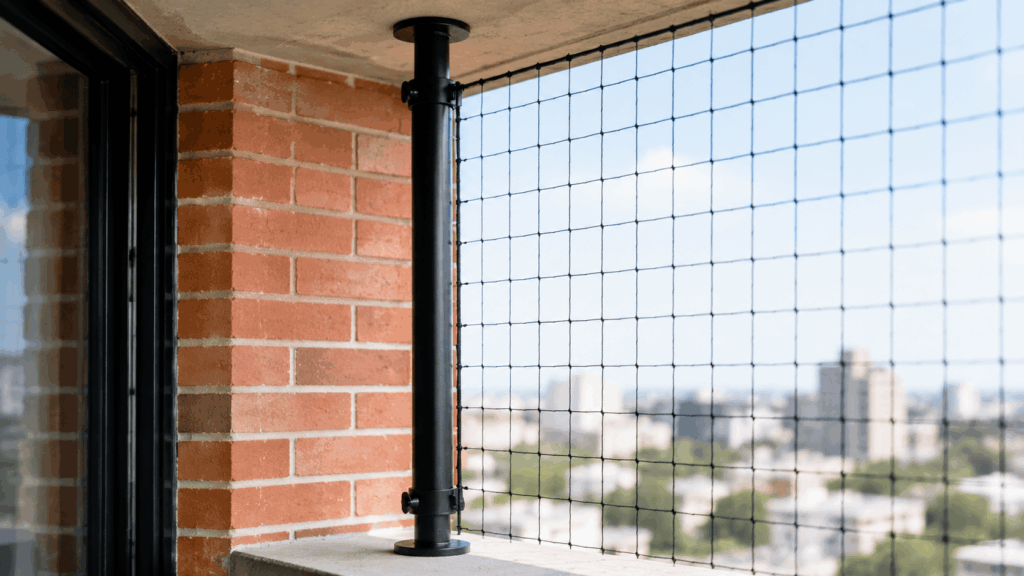
The tension-pole mesh system is the intervention I implemented after Oliver’s moth incident, and it remains my strongest recommendation for most apartment renters. The mechanics are elegantly simple: extendable tension poles — functionally identical to spring-loaded shower curtain rods but engineered for structural load — are compressed between the balcony floor and ceiling overhang, creating vertical support columns. UV-Resistant Mesh panels are then attached between the poles using clip systems, zip ties, or integrated panel channels, enclosing the balcony perimeter without a single drill hole.
The contact points — large rubber or silicone end caps pressing against floor and ceiling — distribute pressure across a wide surface area, leaving zero marks on concrete, tile, or wood composite surfaces. Tension-Mounting is the defining feature that makes this system genuinely Lease-Friendly: there is no chemical bonding, no mechanical fastening, and no alteration of any surface.
A secure balcony can extend the same visual enrichment benefits indoor cats get from window perches, while adding real airflow, sound, and outdoor scent in a controlled space. — it gives your cat the same Visual Enrichment and sensory stimulation of a perch, but in a fully enclosed outdoor environment where they can experience real air movement, ambient sound, and authentic outdoor scent profiles.
Pros:
- Absolute zero drilling, adhesive, or permanent modification
- Fully adjustable to non-standard balcony dimensions and irregular shapes
- Powder-Coated Steel poles provide long-term weather resistance
- Modular panel system allows incremental expansion
- Disassembles completely in 20–30 minutes for moving day
Cons:
- Requires a ceiling or overhead structure for upper tension point — not suitable for fully open terraces without adaptation
- Higher upfront cost than pop-up alternatives
- Monthly tension checks required — poles can loosen over time with thermal expansion and wind vibration
- Initial configuration requires careful measurement and test-fitting
Installation Checklist:
- Measure floor-to-ceiling height at every pole position before ordering
- Check ceiling material — tension against a suspended acoustic tile ceiling is not viable
- Confirm rubber end cap diameter exceeds 3 inches for adequate load distribution
- Inspect tension calibration monthly and after any significant windstorm
2. The Portable Pop-Up Catio
Best for: Frequent Movers, Small Balconies | Renter Safety Rating: ⭐⭐⭐⭐
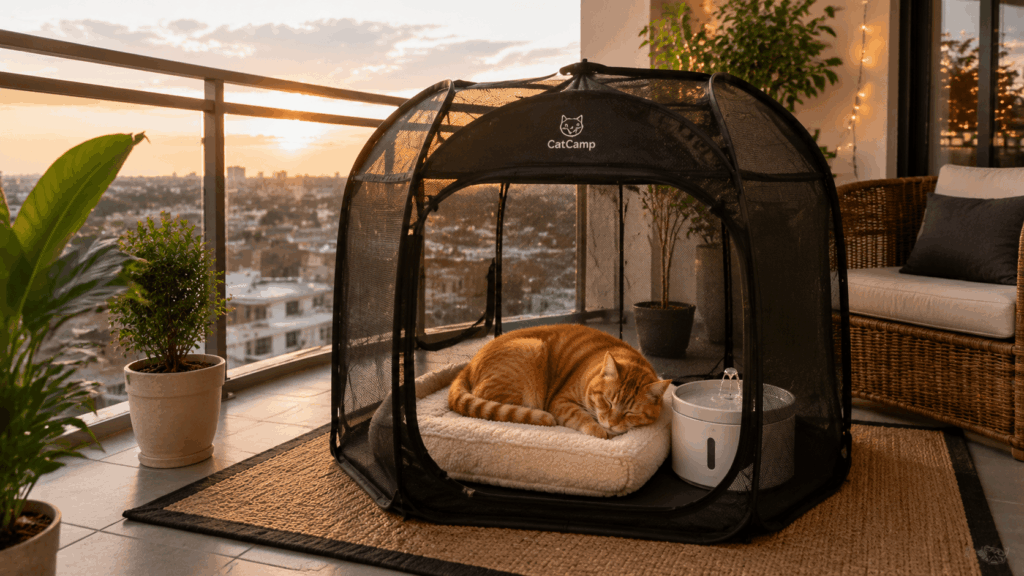
The portable pop-up catio is the yoga bag of cat safety solutions — it compresses into a carry case smaller than a rolled sleeping bag and deploys into a fully enclosed mesh enclosure in under five minutes. These systems use spring-loaded fiberglass or flexible steel poles integrated into the mesh fabric structure, creating a self-erecting tent-style enclosure that sits freestanding on any flat surface.
For renters who move frequently, who want a system they can relocate to a vacation rental or a friend’s balcony, or who need a Lease-Friendly solution they can deploy and remove within a single afternoon, the pop-up catio is unmatched in convenience. It touches nothing except the floor — no walls, no railings, no ceiling required.
My clinical caveat is important here: fabric mesh on budget models has a meaningful failure rate when tested by large, high-drive cats. Oliver — 12 pounds, deeply pigeon-motivated — can stress a zipper seam or push a corner panel within a single outdoor session if the model isn’t sufficiently reinforced. Test any pop-up catio in a controlled indoor environment for at least three supervised sessions before trusting it on a high-floor balcony.
Pros:
- Fastest deployment of all five options — under 5 minutes
- No contact with any building surface whatsoever
- Highly portable — suitable for travel, foster situations, and frequent moves
- Lowest price point of the five options
- Many models include machine-washable mesh components
Cons:
- Durability concerns with large or persistent cats — require careful model selection
- Not weatherproof — fabric mesh saturates in rain
- Wind stability on high floors requires supplemental weighting or anchoring
- Interior volume is limited — not suitable for multi-cat use or enrichment furniture
Wind Stability Tip: Fill a heavy-duty fabric bag with sand or gravel and place it flat inside the tent base. This adds 15–20 pounds of ballast without drilling or damaging the floor surface.
3. Acrylic Railing Guards
Best for: Railing Gap Hazards | Renter Safety Rating: ⭐⭐⭐⭐
Acrylic railing guards address a specific and frequently overlooked hazard: the vertical gaps between balcony railing balusters. As I outlined earlier, standard code-compliant railing gaps can accommodate a motivated cat’s head and body. Transparent acrylic panels — cut to the dimensions of your railing section and secured using cable ties, hook-and-loop fasteners, or friction clips — create a solid vertical barrier without drilling into the railing structure.
The transparency of acrylic is a significant aesthetic advantage over mesh or netting solutions. From the exterior, the railing appears unmodified. From the interior, Visual Enrichment is completely unimpaired — Oliver can see the full cityscape without any visual obstruction. For renters in buildings with strict HOA appearance guidelines, this is often the most permissible option because it is essentially invisible from a distance.
Pros:
- Completely transparent — preserves Visual Enrichment and exterior appearance
- Addresses the railing gap hazard specifically and elegantly
- Cable-tie attachment leaves no permanent marks on powder-coated railing surfaces
- Weather-resistant and UV-stable in quality acrylic grades
- Easy to clean with standard glass cleaner
Cons:
- Does not address the top of the railing — cats can still jump up and over without a supplemental top barrier
- Must be combined with another system (tension mesh or pop-up catio) for complete enclosure
- Custom cutting required for non-standard railing dimensions
- Can develop surface scratches over time, reducing transparency
Measurement Protocol:
- Measure each railing panel section individually — balcony railings are often not perfectly uniform
- Order panels 1 inch shorter than the measured height to allow for thermal expansion without buckling
- Use UV-resistant cable ties rated for outdoor use — standard cable ties become brittle and fail in direct sunlight within one season
4. Strategic Furniture Spacing
Best for: Supplemental Deterrence | Renter Safety Rating: ⭐⭐⭐
Strategic furniture spacing is not a containment system — I want to be explicit about that. It is a supplemental behavioral deterrent that reduces the opportunity for railing access by eliminating the launch points a cat uses to reach the railing in the first place. Used alone, it is insufficient for a cat safe balcony renter setup. Used in combination with any of the first three methods, it meaningfully reduces residual risk.
The principle is simple: cats reach balcony railings by jumping from nearby elevated surfaces — chairs, tables, storage boxes, plant stands, and air conditioning units. By mapping every surface within jumping distance of the railing (a healthy adult cat can cover 5–6 feet horizontally in a single jump) and either removing it or repositioning it to point away from the railing, you reduce the accessible launch architecture.
Furniture Arrangement Guidelines:
- Maintain a minimum 6-foot clearance between any furniture surface and the railing
- Orient chairs and loungers so the seat faces inward — away from the railing
- Replace tall plant stands with low, ground-level planters
- Remove or relocate HVAC covers, storage bins, or any elevated object within the clearance zone
- Consider placing a cat tree in the interior of the balcony, facing inward — this gives Oliver a sanctioned high vantage point that satisfies his elevation drive without railing access
Pros:
- Zero cost — uses existing furniture management
- No installation required
- Reduces behavioral motivation for railing access
- Improves the human usability of the balcony simultaneously
Cons:
- Not a primary containment system — insufficient alone for high floors
- Requires ongoing discipline — items tend to migrate back toward the railing over time
- Does not address a cat who is already on the railing before furniture rearrangement
5. The Harness-Anchor Protocol
Best for: Supervised Single Sessions | Renter Safety Rating: ⭐⭐⭐
For renters who cannot install any physical barrier system due to strict lease or HOA restrictions, the harness-anchor protocol provides a supervised safety measure that keeps a cat physically secured to a fixed point on the balcony. For renters who cannot install nets, a high-quality escape-resistant harness may be used only as a supervised secondary safety measure.
The protocol requires three components working together:
Component 1: The Harness
Not all harnesses are suitable for high-elevation use. A standard H-style or figure-8 harness can be slipped by a determined or panicked cat. For balcony safety, I specify a vest-style escape-proof harness with a minimum of two chest contact points and a back D-ring. The fit must be verified using the two-finger rule at every contact point before every outdoor session.
Component 2: The Anchor Object
The tether attaches to a heavy, floor-level object — a filled planter (minimum 40 pounds), a weighted storage box, or a specifically purchased balcony anchor weight system. The anchor must be too heavy for the cat to drag toward the railing and must be positioned so that the maximum tether extension keeps the cat at least 3 feet from the railing perimeter.
Component 3: Supervised Access Only
This protocol requires your physical presence on the balcony for the entire session. A harnessed cat in a panic — startled by a loud noise, a bird, or a sudden gust — can generate enough force to flip a marginally heavy anchor or achieve an unexpected angle that compromises the tether geometry. This is not an unsupervised solution.
Tether Length Calculation:
- Measure the distance from the anchor position to the nearest railing point
- Subtract 3 feet (the minimum safe buffer)
- That result is your maximum safe tether length
- If the result is less than 2 feet, the anchor position needs to move further from the railing
Pros:
- No building modification whatsoever — fully Lease-Friendly
- Provides meaningful outdoor access in the most restrictive lease environments
- Harness training also prepares cats for leash walking
- Low cost of entry
Cons:
- Requires 100% supervised sessions — cannot be used unsupervised
- Requires consistent harness training investment before balcony use
- Tether geometry must be carefully calculated for each specific balcony
- Panicked cats can sustain tracheal or spinal injury from sudden tether tension — vest harness is non-negotiable

Environmental Hazards: Heat, Bees, and Toxic Plants
Choosing and installing a cat safe balcony renter system addresses the fall risk. But the balcony environment itself contains additional hazards that require active management.
Heat Management at Elevation
High-floor balconies are radiant heat environments. Solar radiation reflects off glass, metal railings, and concrete simultaneously, creating ambient temperatures that can exceed ground-level readings by 15–25°F. Cats regulate heat poorly — they rely on evaporative respiration and paw pad perspiration, both of which are low-capacity systems that are rapidly overwhelmed in extreme heat.
My Clinical Guidelines:
- No unsupervised balcony access when ambient temperature exceeds 85°F (29°C)
- Maximum 30-minute supervised sessions for healthy adult cats above 80°F (26.7°C)
- For brachycephalic breeds (Persians, Himalayans, Exotic Shorthairs), reduce this threshold to 75°F (23.9°C) — their compromised airway makes heat dissipation significantly less efficient
- Senior cats and cats with cardiac or respiratory conditions require individual veterinary guidance on heat exposure limits
Heat Mitigation Strategies:
- Attach 40–70% UV shade cloth to the sun-facing side of your mesh system using zip ties
- Place a gel cooling mat inside the enclosure — pressure-activated, no electricity required
- Install a digital thermometer with remote sensor inside the catio so you can monitor the actual interior temperature from inside your apartment
- Provide a ceramic recirculating water fountain — moving water stays significantly cooler than still bowl water and encourages drinking
Bee, Wasp, and Insect Risk
Urban balconies at any height can experience bee and wasp activity, particularly during spring and summer when swarms are active and nests are establishing. I have managed anaphylactic reactions to bee stings in cats at the clinic — the presentation is fast (15–30 minutes post-sting), dramatic, and genuinely life-threatening without prompt intervention.
Pre-Season Inspection Protocol:
Before Oliver’s first outdoor session of each spring, I conduct a systematic inspection of every inch of the balcony:
- Check all railing joints and hollow posts for wasp nest establishment
- Inspect the ceiling overhang and any drainage channels
- Look under furniture and in the corners of the floor where wasps often initiate ground nests
Emergency Preparedness:
- Keep diphenhydramine (Benadryl) liquid in a pre-measured syringe — Do not give antihistamines or any human medication without veterinary guidance. If your cat is stung by a bee or wasp, call your veterinarian or an emergency veterinary hospital immediately, especially if you notice facial swelling, vomiting, weakness, breathing changes, collapse, or rapid worsening. At 12 pounds, Oliver’s syringe contains 12mg. Confirm this protocol with your veterinarian before implementing it for your specific cat.
- Post your emergency veterinary clinic contact on the balcony door — not just in your phone, but physically visible
- Know the location of the nearest 24-hour emergency veterinary clinic and have the route mentally rehearsed
Toxic Balcony Plants
Balcony gardens are wonderful for Visual Enrichment and sensory stimulation — but many common balcony plants are acutely toxic to cats. The ASPCA Animal Poison Control Center maintains a comprehensive database, and I consult it before introducing any new plant to Oliver’s environment.
Common Balcony Plants That Are TOXIC to Cats:
| Plant | Toxicity Level | Primary Effect |
|---|---|---|
| Lily species (Lilium, Hemerocallis) | Severe — potentially fatal | Acute kidney failure |
| Oleander | Severe — potentially fatal | Cardiac arrhythmia |
| Sago Palm | Severe — potentially fatal | Liver failure |
| Lantana | Moderate–Severe | GI, neurological |
| Wisteria | Moderate | GI distress |
| Foxglove | Severe | Cardiac toxicity |
Cat-Safe Balcony Plants (Confirmed by ASPCA):
- Catnip (Nepeta cataria) — actively beneficial and enriching
- Cat grass (oat, wheat, or barley grass) — supports digestion
- Valerian — calming, cat-attractant properties
- Spider Plant (Chlorophytum comosum) — mild hallucinogenic effect in cats but confirmed non-toxic
- Rosemary — safe and deer-resistant; cats often enjoy the scent
- Marigolds — safe, pest-deterrent, and visually vibrant
While the balcony feels like a wonderful extension of your home, it should never be part of your fire evacuation plan — and that includes leaving a cat in a catio during an emergency. Practice a quick-release retrieval protocol so you can bring your cat inside quickly and safely.For a full emergency setup, see our cat emergency evacuation plan.

Frequently Asked Questions
Is it illegal to put netting on an apartment balcony?
In most places, removable balcony netting is not automatically illegal, but it may violate a lease, building rule, HOA guideline, or exterior appearance policy. Treat this as a building-approval question, not just a safety question. — but it may be subject to lease restrictions, HOA architectural guidelines, or building management approval requirements. The legal question and the contractual question are distinct, and both must be addressed separately.
From a legal standpoint, no jurisdiction I’m aware of prohibits a tenant from installing a temporary, removable pet safety net on a private balcony. However, your lease agreement may contain language prohibiting visible modifications to the building exterior, which netting visible from outside could trigger. Research your local tenant protection laws, get written landlord approval using photos of your specific system, and document all communications. In my experience, landlords are almost always supportive when the system is demonstrably non-damaging.
Can my cat fall through the vertical bars on a railing?
Yes — and this is a risk that far more cat safe balcony renter guides fail to address adequately. Standard building code in most U.S. jurisdictions requires baluster spacing of no more than 4 inches to prevent child falls. The average adult cat’s skull — their widest fixed anatomical point — measures approximately 3.5 to 4 inches at its broadest. This means a code-compliant railing may be only marginally insufficient to contain a cat who is motivated to push through.
Factors that increase the risk include:
- Slim-bodied breeds (Siamese, Abyssinian, Oriental) whose narrower skull profile fits more easily through standard gaps
- Kittens, whose skulls are proportionally smaller than adults
- Motivated cats — a cat pursuing a bird or insect will apply substantially more force to a gap than one who approaches it casually
- Railings wider than code minimum — some building designs use 5 or 6-inch spacing
The solution is acrylic railing guards (Method 3 above) or fine-gauge mesh attached to the interior face of the railing using cable ties. Address this hazard as a priority — it is real.
What is the best cat-safe plant for a sunny balcony?
For a sunny, high-floor balcony where a cat safe balcony renter setup is already in place, my top recommendation is cat grass — specifically a mix of oat, wheat, and barley grass grown in a wide, low ceramic planter. It thrives in full sun, is confirmed non-toxic by the ASPCA, provides meaningful digestive benefits when chewed, and gives cats a physical interaction point with the balcony environment beyond pure observation.
My second recommendation is catnip (Nepeta cataria), which grows enthusiastically in full sun, is completely safe, and provides genuine behavioral enrichment through its nepetalactone content. Fresh catnip is dramatically more potent than dried commercial varieties — Oliver loses his composure entirely in the presence of a living catnip plant, which is both hilarious and clinically reassuring.
For visual interest from the human perspective, marigolds are ASPCA-confirmed safe, perform well in full sun, and have natural pest-deterrent properties that reduce the insect hazard on the balcony.
Final Thoughts: Oliver Is Watching the Moth From Inside the Mesh Now
That Tuesday evening on the 12th floor changed everything about how I approach balcony safety — for Oliver, and for every multi-cat household client I’ve counseled since. The moth got away. Oliver is fine. But the version of that story where I was two seconds slower to look up is one I think about every time I clip the last tension-pole panel into place before letting him out.
A true cat safe balcony renter setup doesn’t require you to own your building, compromise your security deposit, or sacrifice your lease. It requires the right system, installed correctly, inspected consistently, and combined with environmental awareness. The five methods in this guide — from the tension-pole mesh to the harness-anchor protocol — cover every lease situation and every budget. Start with whatever your lease allows today. Add layers as your situation permits.
Oliver gets his pigeons. He gets his moths. He gets his outdoor air and his cityscape and his catnip plant in the corner. He just gets all of it from behind half-inch mesh rated for three times his body weight.
That’s the deal. And as far as he’s concerned, it’s an excellent one.
References
- Whitney, W.O., & Mehlhaff, C.J. (1987). “High-Rise Syndrome in Cats.” Journal of the American Veterinary Medical Association, 191(11), 1399–1403.
- Vnuk, D., Pirkić, B., Matičić, D., Radišić, B., Stejskal, M., Babić, T., Lemo, N., & Trapped, P. (2004). “Feline high-rise syndrome: 119 cases (1998–2001).” Journal of Feline Medicine and Surgery, 6(5), 305–312.
Disclaimer: This article is for educational purposes only and does not replace veterinary advice, emergency care, legal advice, or lease review. Balcony safety, high-floor falls, heat stress, insect stings, toxic plants, and building rules can all create serious risks. Always supervise your cat on a balcony, follow your lease and building policies, and contact your veterinarian or an emergency veterinary hospital if your cat shows sudden symptoms or injury.
-300x169.png)
-300x169.png)
-300x169.png)