.png)
There was a period in Oliver’s life — approximately eighteen months after I adopted him — when he had developed what I diplomatically describe as a “gravitational relationship” with the kitchen counter. He could see it. He wanted to be on it. He would approach it with intent, gather himself, launch — and land about four inches short, sliding back down the cabinet face with a look of profound betrayal directed at the laws of physics.
As a vet tech, I knew exactly what I was looking at: a cat whose caloric intake had quietly exceeded his caloric output for long enough that it was now affecting his mobility, his joint stress, and his quality of life. Switching Oliver to a low calorie cat wet food diet wasn’t about making him suffer through smaller portions — it was about understanding the difference between Nutrient Density and Energy Density, and finding foods that delivered everything his body needed while delivering fewer of the calories his indoor lifestyle couldn’t burn.
Low-calorie wet food works best as part of a complete routine. Our apartment cat feeding and weight control guide explains how to combine food choice, portion size, treats, and daily activity.
Disclaimer: This article is for educational purposes only and does not replace veterinary diagnosis, treatment, or individualized nutrition advice. Weight loss in cats should be gradual and monitored. If your cat has diabetes, kidney disease, urinary issues, pancreatitis, appetite loss, rapid weight loss, vomiting, or any medical condition, consult your veterinarian before changing food or calories.
Low Calorie Cat Wet Food (Quick Answer)
Low calorie cat wet food should provide high moisture, enough animal protein, controlled calories, and clear feeding guidance. For many indoor cats, options around 120–150 kcal per 5.5 oz can may help create a satisfying meal volume, but the right target depends on your cat’s ideal weight, body condition, activity level, and veterinary guidance.
-1024x576.png)
Table of Contents
The Satiety Secret: Why Volume Matters for Indoor Cats
The single most common reason calorie-restricted diets fail in cats is not the cat’s metabolism. It is the Satiety problem — the cat is hungry, they communicate their hunger relentlessly, and the owner, who loves their cat and cannot bear the protest, feeds more than the plan allows.
Understanding why your indoor cat gains weight is the first step before switching to a calorie-controlled diet. The next step is understanding why wet food solves the satiety problem in a way that dry food calorie restriction simply cannot.
The Physics of Feline Fullness
A cat’s Satiety response is triggered by a combination of gastric stretch receptors (the physical sensation of a full stomach) and hormonal signals released in proportion to protein consumption. The stomach must reach a meaningful fill volume to activate the stretch receptor signal — regardless of how many calories are in the food that fills it.
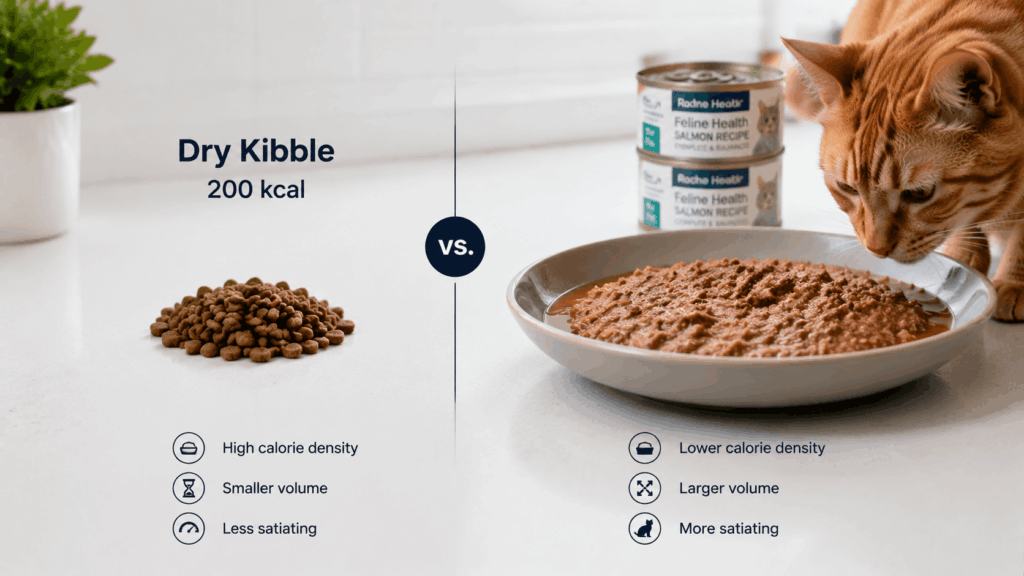
Here is the critical number: a domestic cat’s stomach volume is approximately 45–50 milliliters at comfortable capacity. A 5.5 oz (156g) can of wet food at 80% moisture contains approximately 125ml of content volume. A 5.5 oz serving of dry food at 10% moisture contains approximately 20ml of content volume — less than half the stomach-filling volume at potentially triple the caloric density.
This is why low calorie cat wet food can be a useful tool for feline weight management when portions are measured and the plan is appropriate for the cat: the high moisture content creates physical satiety at appropriate caloric levels. The cat eats a meal that genuinely fills their stomach, the stretch receptors fire, the satiety hormones are released, and the cat rests comfortably rather than immediately returning to the bowl.
The Indoor Activity Deficit
Indoor cats face a structural energy balance problem. Wild and outdoor cats spend 30–40% of their waking hours in predatory behavior — stalking, chasing, pouncing, and hunting. This activity expenditure is built into their caloric requirement baseline. An indoor cat who “hunts” a stationary food bowl for 90 seconds twice a day is expending perhaps 10% of that energy — but their appetite drive, calibrated by evolution for active hunting, continues to demand the same food intake.
The math is unforgiving: a moderately sedentary indoor cat requires approximately 200–250 kcal per day, while the same cat’s hunger drive pushes them toward 350–400 kcal if allowed to self-regulate. Over months and years, this gap manifests as the 14-pound orange tabby who cannot quite reach the counter.
How to Spot ‘High Energy Density’ Fillers on the Label
Label reading is a clinical skill — and for weight management specifically, it is the skill that separates genuinely low-calorie options from foods that are marketed as weight-appropriate but are nutritionally dense in ways the front panel doesn’t disclose.
The Caloric Density Calculation
Metabolizable Energy (ME) is the clinically relevant caloric measurement for cat food — it represents the calories actually available to the cat’s metabolism after accounting for digestive losses. The ME value is typically listed on the food label as “kcal/kg” or “kcal/can.” This is the number that matters, not the serving size calorie count, which can be manipulated by adjusting recommended portion sizes.
What you’re looking for:
- Wet food: under 900 kcal/kg for weight management (≈ under 140 kcal per 5.5 oz can)
- Maintenance wet food: 900–1100 kcal/kg
- High-calorie wet food: above 1100 kcal/kg
Converting to Dry Matter Basis
Because wet foods contain vastly different moisture percentages, you cannot compare their protein and fat content directly from the “as fed” label values. The Dry Matter Basis (DMB) conversion removes moisture from the equation and allows genuine nutritional comparison.
The DMB formula:
Dry Matter % = (As-Fed % ÷ (100 − Moisture %)) × 100
Example: A food showing 10% protein as-fed with 78% moisture:
- DMB Protein = (10 ÷ (100 − 78)) × 100 = 45.5% protein on a dry matter basis
For weight management, target:
- Protein DMB: above 40% (high protein supports lean muscle mass preservation during caloric restriction)
- Fat DMB: below 20% (fat is calorically dense at 9 kcal/gram vs. protein’s 4 kcal/gram)
- Carbohydrate DMB: below 10% (carbohydrates contribute to insulin spikes and fat storage in cats)
For many indoor cats, lower carbohydrate levels may be helpful, but the full diet should be evaluated by calories, protein, moisture, fat, and veterinary guidance—not carbohydrate percentage alone.The High-Energy-Density Filler Red Flags
Scan the ingredient list for these Energy Density inflators that add calories without proportional nutritional benefit:
| Ingredient | What It Is | Why It Can Be a Problem |
|---|---|---|
| Corn starch / corn flour | Starchy carbohydrate binder | Can raise carbohydrate content and calorie density |
| Brewers rice | Grain-based filler | Adds calories without much moisture or satiety benefit |
| Pea starch / potato starch | Starchy binder | Common in grain-free formulas but still calorie-dense |
| Vegetable oil | Added fat source | Increases calorie density quickly |
| Tapioca starch | Starchy binder | Adds calories with limited protein benefit |
| Excessive liver | Organ meat | Nutritious in moderation but calorie-dense in larger amounts |
Green flag ingredients for weight management:
- Named lean protein first (chicken, turkey, whitefish, tuna)
- Broth or water as moisture source (not oil)
- Vegetables listed after the primary protein (adds fiber and volume without caloric density)
- Taurine and essential vitamins listed explicitly (confirms nutritional completeness)
7 Smart Picks for Low Calorie Cat Wet Food
These food choices can support the indoor cat weight management steps we recommend for safe, gradual weight loss. Each pick has been evaluated against clinical criteria: Metabolizable Energy per serving, protein quality, moisture content, ingredient transparency, and real-world palatability data.
1. The Best Overall Maintenance — Hill’s Science Diet Adult Perfect Weight Chicken Entrée
Clinical Rating: 5/5 | Kcal: ~120 kcal per 5.5 oz can
Hill’s Science Diet Perfect Weight is the food I reach for first when a client comes in with a moderately overweight indoor cat who doesn’t have a specific medical condition requiring a prescription diet. It is formulated specifically for weight maintenance rather than aggressive medical weight loss — the ideal choice for cats who need to lose 0.5–1.5 pounds over several months without the clinical intensity of a prescription weight loss protocol.
The Metabolizable Energy value is among the lowest in the mainstream wet food category at approximately 120 kcal per 5.5 oz can, achieved through a combination of high moisture content (82%) and reduced fat formulation rather than reduced protein — which is the clinically correct approach. Protein is maintained at levels sufficient to preserve lean muscle mass during caloric restriction.
The ingredient quality is transparent and appropriate: chicken is the first ingredient, followed by chicken liver for palatability, with no corn starch, no pea starch, and no added vegetable oils. The fat source is salmon oil — providing omega-3 fatty acids that support coat condition during weight loss (a period when fat-soluble nutrient delivery can be compromised).
Nutritional Profile:
- Moisture: 82%
- Protein (DMB): ~42%
- Fat (DMB): ~18%
- Estimated ME: ~120 kcal/5.5 oz
Pros:
- Lowest caloric density of the mainstream (non-prescription) options
- Transparent ingredient list with named lean protein first
- Omega-3 supplementation supports coat condition during weight loss
- Widely available at major pet retailers
Designed by a major veterinary nutrition brand with feeding guidance available
Cons:
- Mid-to-high price point for everyday feeding
- Some picky cats find the pâté texture less appealing than shredded varieties
- Not appropriate for cats requiring aggressive medical weight loss (see prescription options)
2. The Budget-Friendly Bulk Pick — Purina Pro Plan Weight Management Turkey & Chicken Entrée
Clinical Rating: 4/5 | Kcal: ~130 kcal per 5.5 oz can
For clients managing weight in cats on tighter budgets — or managing multiple cats where per-serving cost is a genuine constraint — Purina Pro Plan’s Weight Management line offers clinically reasonable formulation at a significantly more accessible price point. The Dry Matter Basis protein content is strong, the fat content is appropriately restrained, and the caloric density at ~130 kcal per 5.5 oz can falls within the acceptable weight management range.
The formulation uses turkey and chicken as the primary protein sources — both lean meats with favorable protein-to-fat ratios — and avoids the starchy carbohydrate fillers that undermine weight management in cheaper options. Purina Pro Plan is one of the few mass-market brands that publishes AAFCO feeding trial results rather than relying solely on nutrient analysis for nutritional adequacy claims.
Nutritional Profile:
- Moisture: 80%
- Protein (DMB): ~40%
- Fat (DMB): ~20%
- Estimated ME: ~130 kcal/5.5 oz
Pros:
- Most accessible price point of the seven picks
- Available in bulk multipack formats — cost-effective for multi-cat households
- Published AAFCO feeding trial data — verified real-world nutritional adequacy
- Broad palatability — accepted by most cats including selective eaters
- Consistent formulation — fewer recipe changes than some competitors
Cons:
- Slightly higher caloric density than Pick 1 — monitor portion carefully
- Fat content (DMB ~20%) is at the upper acceptable limit for weight management
- Some formulations in the line contain carrageenan — check specific product label if this is a concern
- Less protein density than the high-protein lean option (Pick 3)
3. The High-Protein Lean Choice — Weruva Cats in the Kitchen Chicken Frick ‘A Zee
Clinical Rating: 4.5/5 | Kcal: ~115 kcal per 5.5 oz can
This pick requires some explanation because it represents a different philosophy of weight management than caloric restriction alone. Weruva’s Chicken Frick ‘A Zee achieves its low Metabolizable Energy value not through reduced protein (the common but clinically problematic approach) but through extremely high moisture content (approximately 87%) and minimal fat — leaving a food that is high in lean protein, genuinely low in calories, and exceptionally high in Satiety value per serving.
The protein source is boneless, skinless chicken breast listed as a primary ingredient — among the leanest animal protein sources available, with a protein-to-fat ratio that is difficult to match in commercial cat food. The ingredient list is remarkably short for a commercial wet food: chicken breast, chicken broth, sunflower oil, and vitamins. No starches, no gums, no by-products.
The clinical advantage of this high-protein, low-fat formulation is lean muscle mass preservation during weight loss. Muscle tissue is metabolically active — it burns calories at rest — and protecting it during caloric restriction ensures that weight loss removes fat rather than metabolically valuable muscle.
Nutritional Profile:
- Moisture: 87%
- Protein (DMB): ~55%
- Fat (DMB): ~12%
- Estimated ME: ~115 kcal/5.5 oz
Pros:
- Highest protein-to-calorie ratio of the seven picks
- Human-grade chicken breast — exceptionally clean ingredient list
- 87% moisture — superior hydration and Satiety volume
- Preserves lean muscle mass during caloric restriction
- Grain-free, starch-free, gum-free formulation
Cons:
- Higher price point — premium positioning
- Short ingredient list means limited palatability variation for picky cats
- Requires additional taurine supplementation monitoring — very high moisture dilutes nutrient density
- Not suitable as the sole diet for cats with protein restriction requirements (e.g., advanced CKD)
4. The Picky Eater’s Low-Cal Option — Royal Canin Thin Slices in Gravy Weight Care
Clinical Rating: 4/5 | Kcal: ~125 kcal per 5.5 oz can
The palatability challenge in weight management is real and clinically significant: a cat who refuses their weight management food will find calories somewhere — typically from household companions’ bowls, from counter-surfing, or from an owner who caves to persistent begging and supplements with high-calorie treats. A food that is clinically optimal but palatability-rejected is, in practice, worthless.
Royal Canin’s formulation approach prioritizes palatability engineering alongside nutritional design — their thin-slice-in-gravy texture is accepted by a high percentage of cats who reject pâté formats, and the gravy component adds a liquid-based Satiety contribution that pâté textures don’t provide. For the genuinely selective cat who has rejected other low-calorie options, this is the clinical bridge.
The formulation is nutritionally appropriate for weight management with caloric density at ~125 kcal per 5.5 oz, adequate lean protein, and a moisture content that supports the volume-satiety mechanism.
Nutritional Profile:
- Moisture: 83%
- Protein (DMB): ~38%
- Fat (DMB): ~17%
- Estimated ME: ~125 kcal/5.5 oz
Pros:
- Thin-slice texture accepted by the majority of pâté-refusing cats
- Gravy provides additional liquid Satiety layer
- Royal Canin palatability formulation — designed specifically for selective eaters
- Nutritionally complete and balanced for adult maintenance
- Available in multipack formats for cost management
Cons:
- Contains some carbohydrate binders — not ideal for strict low-carbohydrate management
- Protein DMB (~38%) is the lowest of the seven picks — monitor muscle condition
- Royal Canin uses proprietary ingredient sourcing that limits full transparency
- Gravy-style foods can increase floor mess — consider mat placement
5. The Senior Weight Control — Hill’s Science Diet Senior 7+ Youthful Vitality Chicken & Vegetable Entrée
Clinical Rating: 4.5/5 | Kcal: ~135 kcal per 5.5 oz can
Senior cats present a specific weight management paradox: many older cats are overweight from years of indoor sedentary living, while simultaneously beginning to experience the muscle loss (sarcopenia) that is a normal component of aging. Aggressive caloric restriction in a senior cat risks accelerating sarcopenia — removing muscle mass alongside fat, which is the opposite of what we want.
The Hill’s Senior 7+ Youthful Vitality formulation addresses this through enhanced protein levels relative to standard weight management foods, combined with L-carnitine supplementation — an amino acid that supports fat metabolism and lean muscle preservation specifically validated for use in senior feline weight management.
The caloric density at ~135 kcal per 5.5 oz can is slightly higher than some picks here, but the senior-specific protein enhancement and L-carnitine inclusion justify the modest caloric difference for cats over seven years old.
Nutritional Profile:
- Moisture: 80%
- Protein (DMB): ~44%
- Fat (DMB): ~19%
- Estimated ME: ~135 kcal/5.5 oz
Pros:
- L-carnitine supplementation — clinically validated for senior fat metabolism support
- Higher protein DMB than standard weight management foods — protects against sarcopenia
- Antioxidant enrichment supports immune function in aging cats
- Hill’s veterinary feeding trial validation for senior populations
- Broadly palatable — chicken-first formulation accepted by most senior cats
Cons:
- Slightly higher caloric density than some picks — portion accuracy becomes more important
- Price point is mid-to-high
- Not appropriate as the primary choice for cats under 7 years (protein/vitamin levels calibrated for senior metabolism)
- Pâté texture may be less appealing for cats with dental disease — consider texture options
6. The Sensitive Stomach Lean Pâté — Purina Pro Plan Veterinary Diets EN Gastroenteric Low Fat
Clinical Rating: 4.5/5 | Kcal: ~140 kcal per 5.5 oz can
This pick occupies a clinical niche that deserves dedicated coverage: the overweight cat who also has a history of gastrointestinal sensitivity — vomiting, diarrhea, inflammatory bowel disease, or chronic digestive instability. Many weight management foods use novel protein sources or high-fiber formulations that can trigger GI symptoms in sensitive cats, making compliance impossible.
The Purina EN Gastroenteric Low Fat formulation was specifically developed for concurrent GI management and caloric restriction. The protein sources are highly digestible, the fat content is genuinely restricted (not just labeled as restricted), and the fiber profile is calibrated for GI recovery rather than just weight management.
Important: This is a veterinary prescription diet — it requires a veterinary prescription to purchase. I’m including it because the overlap between obesity and GI disease in cats is common enough that this product has a genuine and underserved clinical audience.
Nutritional Profile:
- Moisture: 79%
- Protein (DMB): ~41%
- Fat (DMB): ~14% (genuinely low-fat, not marketing low-fat)
- Estimated ME: ~140 kcal/5.5 oz
Pros:
- Specifically formulated for concurrent GI disease and weight management
- Genuinely low fat — not just relatively lower than standard foods
- Highly digestible protein reduces GI symptom triggers
- Purina veterinary clinical validation — backed by GI-specific research
- Appropriate for cats with pancreatitis history where fat restriction is medically required
Cons:
- Requires veterinary prescription — additional access step
- Highest price point of the seven picks
- Not appropriate as a long-term maintenance diet without veterinary guidance
- Some cats find the GI-formulated flavor profile less palatable than standard options
7. The Shredded Hydration Specialist — Tiki Cat After Dark Chicken & Chicken Liver
Clinical Rating: 4/5 | Kcal: ~120 kcal per 5.5 oz can
Tiki Cat’s shredded format occupies a specific and valuable niche in the low calorie cat wet food landscape: the maximum-hydration option for cats who need aggressive moisture intake alongside weight management. Cats with concurrent urinary tract conditions — where high water intake is therapeutic — or cats who are chronically under-hydrated on any other format benefit from the 88%+ moisture content of Tiki Cat’s broth-based formulations.
The shredded texture in a thin broth means the cat is consuming approximately 130ml of liquid per 5.5 oz serving — meaningfully exceeding the fluid intake of pâté-format wet foods at the same serving size. For urinary health concurrent with weight management, this dual-benefit profile is genuinely clinically useful.
The caloric density at ~120 kcal per 5.5 oz can is among the lowest of the seven picks, achieved through the broth-heavy, lean-protein formulation rather than through ingredient compromise.
Nutritional Profile:
- Moisture: 88%
- Protein (DMB): ~48%
- Fat (DMB): ~16%
- Estimated ME: ~120 kcal/5.5 oz
Pros:
- Highest moisture content of the seven picks — superior hydration
- Shredded texture highly palatable to cats who reject pâté
- Dual-benefit for concurrent urinary conditions
- Low caloric density achieved through broth formulation rather than ingredient reduction
- Clean ingredient list — no starches, no carrageenan, no gums
Cons:
- High broth content means lower caloric density per feeding — monitor for cats who need higher protein intake
- Broth-based foods can increase litter box output — ensure litter box access is appropriate
- Higher per-serving cost than budget options
- Some cats habituate to broth texture and subsequently reject pâté formats — consider palatability implications of dietary transitions
Vet Tech Tip: The ‘Grams over Cans’ Measuring Rule
This is the single most practical nutritional intervention I offer to clients managing feline weight — and it costs nothing to implement.
Why “One Can Per Meal” Is a Nutritional Fiction
The phrase “feed one can twice daily” is printed on the side of virtually every wet cat food container, and it is, from a weight management perspective, clinically meaningless. Can sizes range from 3 oz to 12.5 oz across the wet food category. Metabolizable Energy per can ranges from 80 kcal to 320 kcal for the same can size, depending on the formula. Telling an owner to feed “one can” without specifying the can size and the caloric density of that can is like telling a human to “eat one meal” without specifying whether that meal is a salad or a double cheeseburger.
The Grams-Based Feeding Protocol
Every overweight cat I manage nutritionally receives a gram-based daily allocation — not a can-based allocation. Here is the protocol:
Step 1: Calculate the target daily caloric intake.
For weight loss in an indoor adult cat:
Target kcal/day = (Ideal Body Weight in kg)^0.67 × 70 × 0.8
The 0.8 multiplier applies a 20% caloric restriction below Resting Energy Requirement (RER) — the standard starting point for feline weight loss. For a cat with an ideal weight of 4 kg (approximately 8.8 lbs):
- RER = (4)^0.67 × 70 = approximately 200 kcal/day
- Weight loss target = 200 × 0.8 = 160 kcal/day
This formula is a starting estimate, not a prescription. Your veterinarian may adjust calories based on age, lean body mass, medical history, activity level, and weight-loss response.Step 2: Calculate grams per day from the food’s label.
Using Pick 1 (Hill’s Perfect Weight) at ~120 kcal per 156g (5.5 oz) can:
- kcal per gram = 120 ÷ 156 = 0.77 kcal/gram
- Daily gram allocation = 160 ÷ 0.77 = 207 grams per day
- Divided into two meals = 103.5 grams per meal
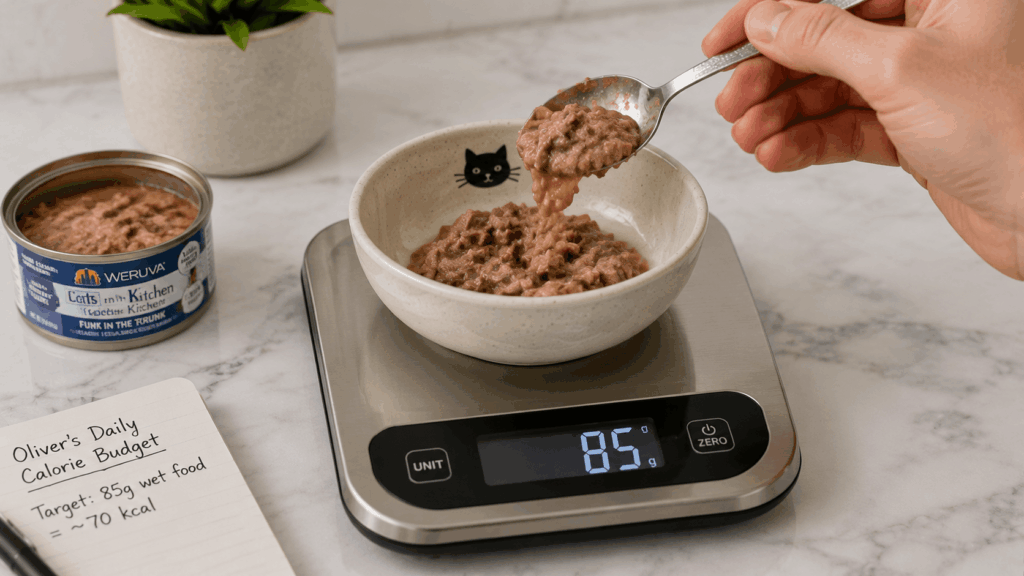
Step 3: Use a kitchen scale for every portion.
A $12 digital kitchen scale with 1-gram precision is the most valuable weight management tool in your apartment. Eyeballing wet food portions introduces errors of 20–40% — errors that, accumulated across weeks, completely undermine a carefully planned caloric restriction protocol.
Oliver’s meals are weighed. Every meal. The scale lives on the counter next to the feeder. It has been there for three years. His weight has been stable at 10.2 pounds for two and a half of those three years.
The Weight Loss Rate Monitor
For a broader product comparison, see our guide to the best wet cat food for weight loss. but for home management with the picks in this guide, the target weight loss rate is:
Common veterinary target: about 0.5–1% of body weight per week, unless your veterinarian recommends otherwise.- For a 14-lb cat: 0.07–0.14 lbs (32–64 grams) per week
- Monthly weigh-in: Essential — use the same scale at the same time of day (before morning meal)
If weight loss exceeds 1% per week: Increase daily allocation by 10% and recheck in two weeks. Rapid weight loss in cats risks Hepatic Lipidosis (fatty liver disease) — a potentially life-threatening condition where fat mobilized from stores is deposited in the liver faster than it can be metabolized.
If no weight loss after 4 weeks: Decrease daily allocation by 10% and recheck. Simultaneously audit for hidden calorie sources: treats (which must be counted in the daily kcal total), food stolen from household companions, and outdoor calorie access if applicable.
Frequently Asked Questions
1. Is grain-free wet food lower in calories?
Not inherently — and this is one of the most persistent nutritional misconceptions I encounter. Grain-free refers to the absence of grain-based carbohydrates (corn, wheat, rice, barley) in the formulation. It does not indicate low caloric density. Many grain-free formulas substitute grain carbohydrates with starchy carbohydrate alternatives — pea starch, potato starch, tapioca — that provide equivalent or higher caloric density than the grains they replace.
The caloric density of a food is determined by its fat content (9 kcal/gram), protein content (4 kcal/gram), and carbohydrate content (4 kcal/gram) — not by the presence or absence of grains specifically. A grain-free food high in pea starch and added fat can easily be more caloric than a grain-containing food with moderate fat and high moisture. Always evaluate Metabolizable Energy per serving — not the grain-free marketing claim — when selecting low calorie cat wet food for weight management.
2. How much weight can a cat safely lose per week?
The veterinary standard for safe feline weight loss is 0.5–1% of current body weight per week — no more. This guideline exists because of Hepatic Lipidosis, a feline-specific metabolic complication in which rapid fat mobilization overwhelms the liver’s processing capacity, leading to fat deposition in hepatic tissue that can progress to liver failure.
In practical terms:
| Current Weight | Safe Weekly Loss Range |
|---|---|
| 10 lb / 4.5 kg | 0.05–0.1 lb / 23–45 g |
| 14 lb / 6.4 kg | 0.07–0.14 lb / 32–64 g |
| 18 lb / 8.2 kg | 0.09–0.18 lb / 41–82 g |
These numbers feel frustratingly small — but the math is correct. A 14-pound cat losing weight at the safe maximum rate of 0.14 lbs per week will reach an ideal weight of 10 pounds in approximately 28 weeks (7 months). This is not a fast process. It is a safe and sustainable one.
Any cat losing weight faster than 1% per week on a calorie-restricted diet should be evaluated by a veterinarian immediately.
3. Can I mix low calorie cat wet food with regular dry food?
You can — but doing so requires careful caloric accounting, and in practice, most owners who mix without calculating undermine their weight management goals without realizing it.
The specific problem: dry food is caloric dense at 300–450 kcal per 100 grams, depending on formulation. Adding even a small amount of dry food “topper” to a carefully calculated wet food meal can add 50–80 kcal to a meal budgeted at 80 kcal — a 60–100% caloric increase from a portion that looks inconsequential. This is the mechanism by which many weight management protocols fail despite the owner’s genuine compliance with the wet food portion.
If you choose to mix:
- Calculate the Metabolizable Energy of both the wet and dry components
- Subtract the dry food’s caloric contribution from the daily allowance before portioning the wet food
- Weigh both components with a digital scale — do not estimate either portion
- Consider whether the dry food’s convenience benefit justifies the accounting complexity it adds to the management protocol
My clinical recommendation for weight management: use low calorie cat wet food as the primary and sole dietary component during the active weight loss phase. Once ideal weight is achieved and maintained for 60 days, reassess whether introducing a small dry food component is appropriate for the maintenance phase.
Final Verdict: Oliver’s Current Bowl
Oliver currently weighs 10.2 pounds. He clears the kitchen counter with approximately 8 inches to spare. He does this not because I found a magic food or a revolutionary feeding strategy, but because I applied the same clinical logic to his nutrition that I apply to every feline patient I manage: Metabolizable Energy matters more than marketing, grams matter more than cans, and Satiety is a physiological requirement that a weight management diet must meet — not a problem to be solved by ignoring the cat’s hunger.
The seven picks in this guide represent useful options for different budgets, textures, and weight-management needs. across different budget levels, texture preferences, and concurrent health needs. They all share the fundamental characteristic of a quality low calorie cat wet food: high moisture, lean protein, controlled fat, and caloric density low enough to feed a satisfying volume within a therapeutic caloric budget.
Your cat doesn’t need to be hungry to lose weight. They need to eat the right food, in the right amount, measured accurately, consistently, and patiently.
Oliver figured that out eventually. So did I.
References
- Laflamme, D. P. (1997). Development and validation of a body condition score system for cats: A clinical tool. Feline Practice, 25(5–6), 13–18.
- Biourge, V., Groff, J. M., Munn, R. J., Kirk, C. A., Nyland, T. G., Madeiros, V. A., Morris, J. G., & Rogers, Q. R. (1994). Experimental induction of hepatic lipidosis in cats. American Journal of Veterinary Research, 55(9), 1291–1302.
-300x169.png)
-300x169.png)
-300x169.png)