An indoor cat enrichment checklist helps you check whether your cat can climb, hide, scratch, hunt, explore, rest, and use essential resources without conflict. You do not need to fill a small apartment with toys. A better goal is to provide a few safe choices that match normal feline behavior and are easy to maintain.
Start by reviewing the seven needs below. Mark each one as ready, needs improvement, or not suitable for this cat. Fix missing essentials before buying optional gadgets, and change one or two things at a time so you can see what your cat actually uses.
Enrichment supports wellbeing, but it does not replace veterinary care. A sudden change in play, appetite, grooming, sleep, movement, litter box use, vocalization, or social behavior can be associated with pain, illness, fear, or stress. Contact your veterinarian when a change is sudden, severe, or accompanied by other symptoms.
Quick Answer
A useful indoor cat enrichment checklist covers seven areas:
- Safe resting and hiding places
- Vertical space and observation points
- Stable scratching choices
- Interactive hunting-style play
- Food foraging and problem-solving
- Well-placed essential resources
- Predictable social contact and routine
The setup should offer choice rather than force participation. Place resources where your cat already spends time, keep them stable and accessible, and adjust for age, mobility, health, confidence, and the number of cats in the home.
Table of Contents
Indoor Cat Enrichment Checklist at a Glance
| Need | Minimum useful setup | What to check |
|---|---|---|
| Rest and hiding | At least one quiet, accessible retreat | Can the cat enter, leave, and rest without being disturbed? |
| Height and observation | A stable elevated spot or secure window view | Is access safe for this cat’s mobility? |
| Scratching | A stable scratcher in a used area | Does its direction and texture match the cat’s preference? |
| Hunting and play | Safe interactive play with a toy kept under human control | Can the cat stalk, chase, catch, and finish calmly? |
| Food enrichment | An easy food search or suitable puzzle | Can the cat succeed without frustration or overeating? |
| Essential resources | Accessible food, water, litter, rest, and scratching areas | Can each cat reach resources without being blocked? |
| Routine and choice | Predictable care plus optional interaction | Can the cat approach, decline, and withdraw? |
Use the table as an audit, not a shopping list. A cardboard box in the right location may be more useful than an expensive bed, and a stable chair beside a safe window may work better than a large cat tree in the wrong room.
1. Provide Safe Resting and Hiding Places
Cats need places where they can rest without being approached from every direction. A good retreat may be a covered bed, open carrier, cardboard box, shelf cubby, or quiet chair under a table. The important features are safety, easy access, and the ability to leave without being trapped.
In a studio apartment, create small zones instead of trying to create a separate cat room. Put one retreat away from the busiest walking route and another near the area where your cat prefers to observe household activity. Some cats prefer an enclosed hiding place; others want a raised bed with a clear view.
Check the following:
- The retreat is dry, stable, and away from heat or electrical hazards.
- Children, visitors, and other pets do not disturb the cat there.
- The entrance is large enough and does not snag a collar or limb.
- An older or mobility-limited cat can reach it without a difficult jump.
- In a multi-cat home, one cat cannot guard every retreat.
Do not pull a frightened cat out of a safe hiding place unless there is an immediate emergency. Instead, keep food, water, litter, and normal household movement accessible while allowing the cat time and choice.
2. Add Vertical Space and Observation Points
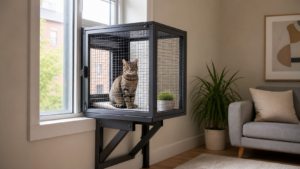
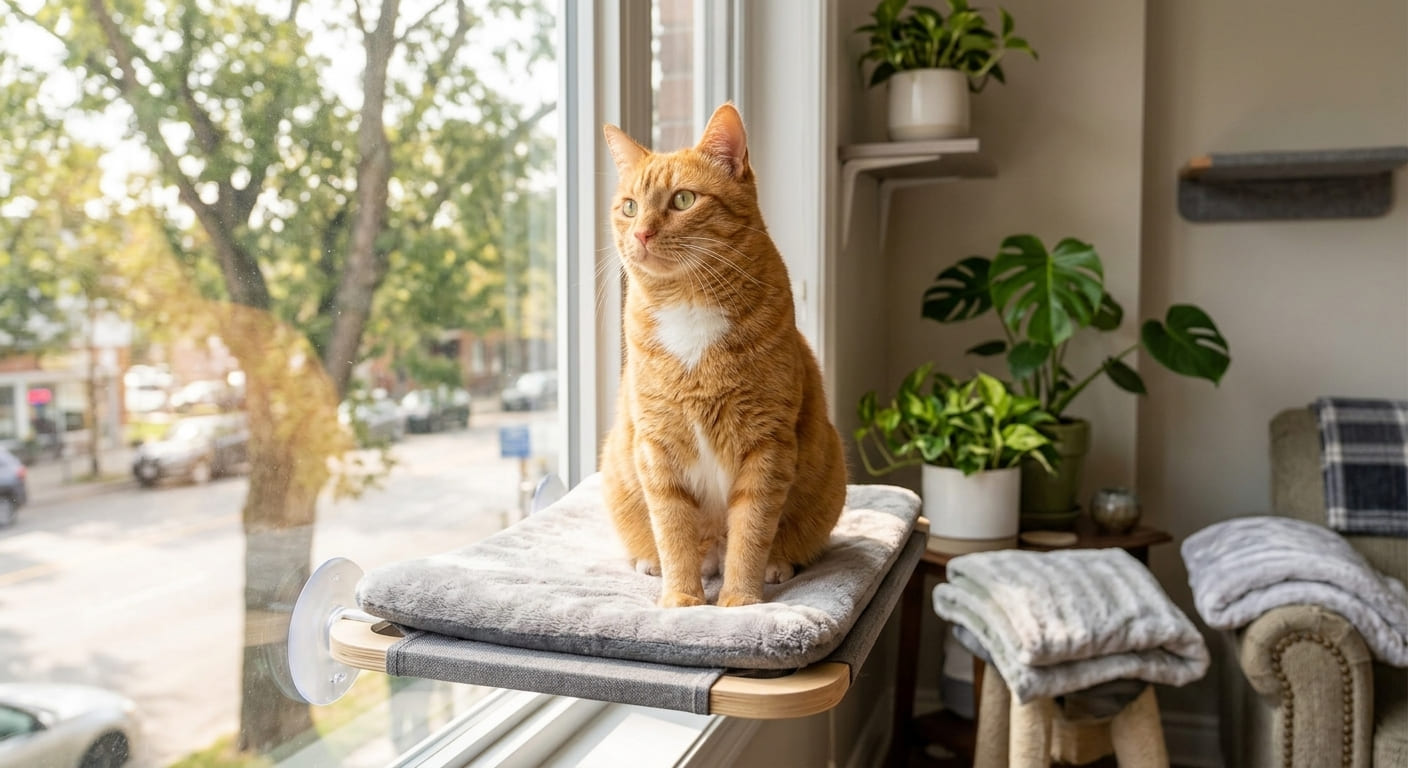
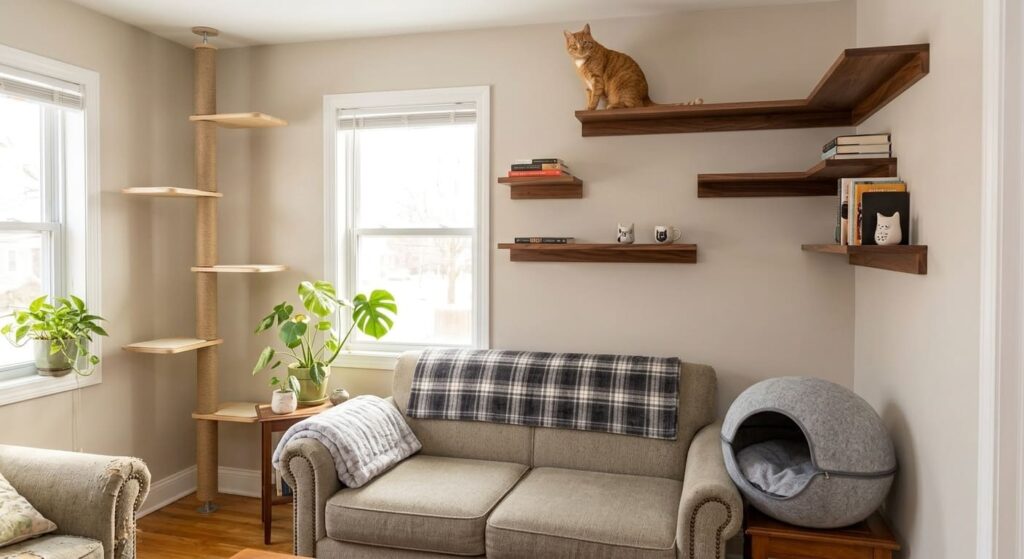
Height can expand usable territory without taking much floor space. Depending on the cat and apartment, this may be a sturdy cat tree, secure window perch, wide shelf, furniture route, or stable platform. The highest option is not automatically the best; safe access and confident use matter more.
Before using a perch or climbing route, check its weight limit, attachment, surface grip, landing area, and distance from hazards. Do not place a perch beside an unsecured window, hot appliance, breakable object, exposed cord, or toxic plant. Freestanding furniture should not tip when the cat jumps on or off.
For kittens, senior cats, and cats with arthritis, vision loss, neurological problems, or recent surgery, use lower platforms and shorter transitions. Add a step, ramp, or intermediate surface if your cat hesitates, slips, or avoids jumping.
Window viewing can be valuable passive enrichment, but watch your cat’s response. If outdoor cats or wildlife trigger prolonged agitation, redirected aggression, spraying, or inability to settle, partially block the view or offer another observation point.
For more ways to use limited floor space, see our indoor cat enrichment in small apartments guide.
3. Offer Stable Scratching Choices
Scratching supports stretching, claw maintenance, scent communication, and visual marking. The most useful scratcher is not simply the one with the best reviews; it is the one that matches your cat’s preferred position, texture, location, and reach.
Offer a tall vertical scratcher if your cat stretches upward, or a horizontal pad if your cat scratches rugs and flat surfaces. Some cats use both. A vertical post should remain stable during a full-body stretch. Place it near a sleeping area, social area, doorway, or existing scratching location rather than hiding it in an unused corner.
If your cat scratches furniture:
- Put the appropriate scratcher directly beside the chosen area.
- Reward voluntary use with attention, play, or a small portion of the cat’s normal food if appropriate.
- Protect the furniture temporarily with a safe cover or barrier.
- Move the scratcher gradually only after the cat uses it reliably.
Avoid yelling, spraying water, or using essential oils as deterrents. Punishment can create fear without providing a suitable place to perform the behavior, and concentrated essential oils may pose a safety risk to cats.
4. Include Hunting-Style Interactive Play
Interactive play can provide movement, mental engagement, and an outlet for stalking and chasing. Use a wand-style or other distance toy that lets the cat watch, stalk, chase, pounce, and catch. Move the toy like prey rather than repeatedly pushing it toward the cat’s face.
There is no single play duration that is correct for every cat. Short sessions may suit a kitten, senior cat, cat with limited stamina, or cat that becomes overstimulated quickly. Let interest, breathing, coordination, recovery, health, and veterinary advice guide the length and intensity.
End with a successful catch and allow the cat to settle. Put string, ribbon, feathers, elastic, and small detachable parts away after supervised play because they may be swallowed or cause injury. Laser play should not be the only hunting outlet; if you use a light toy, finish by directing the cat toward a physical toy or food item it can actually capture.
Signs that play is too intense can include open-mouth breathing, persistent panting, stumbling, sudden withdrawal, or inability to recover normally. Stop the activity and seek veterinary advice when breathing or recovery seems abnormal.
For a practical schedule that can be adjusted to the individual cat, use our indoor cat exercise routine guide.
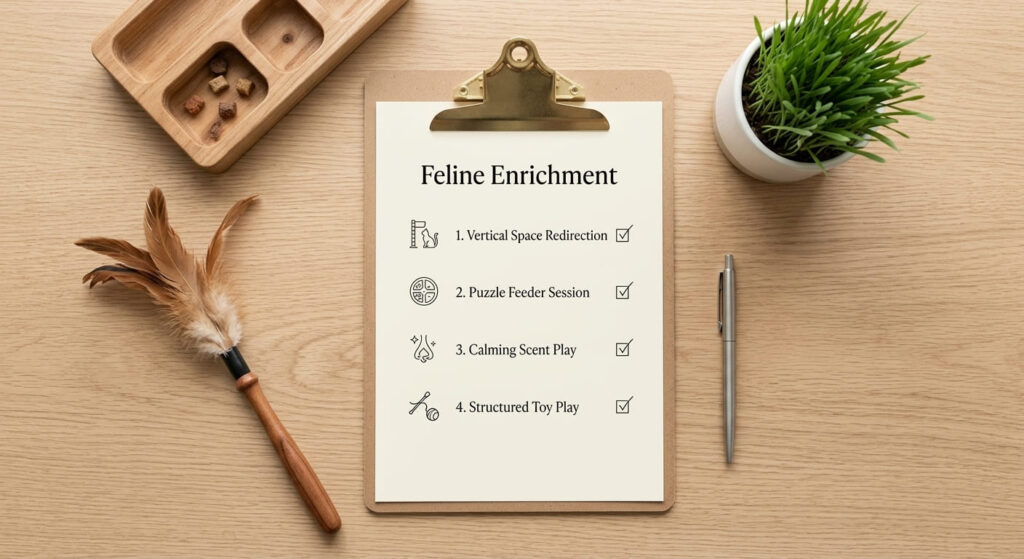
5. Use Food Foraging and Problem-Solving Safely
Food enrichment can turn part of a normal meal into searching, pawing, rolling, or problem-solving. Options include scattering a measured portion in safe locations, hiding small portions around one room, using a slow feeder, or offering an appropriately designed puzzle feeder.
Begin with an easy task. Let the cat see or smell the food and make the first rewards simple to reach. Increase difficulty only when the cat uses the setup confidently. A puzzle that is too difficult may create frustration or reduce food intake rather than provide useful enrichment.
Keep these boundaries in place:
- Use food from the cat’s measured daily allowance rather than adding uncounted calories.
- Wash food-contact surfaces and discard damaged items.
- Avoid homemade objects with sharp edges, staples, tape, loose plastic, string, or holes that could trap the jaw or paw.
- Supervise the first uses and separate cats if one guards the food.
- Do not use a puzzle to delay necessary feeding or to manage a medical diet without veterinary guidance.
- Stop if the cat cannot obtain enough food, vomits, becomes distressed, or loses interest in eating.
Cats with diabetes, kidney disease, gastrointestinal disease, dental pain, food allergies, obesity treatment plans, or prescribed diets may need an individualized feeding approach. Ask the veterinarian before changing food type, amount, or meal timing.
If you are choosing a feeder, compare difficulty, cleanability, portion control, and safety in our best cat puzzle feeders guide.
6. Check the Placement of Essential Resources
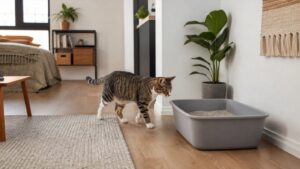
Enrichment cannot compensate for difficult access to food, water, litter boxes, resting areas, or scratching surfaces. These are essential resources, not optional entertainment. In a multi-cat home, apparent sharing does not always mean every cat has comfortable access; one cat may quietly control a doorway, route, or resource.
Walk through the apartment from your cat’s perspective:
- Can the cat reach the litter area without passing another cat at close range?
- Are food and water available in calm locations away from litter contamination?
- Can a cat leave each important area by more than one route when possible?
- Are resting and hiding choices distributed rather than grouped in one corner?
- Can a senior or disabled cat reach daily resources without stairs or high jumps?
- Are noisy appliances, closing doors, and busy walkways making a resource hard to use?
For multi-cat homes, distribute key resources so they are not all concentrated in a single location. The right number and arrangement depend on the cats, the layout, and whether any cat blocks another. Watch for waiting, staring, chasing, guarding, avoidance, or one cat using resources only when the other is absent.
Changes in litter box use, urination, defecation, appetite, or water intake require more than an enrichment adjustment. Contact a veterinarian promptly, especially if a cat strains to urinate, repeatedly enters the litter box with little or no urine, cries, vomits, or becomes weak. Urinary obstruction can be an emergency.
7. Build Predictable Routine, Social Choice, and Novelty
Cats often benefit from predictable feeding, play, cleaning, and quiet periods. Predictability does not mean every minute must follow a rigid timetable. It means important events occur in a way the cat can understand, while the cat retains choices about where to rest and whether to interact.
Offer social contact without forcing it. Some cats seek petting, brushing, lap time, or play; others prefer to stay nearby without being touched. Watch body language and pause when the cat turns away, stiffens, flicks the tail, flattens the ears, or leaves.
Novelty should be controlled rather than constant. Rotate a few safe toys, change a cardboard-box layout, move a food search, or introduce a new scent from a safe object. Keep familiar resting areas and core resources stable so the apartment does not become unpredictable.
A simple routine may include:
- a brief visual and resource check in the morning;
- one or more play opportunities suited to the cat;
- part of a measured meal offered through safe foraging;
- quiet, uninterrupted rest periods;
- a weekly toy and equipment inspection;
- gradual rotation instead of displaying every toy at once.
The routine is working when it remains realistic for the household and the cat continues to choose the activities voluntarily.
A Simple Weekly Apartment Check
Use this shorter checklist once a week or whenever the household setup changes.
| Check | Yes | Needs attention |
|---|---|---|
| Hiding and resting areas are quiet, clean, and accessible | ☐ | ☐ |
| Perches and climbing surfaces remain stable | ☐ | ☐ |
| Scratchers are usable and placed where the cat spends time | ☐ | ☐ |
| Interactive toys are intact and stored safely after use | ☐ | ☐ |
| Food puzzles are clean, achievable, and included in measured food | ☐ | ☐ |
| Food, water, litter, and rest areas are not blocked | ☐ | ☐ |
| Each cat can withdraw from people and other pets | ☐ | ☐ |
| The cat’s appetite, movement, grooming, and litter habits are normal | ☐ | ☐ |
Replace or repair anything that wobbles, frays, cracks, exposes a sharp edge, or releases a small part. Reassess the layout after moving furniture, welcoming another pet, changing work schedules, or noticing conflict between cats.
How to Adapt the Checklist to Your Cat
Kittens
Kittens may seek frequent movement and exploration but have limited judgment. Secure furniture, protect cords, remove swallowable objects, supervise new toys, and provide lower safe landing areas. Recheck the apartment as climbing ability changes.
Senior Cats and Cats With Limited Mobility
Use low-entry litter boxes when appropriate, nonslip paths, warmer resting options, and intermediate steps to preferred locations. Do not assume reduced jumping or play is simply aging; pain and illness should be assessed by a veterinarian.
Shy or Newly Adopted Cats
Start with a smaller predictable area containing all essential resources. Provide hiding options and avoid forcing exploration. Expand access gradually as the cat eats, rests, grooms, plays, and uses the litter box comfortably.
Multi-Cat Homes
Create multiple routes, retreats, observation points, feeding areas, and other important resources. Pay attention to subtle blocking rather than waiting for a fight. A cat that hides, hesitates in doorways, eats only at unusual times, or stops using a favored space may not feel secure.
Small Apartments
Use height, corners, windows, under-table space, and furniture routes without obstructing human walkways or escape routes. Choose a few multi-use items that are stable and easy to clean. Remove unused equipment instead of allowing enrichment to become clutter.
Common Enrichment Mistakes
Buying Before Observing
Observe where your cat rests, scratches, watches, hides, and becomes active. Placement and suitability usually matter more than price or the number of products.
Making Every Activity Too Difficult
Enrichment should create achievable choices. Reduce the difficulty when the cat walks away, cannot obtain food, becomes frustrated, or avoids the setup.
Forcing Interaction
Placing a cat on a new perch, pushing it into a tunnel, or repeatedly presenting a toy can make the item less appealing. Make the option safe and let the cat investigate voluntarily.
Leaving Hazardous Toys Available
String, ribbon, yarn, elastic, feathers, and toys with loose pieces should not be left out unattended. Inspect toys, scratchers, perches, and homemade items regularly.
Treating a Health Change as Boredom
Reduced activity, house soiling, aggression, hiding, overgrooming, nighttime vocalization, and loss of interest in play can have medical or pain-related causes. Environmental improvement may help, but it should not delay veterinary evaluation.
How to Tell Whether the Plan Is Helping
Do not judge enrichment by whether your cat uses every item. Look for voluntary use and broader patterns:
- normal appetite and litter box habits;
- comfortable resting in more than one location;
- regular scratching on suitable surfaces;
- interest in play without prolonged agitation;
- confident movement through the home;
- ability to withdraw and settle;
- less blocking or conflict around resources;
- stable grooming, movement, and social behavior.
Record one simple observation each week, such as which perch the cat uses, whether a puzzle remains achievable, or whether one cat waits for another before approaching a resource. This helps you adjust placement without changing the entire apartment at once.
When to Contact a Veterinarian
Arrange veterinary advice when a behavior change is sudden, persistent, or accompanied by reduced appetite, weight change, vomiting, diarrhea, altered thirst, litter box changes, limping, difficulty jumping, overgrooming, hiding, confusion, aggression, unusual vocalization, or apparent pain.
Seek urgent veterinary care if your cat has difficulty breathing, collapses, has a seizure, may have swallowed string or another foreign object, or repeatedly strains to urinate with little or no urine. Enrichment is preventive and supportive; it is not a diagnosis or treatment for these signs.
FAQ
How much daily enrichment does an indoor cat need?
There is no universal number of minutes that suits every cat. Provide regular opportunities for play, exploration, scratching, observation, food searching, rest, and social choice. Adjust duration and intensity to age, health, interest, stamina, and veterinary advice rather than forcing a fixed schedule.
Does enrichment require expensive cat furniture?
No. Placement and function matter more than price. Cardboard boxes, paper packing material used under supervision, a stable chair near a secure window, measured food searches, and toy rotation can add useful choices. Spend money only when a specific need cannot be met safely with the current setup.
Why does my cat ignore new toys or furniture?
The item may be in the wrong place, unstable, noisy, strongly scented, difficult to use, or unrelated to the cat’s current motivation. Move it closer to an existing activity area, make the first interaction easy, and allow voluntary investigation.
Should I rotate cat toys?
Rotation can preserve novelty without creating clutter. Keep a small selection available, store the rest safely, and reintroduce them gradually. Do not rotate away a favored resting place, scratcher, or essential resource merely for novelty.
Can enrichment stop all unwanted behavior?
No. Enrichment may give normal behavior a safer outlet, but behavior also depends on learning history, social relationships, health, pain, fear, and resource access. Persistent or severe problems may require veterinary assessment and help from a qualified feline behavior professional.
What if my cat becomes frustrated with a puzzle feeder?
Make the puzzle easier or return part of the meal to the cat’s normal feeding method. The cat should be able to obtain adequate food without distress. Stop using the puzzle and seek veterinary advice if food intake falls or eating behavior changes.
Related Apartment Guides
- For room-by-room ideas, read Indoor Cat Enrichment in Small Apartments.
- For play and movement planning, read Indoor Cat Exercise Routine.
- For food-based activities, compare Best Cat Puzzle Feeders.
- For supervised and independent toy options, see Best Interactive Cat Toys for Solo Play.
- To reduce unnecessary equipment, use the Minimalist Cat Owner Guide.
Final Thoughts
An indoor cat enrichment checklist should make the home safer and more usable, not more crowded. Begin with essential resources and safe retreat, then add height, scratching, play, foraging, and predictable social choice. Observe what your cat voluntarily uses and adapt the setup to the individual rather than trying to complete every possible activity.
Make small changes, keep successful resources stable, and review the apartment whenever your cat’s health, mobility, social group, or household routine changes. If behavior changes suddenly or comes with physical symptoms, contact a veterinarian instead of assuming the cat is bored.
References
- Ellis, S. L. H., et al. (2013). AAFP and ISFM Feline Environmental Needs Guidelines. Journal of Feline Medicine and Surgery, 15(3), 219–230.
- Herron, M. E., & Buffington, C. A. T. (2010). Environmental Enrichment for Indoor Cats. Compendium: Continuing Education for Veterinarians, 32(12), E4.