Cat friendly interior design starts with the cat’s daily needs, then fits those needs into a room that is comfortable, practical, and easy to maintain. A stylish apartment can still provide secure resting places, scratching surfaces, vertical choices, accessible litter areas, separated food and water, and safe routes through the home.
The goal is not to hide every cat item. It is to choose a small number of useful features and place them where the cat can actually use them. A beautiful litter cabinet that feels cramped, a shelf with no easy way down, or an unidentified plant within chewing range can create more problems than it solves.
Begin with the cat you have. Age, body size, mobility, confidence, health, and relationships with other cats should guide the layout. Kittens, seniors, large cats, and cats with pain or impaired vision may need lower resting places, shorter transitions, and clearer paths.
Quick Answer: What Makes Interior Design Cat Friendly?
A cat-friendly room provides choices for resting, hiding, climbing, scratching, eating, drinking, toileting, and play without forcing all activities into one crowded corner. It also controls household hazards such as unstable furniture, open or poorly protected windows, blind cords, loose electrical cords, fragile objects, and plants that have not been identified.
Good design is easy for the person to maintain and easy for the cat to understand. Stable furniture, washable surfaces, accessible floors, replaceable scratching materials, and clear routes often work better than complicated built-ins.
Table of Contents
What a Cat-Friendly Room Needs to Accomplish
Feline environmental guidance emphasizes safe places, separated key resources, opportunities for play and predatory behavior, positive human interaction, and an environment that respects a cat’s sense of smell. Interior design can support those needs, but no single product satisfies all of them.
Map the room before shopping. Mark where the cat already sleeps, watches, scratches, eats, drinks, plays, and uses the litter box. Also note narrow passages, loud appliances, direct sun, cold drafts, doors, windows, cords, and places where one cat could block another.
For a broader activity plan, see our guide to indoor cat enrichment in small apartments.
A Simple Design Decision Table
| Design problem | Better starting point | Check before keeping it | Avoid |
|---|---|---|---|
| The room feels cluttered | Combine storage with a few useful cat zones | The cat can reach each resource without squeezing past another cat | Hiding every resource inside closed furniture |
| The cat scratches the sofa | Put a stable scratching surface beside the scratched area | The surface orientation and material suit the cat’s behavior | Moving the only scratcher to an unused corner |
| Floor space is limited | Add stable vertical choices | Each level has traction, a usable landing, and an easy exit | Decorative shelves with unclear transitions |
| Fur and stains are difficult to manage | Use removable, washable layers and accessible floors | Cleaning instructions suit the household | Assuming one fabric is claw-proof or stain-proof |
| The litter box looks unattractive | Improve placement, screening, and storage around it | Access, ventilation, visibility, and cleaning remain practical | A cramped cabinet with one easily blocked entrance |
| Plants complete the room | Verify the exact scientific name before purchase | The plant and planter are appropriate for the cat | Trusting a vague common name or mixed planter label |
| Two cats compete for space | Disperse resting places and key resources | Each cat can approach and leave without being trapped | One premium perch or one narrow route for both cats |
7 Cat Friendly Interior Design Ideas
1. Plan Cat Zones Before Buying Furniture
Divide the apartment into functions rather than filling it with cat products. A resting zone may be a quiet chair, covered bed, or shelf. A scratching zone may be one stable vertical post and one horizontal pad. A play zone only needs enough clear floor for interactive play and safe movement.
Keep key resources from competing with one another. Food, water, toileting, scratching, play, and rest should not all be compressed into one small station. In a multi-cat home, distribute valued resources so one cat cannot control access to everything from a single position.
Use the cat’s current behavior as evidence. If the cat always rests near a particular window or scratches at the end of the sofa, improve those locations first. Do not redesign the entire apartment around a feature the cat has never shown interest in.
The minimalist cat owner guide can help you reduce duplicate or unused items while preserving meaningful choices.
2. Add Stable Vertical Space with a Clear Way Down
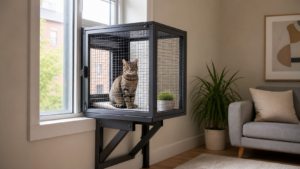
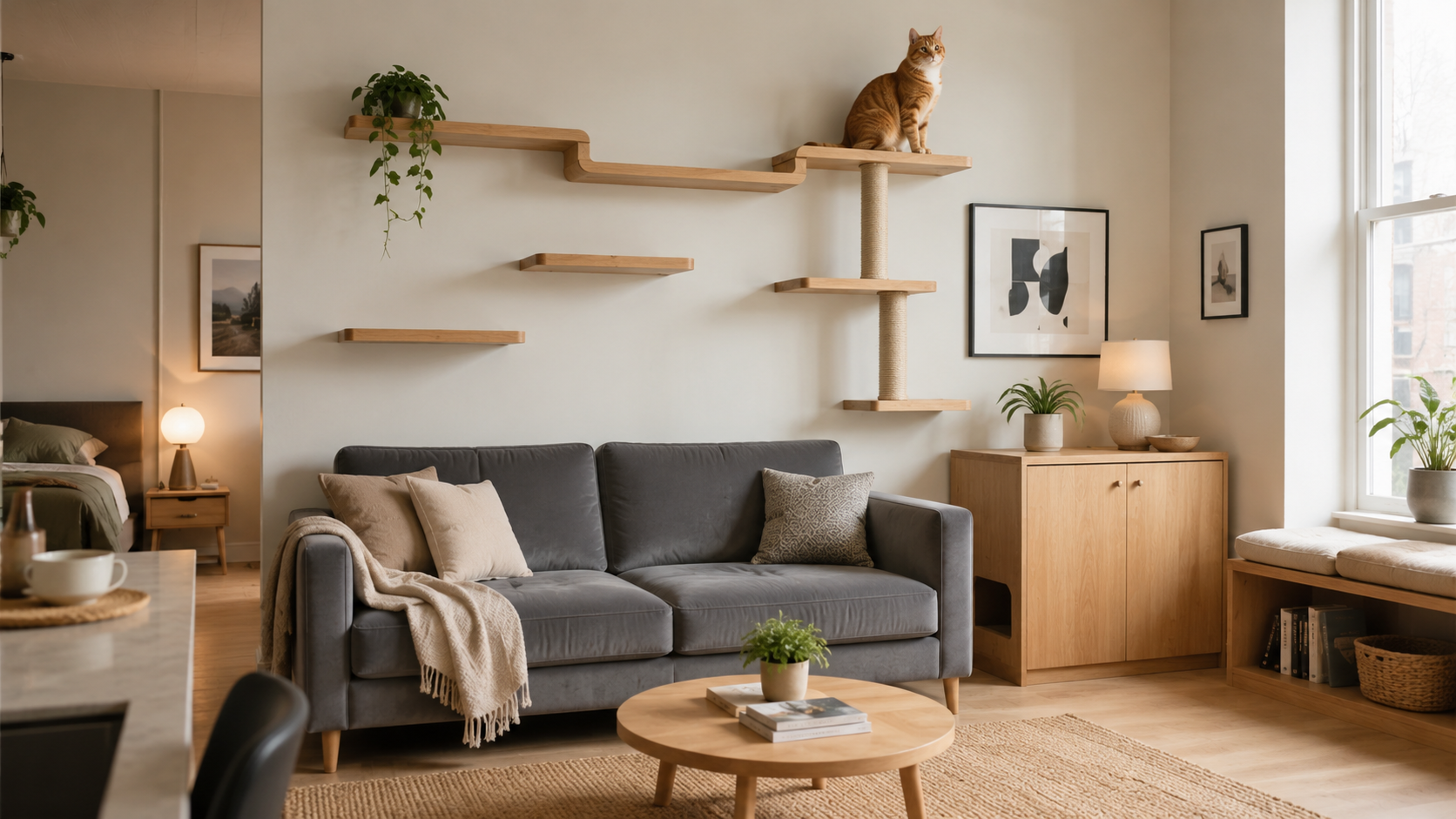
Vertical space can add useful territory without taking much floor area. A stable cat tree, secured furniture top, window perch, or properly installed wall system may provide observation, rest, and movement.
Every elevated surface needs secure footing and a predictable next step. Avoid copying a universal shelf height or spacing diagram. A transition that suits a young, athletic cat may be unsuitable for a kitten, senior, large cat, or cat with pain or poor balance.
Anchor tall or narrow furniture according to the manufacturer’s instructions. Follow the current installation instructions for any wall shelf or perch, confirm that the mounting method matches the wall, and never use adhesive picture-hanging strips as the sole support for a weight-bearing cat platform.
Keep routes away from hot appliances, cooking areas, ceiling fans, fragile decor, open exterior doors, and unprotected windows. Standard insect screens may not be designed to stop a cat from pushing through them.
For detailed selection criteria, compare our guide to the best cat wall shelves for small apartments.
3. Choose Upholstery for Cleaning, Then Test a Sample
There is no universal “best” or claw-proof fabric for every cat and household. Instead of relying on a numerical fabric ranking, evaluate how the material is woven, how easily fur can be removed, whether the cover can be taken off, and what the manufacturer permits for cleaning.
Ask for a swatch when possible. Check whether claws catch easily in the weave, whether the color makes routine fur removal manageable, and whether the texture changes after the approved cleaning method. A removable cover or washable throw can be easier to replace than an entire upholstered piece.
Read the furniture cleaning code and care instructions before using water, detergent, steam, or another treatment. Test any permitted cleaner on a hidden area first. Do not assume that “performance,” “pet-friendly,” or “stain-resistant” means indestructible or safe for every cleaning product.
Color can reduce how noticeable shed fur looks between cleanings, but it does not replace cleaning. Choose a color and pattern you enjoy, then use washable layers in the places where the cat rests most often.
4. Make Scratching Part of the Room
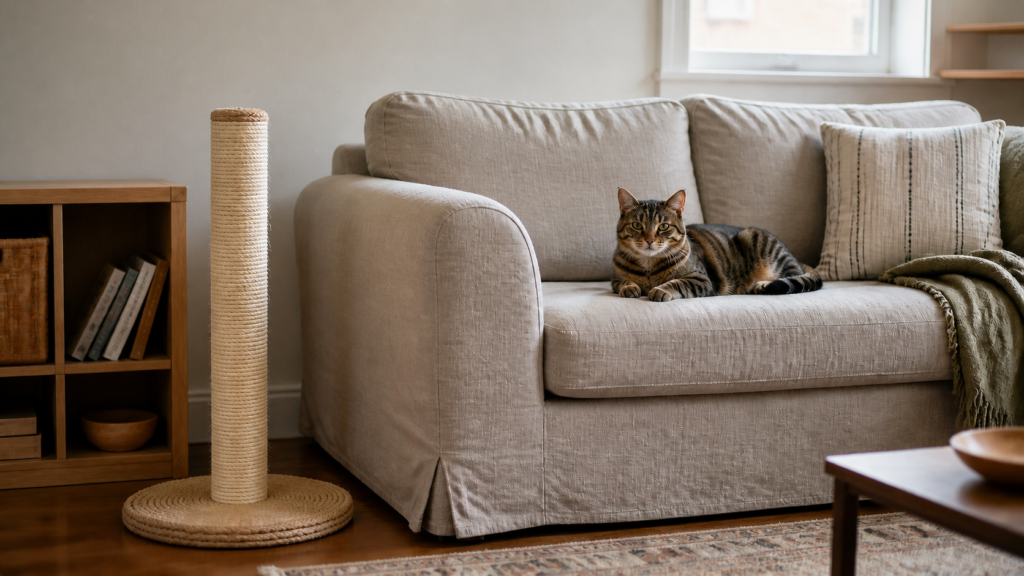
Scratching is a normal feline behavior, not a decorating failure. A scratching surface is more likely to be useful when it is stable, tall or long enough for the cat’s normal posture, and placed where scratching already occurs.
If the cat scratches a sofa arm, place an appropriate scratcher directly beside that area while protecting the furniture with a secure cover or guard. If the cat scratches carpet, offer a stable horizontal surface near the preferred spot. Observe whether the cat prefers vertical, horizontal, or angled scratching rather than assuming one style will work.
Match the scratcher to the room with color, shape, or replaceable material, but do not reduce its usable size or stability for appearance. A narrow decorative post that tips, rotates, or moves across the floor may be ignored.
Do not punish or startle the cat for scratching. Make the preferred surface easier to reach and more rewarding, and prevent access to the damaged area while the new habit develops.
5. Design the Litter Area for Access, Not Just Concealment
A litter area should be easy for the cat to enter, turn around in, and leave. It should also be practical for daily observation and cleaning. A cabinet may reduce the visual impact of a box, but it is not automatically better for the cat.
Our studio apartment litter box placement rules can help you compare bathroom, closet, entryway, and room-divider locations before building the rest of the layout around the box.
Before using an enclosure, consider ventilation, internal space, noise, door movement, lighting, and escape options. In a multi-cat home, a single entrance can be guarded. A box hidden beside a washer, dryer, boiler, or other sudden noise source may be avoided even when it looks tidy.
Do not place food or water directly beside the litter area. Keep the route clear, and avoid making the cat pass through a narrow or busy location. If a senior cat or a cat with mobility problems begins toileting outside the box, provide easier access and contact a veterinarian to rule out pain or illness.
The best-looking solution is the one that remains accessible and clean. A simple open box with a tasteful screen, washable mat, and organized supply storage may work better than a tightly enclosed cabinet.
6. Make Cleaning and Hazard Checks Easy
Furniture with visible, reachable floor beneath it can simplify fur and litter cleanup. Removable covers, washable mats, sealed storage for supplies, and a dedicated place for grooming tools can reduce visual clutter without hiding problems.
Choose furniture legs and clearances according to the cleaning tools you actually use rather than following a fixed measurement. If the vacuum head or mop cannot pass beneath a piece, decide whether the base can be moved safely or whether a closed plinth would be easier to maintain.
Use cord covers or secure cable management where appropriate, and keep blind cords out of reach. Place fragile objects away from takeoff and landing areas. Check that window barriers, balcony access, floor lamps, shelves, and tall furniture remain stable after rearranging the room.
Avoid making a rigid cleaning schedule sound universal. Clean litter areas, food surfaces, washable covers, and floors often enough for the number of cats, the material, the product instructions, and the condition you observe. Stop using a cleaner if it leaves a strong residue or causes irritation, and ask your veterinarian about safe alternatives when needed.
For compact product layouts, see our guide to cat furniture for small apartments.
7. Add Only Plants You Can Identify and Verify
Plant safety depends on the exact plant, not the room style or the seller’s general “pet-friendly” label. Confirm the scientific name on the pot or supplier record, then check that name in a reliable toxicity database before bringing the plant home.
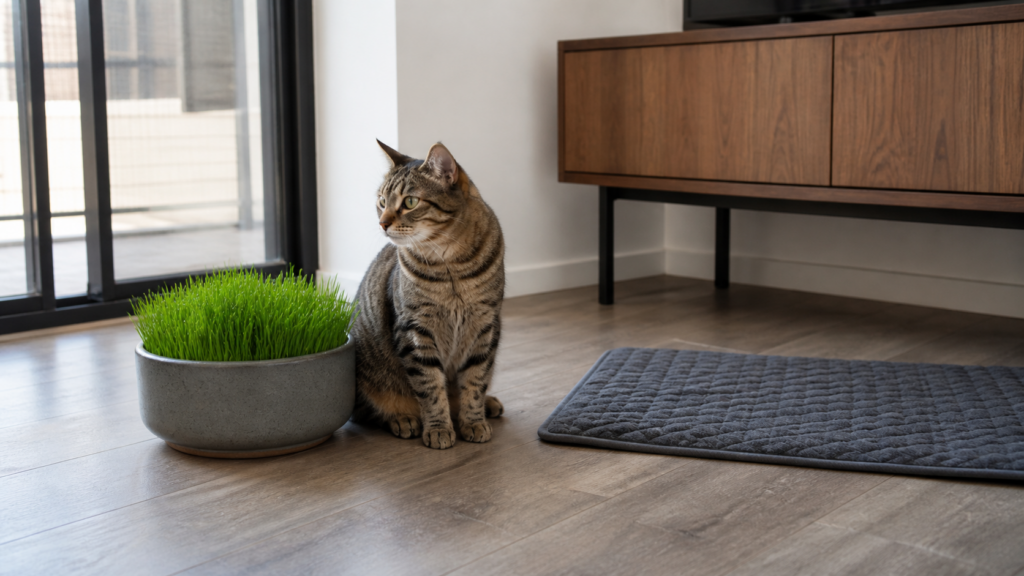
The ASPCA lists spider plant (Chlorophytum comosum) as non-toxic to cats, but even plant material listed as non-toxic can cause vomiting or gastrointestinal upset if eaten. Cat grass can be a simple way to add greenery, but the seed or plant should still be identified and grown without unsafe treatments.
Avoid unidentified mixed planters. Keep soil, fertilizer, decorative stones, and standing water from becoming additional hazards. Use a stable planter that cannot easily tip and remove damaged or moldy plant material.
If a cat chews an unidentified or potentially toxic plant, do not wait for a decorating guide to provide a diagnosis. Contact a veterinarian or animal poison-control service and keep the plant label, a photograph, and any packaging available.
For a plant-by-plant comparison, use our cat safe plants apartment guide.
Adapt the Design for Different Cats and Homes
Senior or Mobility-Limited Cats
Use lower resting surfaces, shorter transitions, secure traction, and easy routes to food, water, resting areas, and litter boxes. Do not require repeated jumping to reach every valued resource. A sudden change in climbing, grooming, toileting, or willingness to move deserves veterinary attention.
Multi-Cat Apartments
More furniture does not automatically create more usable territory. Separate key resources and provide multiple resting choices in different locations. Avoid narrow dead ends, a single prized window perch, or a layout in which one cat can watch every route.
Visual barriers can help break long sight lines, but each cat still needs a clear way to approach and leave. Our guide to two cats in a studio apartment covers resource distribution in more detail.
Rental Apartments
Start with stable freestanding items, secured furniture, removable washable layers, and reversible cord management. Obtain written permission before drilling or making permanent changes. Do not use an unapproved adhesive product to support a platform that a cat will stand or land on.
Kittens and Newly Adopted Cats
Begin with a simple, predictable layout. Block dangerous gaps, secure cords, protect windows, and keep high routes limited until coordination and behavior are understood. Give a newly adopted cat a safe room or quiet base area rather than immediate access to every decorative feature.
Room-by-Room Cat-Friendly Design Audit
Walk through the apartment at the cat’s eye level and check:
- Can the cat reach food, water, litter, scratching, play, rest, and hiding areas without crossing a frightening or easily blocked route?
- Are tall and narrow furniture items secured according to their instructions?
- Do elevated surfaces have traction, usable landings, and an easy way down?
- Are windows, screens, balcony doors, blind cords, electrical cords, and fragile items managed safely?
- Can another cat guard the only entrance to a box, bed, shelf, or feeding area?
- Are sofa covers, mats, and bedding removable or cleanable according to their care labels?
- Can you see and clean beneath or around the main furniture?
- Have all plants been identified by scientific name and checked in a reliable source?
- Does the room still work for the cat’s current age, health, mobility, and confidence?
Change one problem area at a time. A small improvement based on observed behavior is easier to evaluate than a complete room makeover.
Frequently Asked Questions
What is the best fabric for a home with cats?
No fabric is universally best or claw-proof. Look for a weave that does not catch easily, removable or washable layers, clear manufacturer care instructions, and a color you can maintain. Test a sample before buying when possible and place an appropriate scratching surface near the furniture.
Can I hide a litter box inside a cabinet?
You can use a cabinet only if the cat has enough usable space, easy access, suitable ventilation, and a route that cannot be blocked. Keep it away from sudden appliance noise and do not sacrifice cleaning or observation for appearance.
How do I make cat furniture match my apartment?
Repeat a limited palette and a few consistent materials, then prioritize stability, usable surface size, traction, and placement. One stable cat tree and one well-positioned scratcher often look more intentional than several small items scattered around the room.
Are wall shelves necessary for cat friendly interior design?
No. Vertical choices can also come from a stable cat tree, secured furniture, a suitable window perch, or low steps. Wall shelves are useful only when they are compatible with the wall, properly installed, and appropriate for the cat.
Which indoor plants are safe for cats?
Safety must be checked by exact scientific name. The ASPCA database lists examples of toxic and non-toxic plants, but it is not a substitute for veterinary advice after an exposure. Even a non-toxic plant may cause gastrointestinal upset if a cat eats enough of it.
How often should I redesign the room?
Do not redesign on a fixed schedule. Reassess after moving furniture, adding a pet, changing homes, noticing conflict, or seeing a change in the cat’s mobility or behavior. Preserve familiar safe places and introduce major changes gradually.
Final Thoughts
Cat friendly interior design is successful when the apartment remains attractive to the person and understandable, accessible, and safe for the cat. Start with daily functions: rest, hide, climb, scratch, eat, drink, toilet, play, and move through the home.
Choose stable furniture, cleanable materials, useful vertical space, accessible litter placement, and plants verified by exact name. Avoid universal measurements, fabric ratings, and decorative features that are difficult to inspect or maintain.
The strongest design is usually not the most complicated. It is a room where the cat has meaningful choices and the person can quickly see, clean, and correct a problem.
References
ASPCA Animal Poison Control Center. Spider Plant (Chlorophytum comosum).
Feline Veterinary Medical Association. AAFP and ISFM Feline Environmental Needs Guidelines.
Feline Veterinary Medical Association. 2024 AAFP Intercat Tension Guidelines: Recognition, Prevention, and Management.
ASPCA Animal Poison Control Center. Toxic and Non-Toxic Plants.