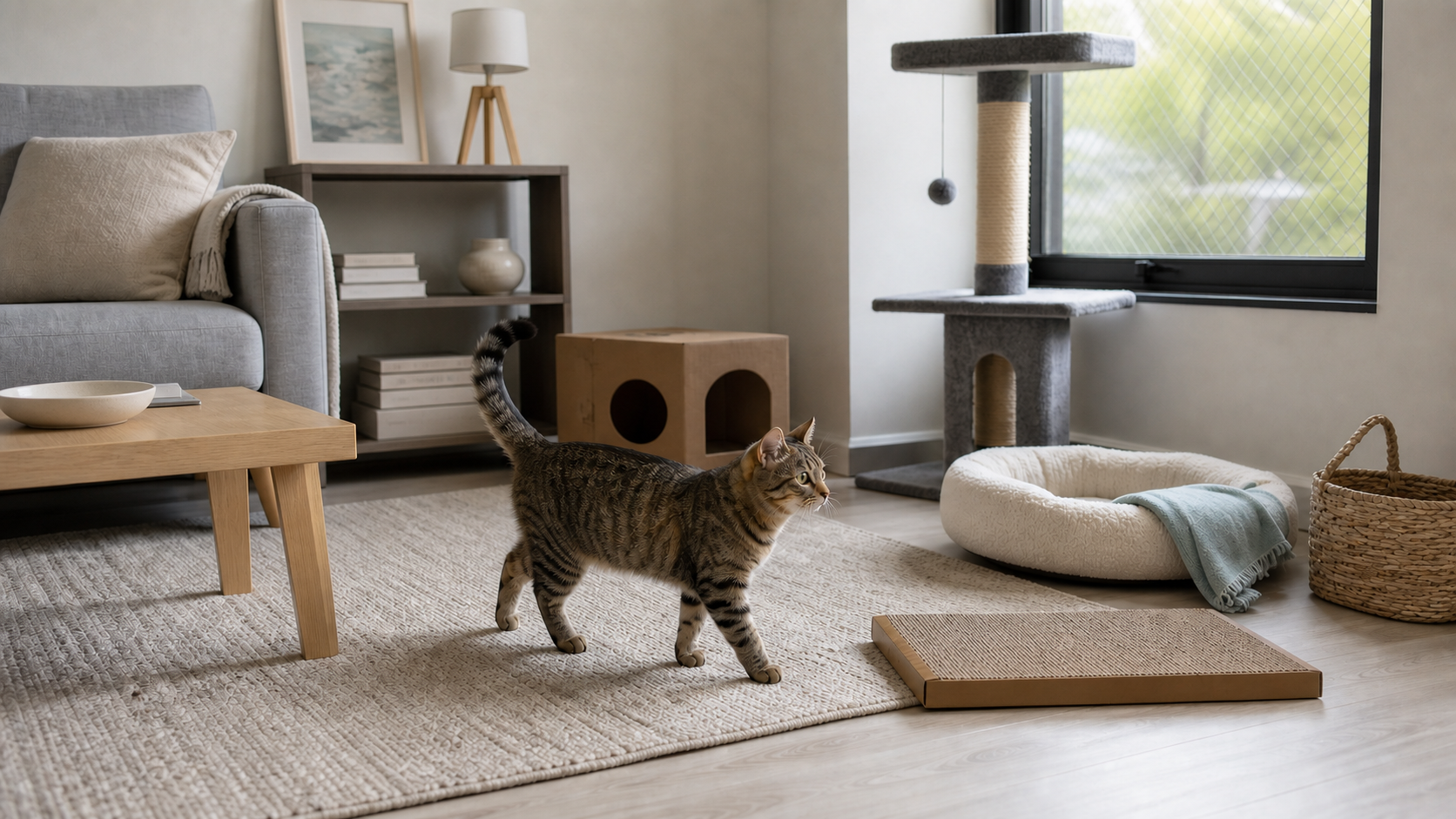
Indoor cat enrichment in small apartments works best when every item has a clear purpose. A cat does not need a room full of equipment. It needs safe places to climb, hide, scratch, watch, hunt, rest, and interact with you without those activities competing for the same few feet of floor space.
The seven ideas below turn walls, windows, furniture edges, and short daily routines into a practical enrichment system. Start with one or two changes, watch how your cat responds, and adjust the setup to fit its age, mobility, confidence, and preferences.
Safety note: Secure tall furniture and wall-mounted equipment into appropriate studs or anchors, keep blind cords and electrical cables inaccessible, use intact window screens, supervise string or wand toys, and do not introduce foods or scented materials that are unsafe for your cat. A sudden behavior change, reduced appetite, pain, hiding, elimination change, or loss of mobility needs veterinary attention rather than an enrichment-only solution.
Table of Contents
Quick Answer
The most useful indoor cat enrichment in small apartments combines seven things:
- A stable vertical route with more than one usable level.
- A secure window observation area.
- Short hunting-style play and measured puzzle feeding.
- Scratching surfaces in the places the cat naturally uses.
- Quiet hiding and resting choices.
- Safe novelty through scent and toy rotation.
- A predictable routine with positive human interaction.
You do not need to install all seven at once. Begin with a secure hide, a scratching surface, and one daily interactive play session. Add height or a window perch next. The goal is not to make the apartment look busy; it is to give the cat meaningful choices.
Why Small-Apartment Enrichment Is Different
In a large home, resources may naturally spread across several rooms. In a studio or compact apartment, food, water, litter, sleeping areas, foot traffic, noise, and human activity can occupy the same limited zone. A cat may have everything on a shopping list but still lack privacy, distance, or control.
Think in three dimensions. Floor space is only one part of the apartment. A broad cat-tree platform, secure wall shelf, protected window ledge, or top of stable furniture can add usable territory without blocking a walkway. A covered bed or open carrier can add privacy without requiring another room.
Also think in functions rather than products. One cardboard box can be a hide. A folded blanket on a stable shelf can become a resting site. A chair placed near—not against—an intact screened window can support observation. A paper bag with the handles removed can offer brief supervised novelty. Expensive equipment is optional; safety, placement, and the cat’s willingness to use it matter more.
Environmental-needs guidelines emphasize choice, safe places, separated key resources, opportunities for play and predatory behavior, positive human interaction, and respect for a cat’s sensory world. Those principles are especially useful in a small home because they prevent one crowded “cat corner” from becoming the only available option.
1. Build a Stable Vertical Route
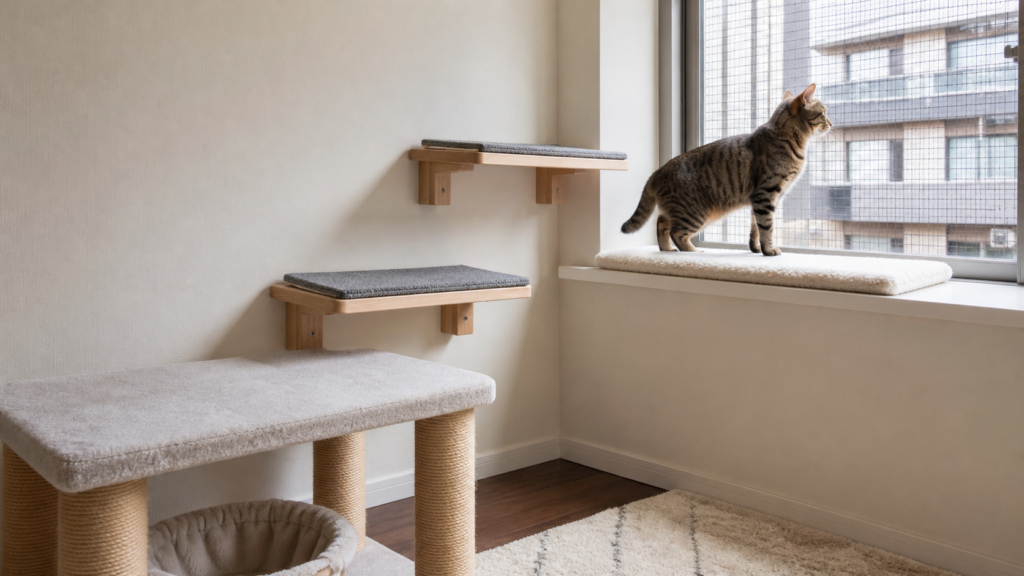
Vertical space gives a cat a place to observe and withdraw while people move below. The useful feature is not height by itself. The route must be stable, reachable, wide enough for the cat to turn or rest, and appropriate for its mobility.
Start with what you already have. Identify one low surface, one middle level, and one comfortable destination. That might be a sturdy ottoman, the broad platform of a cat tree, and a secured shelf. Test every surface for wobble. Add non-slip material where needed, and keep landing zones clear.
For a healthy adult cat, staggered levels can create a short climbing route. For a kitten, senior cat, overweight cat, or cat with arthritis, use lower steps, wider platforms, and shorter gaps. A ramp or intermediate stool may be more useful than a tall tower. Never assume a cat can safely jump down simply because it managed to climb up.
Place the route where it leads somewhere valuable: a resting pad, a view, or a quiet observation point. Avoid dead ends in multi-cat homes. A timid cat should not have to pass another cat on a narrow shelf to get down. When possible, provide two directions of travel or a second nearby descent.
Anchor freestanding towers according to the manufacturer’s instructions. Wall shelves must use hardware suitable for the wall construction and the combined dynamic load of a jumping cat. Do not place a route over a stove, aquarium, fragile display, television, or an area where a fall could cause injury.
If you need a compact starting point, compare the stability, platform size, and footprint considerations in our cat trees for small apartments guide.
2. Create a Secure Window Observation Area
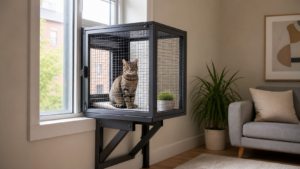
A window can offer changing visual information—people, weather, shadows, birds, and outdoor movement—without adding clutter. It can also become unsafe if the screen is weak, the window opens too far, the perch shifts, or the cat can reach blind cords.
Inspect the entire window before adding a perch. The screen should fit tightly with no tears, loose corners, or gaps. A standard insect screen is not automatically cat-proof. Follow local building and rental rules, and use a secure solution appropriate for the window type. Never rely on an open unscreened window, even on a high floor.
Choose a perch with a stable base and enough room for the cat to lie down and turn. Suction-mounted products require clean glass, correct installation, regular inspection, and adherence to their weight limits. A broad platform on a stable cat tree can be simpler when the window design is unsuitable for a mounted perch.
Keep blind and curtain cords secured completely out of reach. Move breakable objects, toxic plants, essential-oil devices, and exposed cables away from the area. Consider temperature: strong direct sun can overheat a small window zone, while winter glass may be cold. Give the cat another resting option so it can leave the view whenever it chooses.
Not every cat enjoys constant outdoor activity. If your cat becomes tense, chatters continuously, redirects aggression, or patrols the window after seeing another cat, partially block the lower view or move the perch. Observation should be optional, not an unavoidable source of arousal.
For different mounting styles and safety checks, see our guide to choosing a window perch for cats.
3. Use Short Hunting Play and Puzzle Feeding
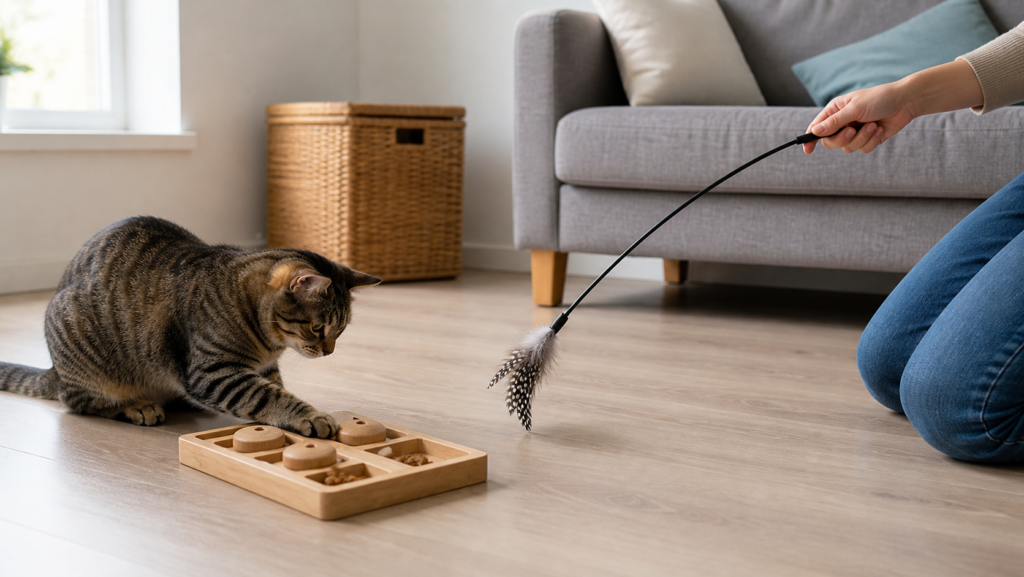
Cats are adapted to repeat short sequences of locating, stalking, chasing, pouncing, and capturing. One long, exhausting session is not necessary. In a small apartment, two or three focused sessions of about five to ten minutes may be easier to fit into the day and easier for the cat to sustain.
Use a wand toy to imitate prey moving away from the cat, pausing behind an object, and becoming catchable. Let the cat succeed regularly. End by slowing the movement and allowing a final capture; a small portion of the cat’s normal meal can follow. Store the wand and string securely after play. Loose string, ribbon, yarn, feathers, and damaged attachments can be swallowed and should not remain accessible without supervision.
Match movement to the individual. A young agile cat may chase across the floor and up a safe platform. A senior or less mobile cat may prefer slow movements around a box, short reaches from a bed, or batting without jumping. Watch breathing and coordination, and stop before fatigue turns play into frustration.
Food puzzles can add searching and manipulation, but they must fit the cat’s skill and diet. Begin with an easy device: a few pieces of measured kibble in an open puzzle tray, or small portions of wet food in shallow wells designed for cleaning. Show the cat where the food is. Increase difficulty only after it uses the puzzle comfortably.
Puzzle food is part of the daily ration, not an automatic extra. Measure the total day’s calories and subtract what goes into the puzzle. Wash food-contact surfaces promptly, discard damaged equipment, and avoid homemade pieces that can be chewed off or swallowed. If your cat has a prescribed diet, food allergy, dental problem, swallowing difficulty, or medical feeding plan, ask your veterinarian before changing delivery methods.
Rotate two or three toys instead of leaving a large pile on the floor. A toy that disappears for several days may regain interest when it returns. Keep one predictable favorite available if removing everything seems stressful.
Our DIY cat enrichment ideas for apartments include low-cost activities that can be matched to the cat’s ability and supervised safely.
4. Put Scratching Surfaces Where They Are Needed
Scratching is not a bad habit that enrichment should eliminate. It supports stretching, claw maintenance, communication, and scent marking. The practical goal is to provide an acceptable surface with the right orientation, texture, stability, and location.
Observe what the cat already chooses. Scratching a vertical sofa corner suggests a tall upright option; scratching carpet may point to a horizontal surface. Some cats use both. A vertical post should be tall enough for a full-body stretch and stable enough not to rock or tip. A flat cardboard or sisal scratcher should not slide across the floor.
Placement often matters more than adding another scratcher. Put one near a sleep area because many cats stretch and scratch after waking. Place another near a frequently used route, room entrance, or furniture area the cat has selected. Hiding every scratcher in an unused corner can make the approved option irrelevant.
Encourage investigation with play, praise, or a reward the cat values. Do not force the paws onto the surface. Avoid punishment, spraying, yelling, or startling devices; these may increase fear without teaching an acceptable alternative. Protect furniture temporarily while making the preferred scratcher easier and more rewarding to use.
Check scratchers for exposed staples, loose strands, sharp edges, or unstable bases. Replace them when damage creates a hazard, not merely when the surface begins to look used. Visible wear can be part of what makes a familiar scratcher valuable to the cat.
5. Provide Hiding and Resting Choices
A safe place lets a cat withdraw from visitors, household noise, handling, or ordinary activity. In a small apartment, a hide does not have to be large. A sturdy cardboard box on its side, a covered bed, an open carrier with bedding, or a draped space beneath a stable table can work.
The location should be quiet but not trapping. Do not put the only hide beside a washing machine, speaker, frequently slammed door, litter box, or busy walkway. The cat should be able to enter and leave without being grabbed. Children and guests should understand that a cat in its safe place is not available for interaction.
Offer more than one resting style if space allows: one covered location, one open padded surface, and one elevated option. Cats change preferences with temperature, time of day, noise, and social activity. Choice is the enrichment.
An open carrier can serve as an everyday safe resting place instead of appearing only before a veterinary visit. Secure the door so it cannot swing or close unexpectedly. Add washable bedding and occasional rewards. Never use the carrier as punishment.
In a multi-cat home, one “best” bed is not enough if another cat can block it. Distribute resting and hiding choices so each cat can reach a suitable location without passing through a conflict point. Watch doorways, narrow halls, shelf routes, and litter access for subtle blocking.
Hiding can be normal, especially during rest or after a change. A new increase in hiding accompanied by reduced appetite, altered elimination, vomiting, limping, vocalization, or reluctance to move needs veterinary assessment. Enrichment should support a medically healthy cat; it should not delay care.
6. Add Safe Scent and Novelty Without Overloading the Room
Novelty can be simple: a different cardboard box, a paper packing sheet without tape or staples, a toy moved to a new location, or a safe object carrying a familiar household scent. Introduce one change at a time so you can see whether the cat approaches, ignores, or avoids it.
Let the cat control the interaction. Place the new item at a distance and allow voluntary investigation. Do not push it toward the cat or place a nervous cat inside a new box. Remove the item if it leads to prolonged vigilance, avoidance, conflict, chewing, or attempts to ingest material.
Catnip and silver vine interest many cats, but not every cat responds. Offer a small amount on a toy or scratcher and supervise the first exposure. Stop if the cat becomes overly aroused, aggressive, or unwell. Store the material securely and keep it separate from food unless the product is intended and safe for that use.
Avoid essential-oil diffusers, concentrated fragrances, potpourri, and scent products around the cat. Cats have a sensitive sensory environment, and some substances can be harmful by inhalation, skin contact, or ingestion. “Natural” is not the same as cat-safe. If a scented product may have contacted your cat, contact your veterinarian or an animal poison service for case-specific advice.
A small rotation basket helps prevent clutter. Keep most washable toys stored, offer a few at a time, inspect them during every rotation, and discard anything with broken seams, exposed stuffing, damaged bells, or loose components.
7. Use a Predictable Routine and Positive Interaction
Enrichment is not only furniture and toys. Predictable access to food, play, rest, litter, and calm interaction can help the cat understand what happens next. The schedule does not need to be exact to the minute, but a repeatable sequence is useful.
A practical weekday pattern might be:
- Morning: brief greeting, fresh water and litter check, five minutes of play, then breakfast.
- Midday: window access, a simple measured puzzle, or quiet independent time.
- Evening: interactive play, dinner, grooming or calm contact if the cat seeks it.
- Before bed: a short low-intensity activity followed by a settled resting period.
Respect the cat’s choice about touch. Look for an approach, relaxed posture, head rub, or continued proximity. Pause frequently. If the cat turns away, flicks its tail sharply, flattens its ears, ripples its skin, or leaves, let the interaction end.
Positive-reinforcement training can also provide mental activity in a small area. A cat can learn to touch a target, enter a carrier, move to a mat, or come when called. Keep sessions to one or two minutes at first, use tiny rewards from the daily food allowance, and stop while the cat is still willing to participate. Our clicker training for indoor cats guide explains a gradual starting process.
Do not use attention only when the cat bites, knocks objects down, or vocalizes intensely. Schedule short periods of appropriate play and interaction before common problem times. At the same time, investigate new or escalating behavior rather than assuming it is manipulation or boredom.
A One-Room Enrichment Layout
You can create distinct functional zones even when the apartment is one open room.
| Zone | Practical placement | What to include | Keep away from |
|---|---|---|---|
| Observation | Secure screened window or calm room edge | Stable perch, broad platform | Loose cords, unsafe plants, overheating |
| Activity | Clear section of floor beside a stable route | Wand play, scratcher, easy puzzle | Breakables, exposed cables, slippery landings |
| Rest | Quiet corner or elevated stable surface | Covered hide, open bed, carrier | Speakers, busy doors, forced handling |
| Food and water | Separate calm locations when possible | Clean bowls or measured puzzle | Litter, noisy appliances, conflict points |
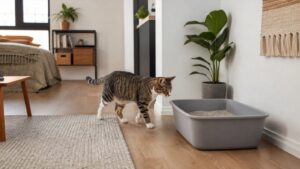
| Litter | Private, accessible, ventilated area | Appropriately sized clean box | Food, trapped corners, blocked exits |
Separation does not always mean another room. A few feet, a furniture barrier, different elevation, or placement on opposite sides of a walkway can make two resources feel more distinct. The setup should allow the cat to use each resource without being interrupted.
Budget Setup: What to Add First
If you are starting with an empty apartment, prioritize function in this order:
- Safe basics: suitable litter setup, food and water locations, a secure hide, and veterinary care.
- Scratching: one stable surface in the preferred orientation and location.
- Interactive play: one durable supervised wand toy stored after use.
- Height: a stable furniture route or securely anchored cat tree.
- Observation: a safe window position if the cat enjoys it.
- Food activity: one easy, washable puzzle that fits the feeding plan.
- Rotation: a small selection of inspected toys and safe novelty items.
Buying a large bundle before observing the cat can waste money and floor space. Test one category, note its use for a week, and then decide what gap remains.
Multi-Cat Enrichment in a Small Apartment
More cats do not simply require a larger version of one shared setup. Each cat needs access to key resources without being stared at, followed, cornered, or blocked. Conflict can be subtle: one cat may sit in a doorway, occupy the only high platform, wait beside a litter route, or approach whenever the other cat tries to eat.
Spread resources across different directions and heights. Avoid lining every bed, bowl, scratcher, and toy station along one wall. Provide multiple resting sites and hides, and create more than one route through heavily used areas. A shelf route with one entrance and no alternate exit may become controlled territory rather than enrichment.
Play with cats separately when their speed, confidence, or toy preference differs. Feed measured puzzle portions separately if one cat steals or guards food. Do not force close proximity in the name of social enrichment.
Look for staring, chasing, blocking, displaced resting, litter avoidance, overgrooming, spraying, reduced play, and one cat consistently waiting until the other leaves. Discuss persistent tension with your veterinarian; medical problems can affect behavior, and a qualified behavior professional may be needed.
A 7-Day Small-Apartment Starter Plan
Use this plan to add enrichment without changing everything at once.
Day 1: Map the Apartment
Mark where the cat sleeps, scratches, watches, eats, drinks, plays, and eliminates. Note noise, cords, unstable furniture, narrow routes, and places where people interrupt the cat.
Day 2: Improve One Safe Place
Add a box, covered bed, or open carrier in a quiet location. Leave it available and do not place the cat inside.
Day 3: Fix the Scratching Option
Match the preferred orientation and move the scratcher beside a location the cat already uses. Stabilize it and reward voluntary interest.
Day 4: Add One Short Play Session
Schedule five to ten minutes at a time the cat is naturally alert. Use catchable movement and store the toy afterward.
Day 5: Add Safe Height or a View
Stabilize an existing route or install one properly secured platform. Confirm the descent is as safe as the climb.
Day 6: Introduce an Easy Food Activity
Use part of the normal ration in a simple puzzle. Watch for frustration and return to a bowl if the cat will not eat adequately.
Day 7: Review the Evidence
Keep what the cat uses. Move, simplify, or remove what it avoids. Check every item for wear and confirm that the apartment still has clear human and feline pathways.
For a printable review of the main categories, use our indoor cat enrichment checklist.
How to Tell Whether the Setup Is Working
Useful signs include voluntary play, relaxed use of several resting areas, normal appetite and litter habits, scratching approved surfaces, comfortable exploration, and the ability to disengage and rest. Improvement may be gradual, and not every cat will use every feature.
Change the setup if the cat repeatedly slips, hesitates at a gap, cannot turn on a platform, becomes trapped by another pet, avoids an essential resource, or shows persistent frustration around a puzzle. Remove damaged equipment immediately.
Do not measure success by constant activity. Sleep and quiet observation are normal. The goal is a cat that can choose activity or rest, social contact or distance, height or floor level.
If you are unsure whether a behavior reflects unmet activity needs, review these signs an indoor cat may be bored, while remembering that new behavior can also have a medical cause.
Common Small-Apartment Enrichment Mistakes
Crowding Everything Into One Cat Corner
A tower, bed, bowls, litter box, and scratcher placed together may look organized to a person but removes meaningful separation. Distribute functions across the apartment.
Adding Height Without a Safe Route Down
Cats may climb an unstable or difficult route and then hesitate at the descent. Test landings, traction, width, and alternate exits before encouraging use.
Leaving String Toys Available
Wand toys and string-like materials require supervision and secure storage. A toy does not stay safe simply because it was sold for cats.
Making Food Puzzles Too Difficult
A frustrated cat may stop eating or abandon the puzzle. Begin easy, use familiar food, and provide an appropriate alternative.
Changing the Entire Apartment in One Day
Too much novelty can reduce a cat’s sense of familiarity. Preserve favorite beds and routes while adding one change at a time.
Treating Behavior as “Just Boredom”
Pain, dental disease, urinary problems, gastrointestinal illness, sensory change, and other medical issues can alter activity or behavior. Seek veterinary advice for a new, sudden, persistent, or concerning change.
Frequently Asked Questions
How much daily enrichment does an indoor cat need?
There is no single minute target for every cat. Several short opportunities distributed across the day are often more practical than one long session. Combine interactive play, independent choices, observation, scratching, rest, and calm social contact. Adjust for age, health, mobility, and interest.
Can a studio apartment be enough for a cat?
A studio can support a cat when it provides safe resources, usable vertical space, privacy, clean litter access, exercise, interaction, and veterinary care. Square footage alone does not determine welfare. Layout, resource placement, household activity, and the individual cat matter.
What is the best enrichment item for a small apartment?
There is no universal best product. A stable multi-level route often adds the most usable space, but a secure hide, appropriate scratcher, and daily interactive play may be higher priorities for a particular cat. Choose the unmet function first, then the item.
Should toys remain out all day?
Safe independent toys may remain available if they are inspected regularly. Store string, ribbon, wand, feather, and damaged toys after supervised use. Rotating a few toys can preserve novelty and limit clutter.
Are window perches safe for cats?
They can be when the window is closed or securely screened, the perch is installed and inspected correctly, blind cords are inaccessible, and temperature is comfortable. Do not assume an insect screen will contain a cat, and never provide access to an unscreened open window.
Does enrichment stop nighttime activity or unwanted behavior?
Appropriate daytime and evening activity may help some routines, but enrichment is not a guaranteed cure. Nighttime activity, vocalization, aggression, elimination change, or destructive behavior can have several causes. Evaluate timing, reinforcement, stress, environment, and health with professional help when needed.
How often should I change the setup?
Keep core resources and favorite resting locations predictable. Rotate selected toys or safe novelty items every few days or weekly, depending on the cat’s response. Change one element at a time and retain familiar options.
Final Small-Apartment Checklist
Before calling the setup complete, confirm that:
- Tall furniture and climbing equipment are stable and properly secured.
- The cat has a safe route up and down, with suitable traction and landing space.
- Windows are closed or protected by an intact, appropriate secure screen.
- Blind cords, electrical cables, string toys, toxic plants, and unsafe scents are inaccessible.
- Scratching surfaces match the cat’s orientation and location preferences.
- At least one quiet hiding place remains undisturbed.
- Food, water, litter, rest, and activity are separated as much as the apartment allows.
- Puzzle food is counted within the daily ration.
- Multi-cat routes and resources cannot be easily blocked by one cat.
- New or concerning behavior is evaluated medically rather than labeled as boredom.
The strongest small-apartment plan is not the one with the most products. It is the one that gives your cat safe, usable choices and that you can maintain every day.
References
Feline Veterinary Medical Association. Positive Reinforcement Training Educational Toolkit. https://catvets.com/wp-content/uploads/2026/01/Positive-Reinforcement-Training-Educational-Toolkit_Addressing-Undesirable-Behavior.pdf
Ellis SLH, Rodan I, Carney HC, et al. AAFP and ISFM Feline Environmental Needs Guidelines. Journal of Feline Medicine and Surgery. https://pmc.ncbi.nlm.nih.gov/articles/PMC11383066/
Herron ME, Buffington CAT. Environmental Enrichment for Indoor Cats. Compendium. https://pmc.ncbi.nlm.nih.gov/articles/PMC3922041/
Feline Veterinary Medical Association. Meeting the Needs of Indoor Cats Position Statement. https://catvets.com/resource/meeting-the-needs-of-indoor-cats-position-statement/
Ohio State University Indoor Pet Initiative. Hiding Instinct. https://indoorpet.osu.edu/cats/understanding-cats/hiding-instinct
Ohio State University Indoor Pet Initiative. Increasing Activity. https://indoorpet.osu.edu/cats/problem-solving/increasing-activity
Next Steps
If you are setting up indoor cat enrichment in small apartments, start with the printable Indoor Cat Enrichment Checklist above and make one upgrade this week: a higher resting spot, a safer window view, a better scratching surface, or a short evening play routine.
For related guides, read our apartment cat setup resources:
- How to Entertain an Indoor Cat While at Work
- Best Cat Trees for Small Apartments
- How to Introduce a Second Cat in a Small Apartment
🐾More Enrichment Guides: