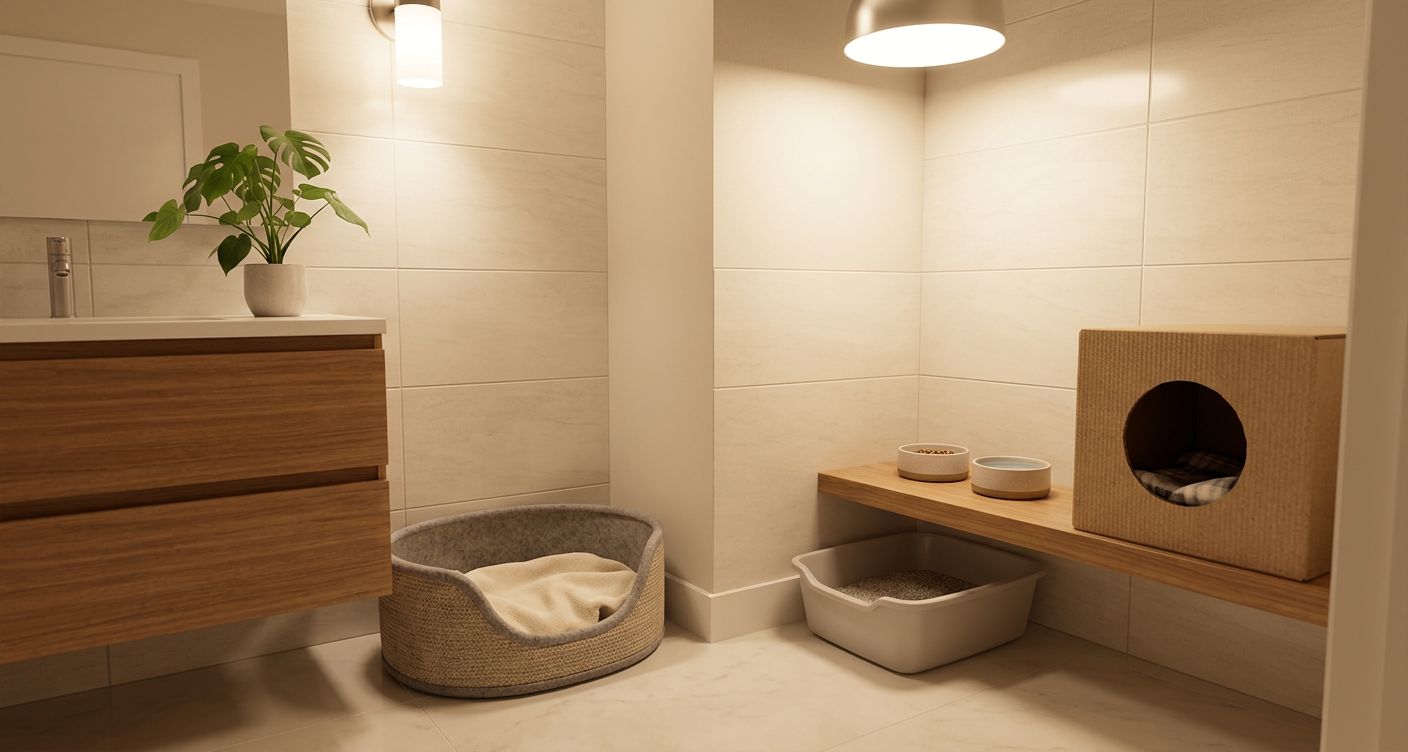
To introduce second cat small apartment life safely, start with separation, scent, and patience before face-to-face contact. A small apartment gives cats fewer escape routes, so the introduction needs to be more structured, not more rushed.
I learned this the hard way when Milo arrived in my one-bedroom apartment and Oliver puffed himself into a furious orange balloon across the room. I had one bedroom, one bathroom, and one door that actually closed. That was enough, but only after I treated the bathroom as a basecamp and stopped expecting the cats to “work it out.”
This guide shows you a six-step small-apartment cat introduction plan: basecamp setup, scent swapping, door feeding, controlled visual contact, short supervised meetings, and long-term resource planning.
How to Introduce a Second Cat in a Small Apartment(Quick Answer)
The safest way to introduce a second cat in a small apartment is to keep the new cat in a separate basecamp room first, usually a bathroom or bedroom. Spend several days on scent swapping before visual contact, then feed both cats on opposite sides of a closed door, progress to a cracked door or tall gate, and only allow short supervised shared-space sessions when both cats can disengage calmly.
Most introductions take four to eight weeks. Hissing, hiding, or brief growling does not always mean failure, but hard staring, blocking exits, repeated chasing, fighting, not eating, or litter box avoidance means you should slow down and consider veterinary or certified behavior support.
Important Safety Note
This guide is for normal, low-level introduction tension such as hissing, hiding, and cautious avoidance. If either cat stops eating, cannot use the litter box safely, injures the other cat, repeatedly attacks, or stays highly distressed for more than a few days, contact your veterinarian or a qualified feline behavior professional before continuing.
Why Cat Introductions Fail — Especially in Small Spaces
Cat introductions fail for one consistent reason: they happen too fast. An owner sees two cats who aren’t immediately fighting and interprets this as compatibility, removes the separation, and within forty-eight hours has a full territorial conflict that can take months to undo.
In a house, cats can self-manage territory by avoiding each other across multiple rooms and floors. In a small apartment, that option doesn’t exist. Two cats in 600 square feet with no established territory protocol and no vertical hierarchy will experience that space as one inescapable confrontation — which is extremely stressful for both cats and produces the hissing, hiding, inappropriate elimination, and occasional physical altercation that makes people conclude the cats are simply incompatible.
They are usually not incompatible. They are simply unintroduced. The protocol below exists to build the shared context that makes cohabitation possible — not overnight, but reliably.
Before You Begin: What You Need in Place
Before the new cat arrives, set up the following. Doing this in advance removes the panicked scrambling that happened in my apartment when Milo arrived without warning.
Supplies checklist:
- A separate food bowl, water bowl, and litter box for the new cat — fully set up in the basecamp room before arrival
- A carrier, a hiding spot (even a cardboard box), and a soft bed in the basecamp room
- A tall baby gate or pet gate with a small cat door, or a screen door if available — for later visual introduction stages
- Pheromone diffuser plugged into the basecamp room and the main living area (synthetic feline facial pheromone formulas are widely available; they reduce ambient territorial stress and ease the introduction process)
- Your existing cat’s favorite bedding and toys distributed normally — don’t rearrange your resident cat’s environment right before introducing a newcomer
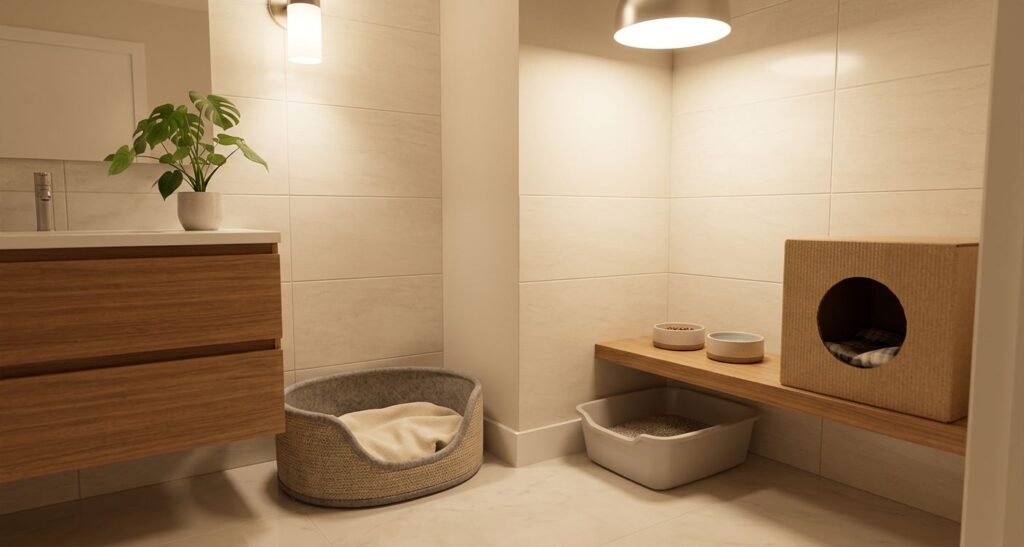
Step 1: The Basecamp — Separate Completely for the First Week
The moment the new cat arrives, they go directly into the basecamp room. The door closes. This is not isolation — it is foundation.
The new cat needs a contained, safe environment where they can decompress from the stress of transport and unfamiliar surroundings without simultaneously processing the presence of a resident cat. Oliver needs to process the new smell under the door without experiencing visual or physical confrontation. Both cats need time to register the other’s existence at a distance before any escalation.
Setting Up the Basecamp Successfully
The basecamp should contain everything the new cat needs: food, water, litter, hiding options, a soft resting surface, and something with your scent on it (an old t-shirt works well) to reduce stress. Spend time in the basecamp room daily — sitting quietly, letting the new cat approach on their terms, building association between your presence and safety.
What to expect in the first 48 hours:
- New cat may hide completely and refuse food — this is normal stress response, not illness, for the first 24–48 hours
- Resident cat will almost certainly sniff intensely at the door, may vocalize, may show heightened patrol behavior around the apartment
- Do not open the door to let them “sort it out” — this is the most common mistake and the one most likely to require starting over
Keep the door closed, maintain calm routines for your resident cat, and let the under-door scent exchange begin its work.
Step 2: Scent Swapping — The Introduction That Happens Before Any Introduction
Cats process identity and safety primarily through scent. Before two cats ever see each other, they can build a detailed behavioral profile of the other through smell alone — and the goal of scent swapping is to make that profile familiar, unthreatening, and associated with positive things.
The Blanket Swap Protocol
Starting on day two or three:
- Take a soft blanket or towel that the new cat has been sleeping on and place it in the main living area where your resident cat can investigate it freely
- Take a blanket from the resident cat’s favorite sleeping spot and place it in the basecamp room
- Do this exchange every one to two days, rotating items back and forth
Watch the reactions carefully. Initial hissing at the scented item is normal and not a failure signal — it’s information processing. The sign you’re ready to progress is when both cats can approach, sniff, and settle near the scented item without sustained hissing or stress response. This typically takes five to ten days.
An additional technique: rub a soft cloth gently around the new cat’s face (where scent glands are concentrated), then allow the resident cat to sniff it. Repeat with the resident cat’s facial scent introduced to the new cat. This delivers the most socially relevant scent information directly.
This same safe-room concept also helps during territory disruption. If you are changing apartments, use our moving apartment with cat guide to plan the room, door control, and scent setup before the move begins.
Step 3: The Door Feed — Building Positive Association With Each Other’s Presence
Once both cats are investigating scented items calmly, begin feeding both cats simultaneously on opposite sides of the closed basecamp door. The goal is to establish a conditioned association: the other cat’s smell equals food appears, which equals good things happen.
Running the Door Feed Correctly
Start with the bowls positioned well away from the door on both sides — several feet back if either cat shows stress. If both cats eat calmly, move the bowls incrementally closer to the door over the following days until they are eating directly on opposite sides of the door.
Signs the door feed is working:
- Both cats approach their bowl without hesitation
- No sustained growling or hissing during the meal
- Cats may sniff under the door gap between bites — this is positive engagement, not conflict
If either cat refuses to eat near the door, move the bowl back to a comfortable distance and progress more slowly. A cat too stressed to eat is being pushed past its threshold, and pushing past threshold sets the introduction back rather than forward.
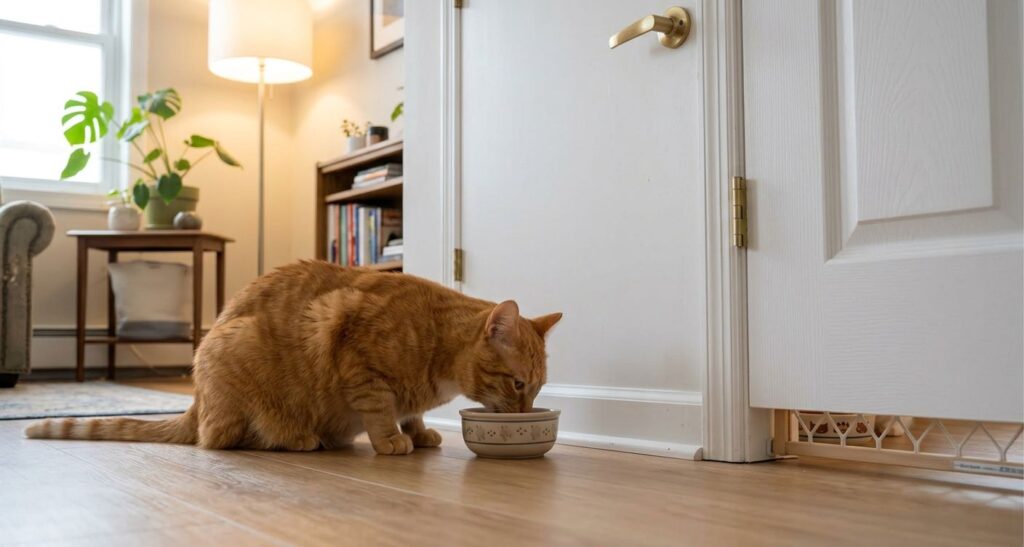
Step 4: The Visual Introduction — Cracked Door and Baby Gate
After five to seven days of successful door feeding, introduce visual contact — but controlled, limited, and escapable for both cats.
The simplest method in a small apartment is cracking the door open two to three inches while feeding, securing it with a doorstop so neither cat can push through. Both cats can see each other, process the visual information, and retreat to their respective sides if needed.
Progressing to a Tall Pet Gate
Once both cats consistently look at each other through the cracked door without hissing or fleeing, replace the cracked door with a tall pet gate across the doorway. This allows full visual and limited olfactory contact while maintaining physical separation.
If one cat steals meals or blocks the other cat from eating, a microchip feeder can help protect separate portions; compare safe options in our best microchip cat feeder guide.
What good visual introduction behavior looks like:
- Approaching the gate, sniffing, then walking away calmly
- Brief eye contact followed by disengagement (looking away is a feline social signal for “I’m not threatening you”)
- Eating and playing normally while the other cat is visible
What requires slowing down:
- Sustained hard staring with dilated pupils
- Flattened ears, puffed tail, or crouched aggressive posture
- Hissing or growling that doesn’t subside within a few minutes
This stage can last anywhere from a few days to two weeks depending on the individual cats. Oliver took nine days at the gate before I was confident he wasn’t planning an ambush.
Spraying is the ultimate red flag of social tension. If spraying appears during the introduction, first confirm whether it is marking or full urination using our cat spraying vs peeing guide.
Step 5: Supervised Mingling — The First Shared Space Sessions
The first time both cats are in the same space together, every variable should be in your favor.
In small spaces, horizontal distance isn’t always possible. For layout planning in very small spaces, use our guide to living with two cats in a studio apartment.
Choose a time when both cats are calm and slightly hungry — not post-nap zoomies hour, not right after a stressful event. Have high-value treats ready for both cats. Create multiple exit routes and elevated surfaces so neither cat feels cornered. Open the gate or door and let them choose whether to approach each other.
Managing the First Sessions
Keep first sessions short — ten to fifteen minutes maximum. Interrupt and separate before any tension escalates to physical contact. End every session on a neutral or positive note, not mid-conflict.
Your role during supervised mingling:
- Remain calm — your stress is readable to both cats and elevates theirs
- Redirect approaching conflict with a treat toss between them (redirects attention to food, breaks the stare-down)
- Do not physically intervene in minor posturing — some mutual communication is necessary and healthy
- Do intervene immediately if either cat blocks the other’s exit route (this is a precursor to physical attack)
Gradually extend session length over the following days and weeks as both cats demonstrate they can occupy the same space without sustained stress. Full unsupervised access should only come when you’ve observed multiple calm, uneventful sessions.
Resource competition is the primary driver of feline fights. If one cat starts guarding food, litter, windows, or resting spots, compare the behavior with our cat resource guarding guide.
Step 6: Permanent Cohabitation — Setting Up for Long-Term Peace
Once both cats are tolerating shared space, the physical setup of your apartment determines whether that tolerance becomes genuine coexistence.
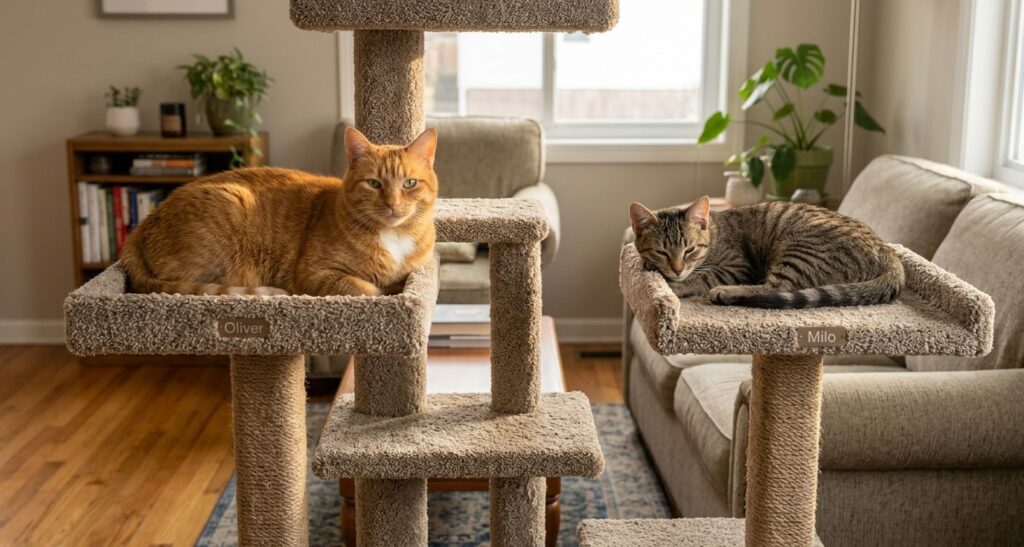
The single most important factor for peaceful multi-cat apartments is vertical space. Cats establish hierarchy partly through height — the cat who occupies the highest point is signaling dominance, and the lower cat can accept a lower position without it becoming a physical confrontation.
When there is no vertical hierarchy available, position conflicts play out horizontally — which means directly, physically, in a small space. Investing in wall shelves, tall cat trees, and multiple elevated resting options at different heights gives both cats a non-confrontational way to negotiate status. For a full room-by-room setup, use our indoor cat enrichment in small apartments guide.
The Resource Distribution Rule
In a multi-cat household, resources must be distributed to prevent guarding behavior:If one cat already blocks food, litter, windows, or resting spots, compare the behavior with our cat resource guarding guide before adding more shared access.
- Litter boxes: One per cat plus one — for two cats, that’s three boxes ideally, or minimum two positioned in different locations. A dominant cat guarding access to a single litter box causes serious welfare problems for the subordinate cat and creates exactly the kind of house-soiling behavior that’s hardest to address.
- Adding a second cat also means doubling the daily waste load, which makes a rigorous odor control routine genuinely non-negotiable in tight quarters: how to keep litter box from smelling in small apartment.
- Food bowls: Fed in separate locations, or at minimum on opposite ends of the same surface, to prevent competitive eating
- Resting spots: Multiple options at multiple heights — no single “best” spot that both cats want
Realistic Timeline: What to Expect Week by Week
| Phase | Timeframe | What’s Happening |
|---|---|---|
| Basecamp only | Days 1–7 | Scent introduction under door; both cats decompressing |
| Scent swapping | Days 3–14 | Blanket exchanges; monitoring stress responses to each other’s scent |
| Door feeding | Days 7–14 | Building positive food association with each other’s smell |
| Visual introduction | Days 10–21 | Cracked door → pet gate; controlled visual contact |
| Supervised mingling | Weeks 3–5 | Short shared sessions, gradually extended |
| Unsupervised access | Week 5–8+ | Full cohabitation, resource distribution in place |
These timelines are averages. Some cats move faster; some need double the time at each stage. The protocol works at the pace of the slower or more anxious cat — never at the pace of your schedule or your impatience. Rushing a stage that’s producing sustained stress will reliably set you back further than going slowly.
In rare cases, the stress of your absence can cause territorial anxiety. If your sweet pet acts out, read our vet-backed guide on why an indoor cat suddenly aggressive behavior occurs.
FAQ
How long does the process take when learning how to introduce a second cat in a small apartment?
For most cats, four to eight weeks from first arrival to relaxed unsupervised cohabitation is a realistic range. Kittens introduced to adult cats often move faster — kittens are less threatening to established cats because they don’t yet read as territorial competitors.
Adult-to-adult introductions, especially when the resident cat has been a solo cat for several years (as Oliver had), tend to take the full eight weeks or longer. Some cats reach peaceful coexistence within two weeks; others take three to four months. Both outcomes are within the normal range — what matters is following the scent-first, pace-the-slower-cat protocol regardless of timeline.
My cats hissed at each other through the gate. Is this a bad sign?
Hissing is communication, not failure. A cat that hisses at another cat through a gate and then walks away is setting a boundary — “I see you, I’m not comfortable, and I’m telling you so.” This is dramatically healthier than a cat that freezes, stares in prolonged silence, and then attacks.
The concerning signals are sustained hard staring without blinking, low crouching with a lashing tail, and any behavior that blocks the other cat’s retreat. Single hisses followed by disengagement are normal, expected, and not a reason to pause the protocol. Consistent hissing every time the cats approach the gate for more than two weeks is a reason to slow down and extend the scent-swapping phase.
Is a one-bedroom apartment too small for two cats permanently?
No — with the right setup, a one-bedroom apartment is workable for two cats of compatible temperament. The key variables are personality compatibility (two highly territorial, low-sociability cats in a small space are a harder pairing than two more social cats), vertical space (tall cat trees and wall shelves are not optional in a multi-cat small apartment), and resource distribution (two litter boxes in different locations, two feeding stations, multiple resting options).
The apartment’s square footage matters less than its three-dimensional complexity and resource abundance. A 500-square-foot apartment with good vertical structure and well-distributed resources can support two cats more peacefully than a 900-square-foot flat floor plan with a single food bowl and one litter box.
Should I introduce two cats faster if they seem calm?
No. Calm behavior through a door or gate is a sign that the current stage is working, not proof that the cats are ready for full access. In a small apartment, one rushed meeting can create chasing, hiding, litter box avoidance, or long-term guarding. Move forward only after several calm repetitions at the same stage.
What if my resident cat refuses to eat near the new cat’s door?
Move the bowl farther away from the door and rebuild the association from a distance where your cat can still eat normally. A cat who will not eat is over threshold. The goal is not closeness; the goal is relaxed eating while the other cat’s scent is present.
When should I stop the introduction and ask for help?
Pause the introduction and ask your veterinarian or a qualified feline behavior professional for help if either cat is injured, repeatedly attacks, stops eating, avoids the litter box, hides continuously, or cannot relax even with the cats separated again.
Final Thoughts
Introducing a second cat in a small apartment is not about forcing friendship. It is about giving both cats enough time, scent information, escape routes, and separate resources to decide that the other cat is not a threat.
The smaller the apartment, the more the protocol matters. A bathroom basecamp, slow scent swapping, careful door feeding, and multiple vertical resting places can turn a tense first week into a workable long-term household.
References
Barry, K. J., & Crowell-Davis, S. L. (1999). Gender differences in the social behavior of the neutered indoor-only domestic cat. Applied Animal Behaviour Science, 64(3), 193-211.
Ellis, S. L. H., Rodan, I., Carney, H. C., Heath, S., Rochlitz, I., Shearburn, L. D., Sundahl, E., & Westropp, J. L. (2013). AAFP and ISFM Feline Environmental Needs Guidelines. Journal of Feline Medicine and Surgery, 15(3), 219-230.
Levine, E., Perry, P., Scarlett, J., & Houpt, K. A. (2005). Intercat aggression in households following the introduction of a new cat. Applied Animal Behaviour Science, 90(3-4), 325-336.
-300x169.png)
-300x169.png)
-300x169.png)