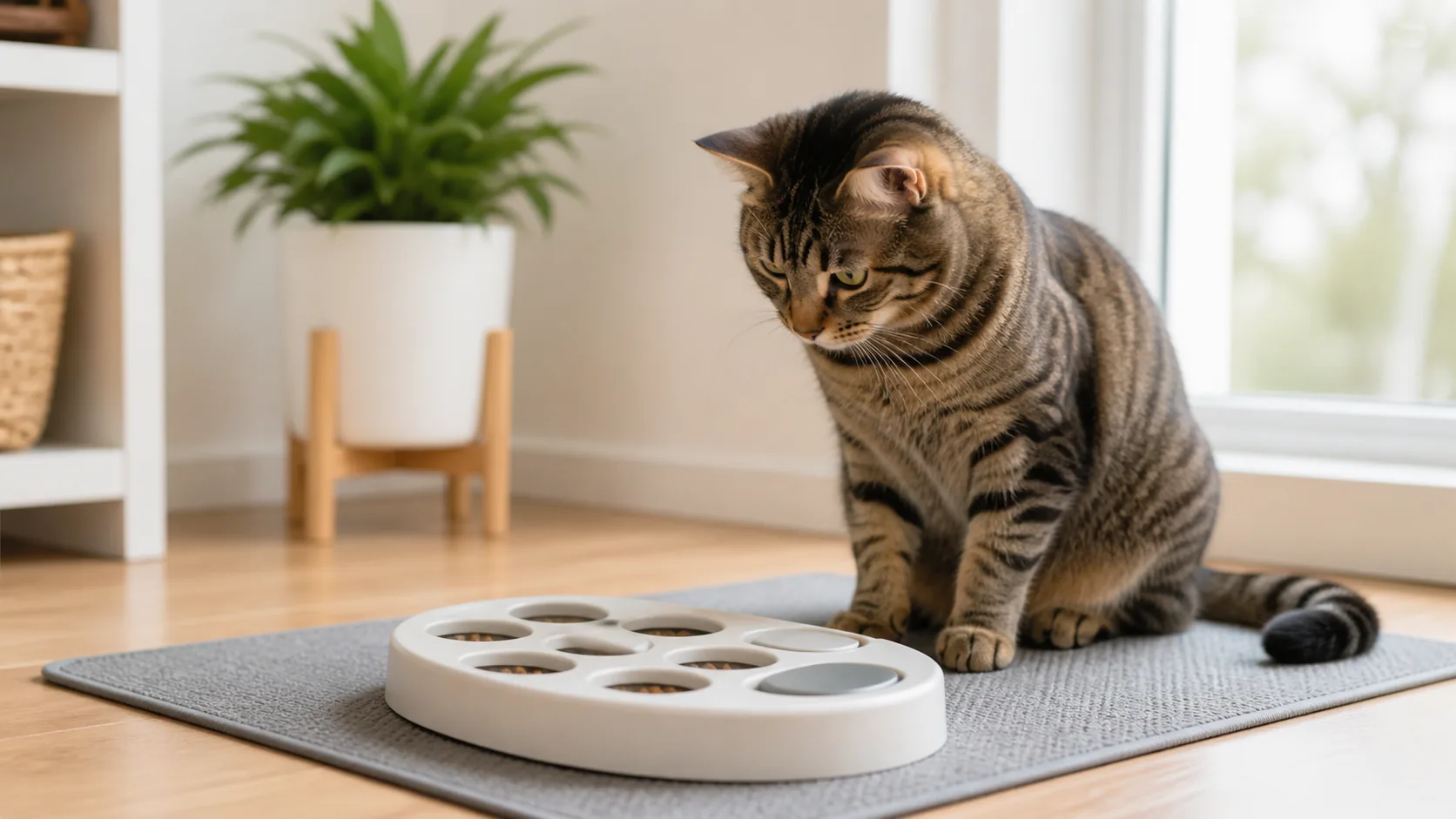
How to teach a cat to use a puzzle feeder starts with making the first meal almost effortless. Put familiar food in an open, stable puzzle, leave most compartments uncovered, and let your cat discover a reward. Increase only one part of the challenge after your cat eats calmly and returns willingly.
A puzzle feeder should never be a test your cat must pass to earn food. It is an optional way to add searching, pawing, licking, or problem-solving to a measured meal. Some cats learn in one session; others need several days, a different mechanism, or a conventional bowl alongside the puzzle. A cat that repeatedly walks away is giving useful feedback—not being stubborn.
Quick answer: Begin with 5–10 pieces of familiar food placed on and around the easiest part of the feeder. Keep the puzzle still, expose the food, and step back. When your cat retrieves the food without hesitation, partly cover one compartment or make one dispensing opening slightly smaller. End the session while the cat is still successful. Never withhold the rest of a meal to force participation.
Table of Contents
Why Puzzle Feeder Training Should Be Gradual
Cats do not automatically understand that moving a cover, pushing a ball, reaching into a cup, or licking across a textured surface will release food. Each design asks for a different behavior. A cat that readily scoops kibble from a shallow tray may dislike a rolling dispenser. A wet-food eater may understand a lick mat immediately but ignore a tube designed for dry food.
The Feline Veterinary Medical Association’s feeding guidance encourages feeding plans that consider normal feline behaviors, including frequent small meals, foraging, and the use of appropriate puzzle feeders. The important word is appropriate. The feeder must fit the individual cat’s food, mobility, confidence, household, and health needs.
Research on food puzzles also recommends starting with an easy task and gradually increasing difficulty. Published evidence is still developing, and puzzle feeders are not guaranteed to increase activity or solve a behavior problem. Their most practical value is giving a cat a safe opportunity to work for part of a normal measured meal.
Training gradually matters because early frustration can teach the wrong lesson. If the first puzzle rolls loudly, traps every piece, slides across the floor, or requires an unfamiliar paw movement, the cat may learn that the object is unpleasant. An easy first success instead teaches a simple association: interacting with this object makes familiar food available.
Before You Start: Choose the Easiest Suitable Puzzle
The best starter puzzle is not necessarily the most advanced or expensive. It is the design your cat can approach comfortably and solve with minimal effort.
Match the mechanism to your cat
Choose a feeder based on behaviors your cat already performs:
- Licking: Use a shallow lick mat or a wide, textured wet-food surface.
- Scooping with a paw: Try a shallow cup, muffin-tin-style setup, or wide digging compartment.
- Sliding objects: Use a low board with one large attached cover left mostly open.
- Batting or chasing: A rolling dispenser may work, but begin with the opening fully adjusted and limit how far it can roll.
- Searching: Place several tiny portions in easy, visible feeding locations before hiding anything.
If you have not selected a feeder yet, compare food type, stability, cleanability, and adjustable difficulty in our best cat puzzle feeders guide. Product choice and puzzle training are separate decisions: the comparison helps you choose a design, while this guide explains how to teach the behavior.
Use familiar food
The first session is not the time to introduce a new diet. Use part of the food your cat already eats willingly. Count puzzle food as part of the daily ration rather than adding unmeasured treats. If you are unsure how the portion fits the full day, start with our guide to how much to feed an indoor cat, then confirm an individual target with your veterinarian.
For dry food, check that the pieces pass easily through every opening. For wet food, use only surfaces designed to hold moist food and that can be washed thoroughly. Do not put wet food inside an enclosed rolling puzzle unless the manufacturer specifically permits it and every food-contact area is accessible for cleaning.
Set up a quiet, stable training area
Place the puzzle where your cat already feels comfortable eating. A washable nonslip mat can reduce movement and catch scattered food. Keep dogs, children, loud appliances, and competing cats away during the first sessions. The cat should have a clear approach and exit route; do not corner the cat between furniture and the feeder.
Inspect the puzzle before every use. Covers should move smoothly, openings should not pinch paws, and no component should be cracked, chewed, loose, or small enough to swallow. Follow the current manufacturer’s food, cleaning, age, and supervision instructions.
How to Teach a Cat to Use a Puzzle Feeder in 7 Steps
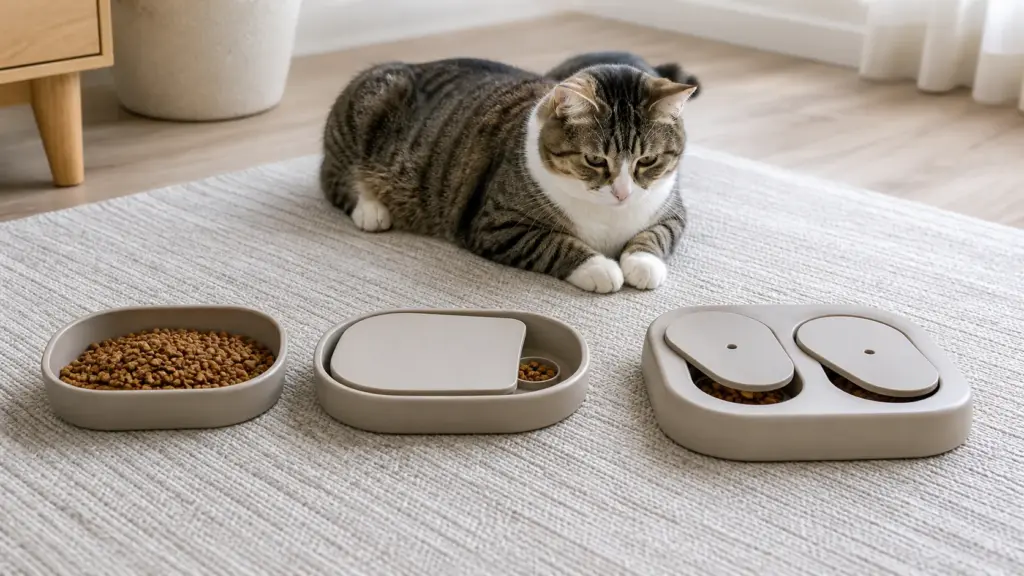
The seven steps below work for many stationary, rolling, digging, and licking feeders. Adjust the details to the mechanism, but preserve the sequence: easy access, one simple action, repeated success, then a small increase in challenge.
1. Let Your Cat Investigate an Empty, Easy Feeder
Set the clean feeder on the floor for a brief, low-pressure inspection. Keep every door open, remove optional obstacles, and prevent a mobile feeder from rolling far. You do not need to place the object beside your cat or move the cat’s paws.
If your cat sniffs it and walks away, that is enough for the first exposure. Leave it in a neutral location for a few minutes, then put it away. A cat that is wary of new objects may need several short exposures before food is added.
Avoid clicking, shaking, or demonstrating the puzzle close to the cat’s face. Sudden movement may make an otherwise manageable object seem threatening. The goal is simple familiarity, not immediate performance.
2. Put Familiar Food on Top and Around the Puzzle
Place a few pieces of food beside the feeder, on its flat edge, and in fully exposed wells. For a lick mat, put a small mound of wet food on the easiest central area rather than pressing food into every groove. For a rolling feeder, place several pieces outside it and leave the dispensing opening at its widest setting.
The cat should be able to eat something without moving any part. This creates an immediate food association. Stay nearby only if your presence makes the cat comfortable; otherwise, step back and let the cat investigate privately.
Do not lift the cat, point its face toward the food, or hold a paw against the mechanism. Forced contact can create avoidance and does not teach the voluntary action needed later.
3. Make One Reward Require One Easy Action
After the cat readily eats exposed food, add the smallest possible challenge:
- Move one sliding cover over only a quarter of a food well.
- Put food near the rim of one wide cup.
- Spread wet food in a thin layer across one easy section.
- Place a few dry pieces inside a rolling feeder with the largest opening available.
- Put one forage portion in plain sight a short distance from the normal feeding area.
Load only one challenging area and keep the rest easy. When the cat touches, nudges, licks, or paws the mechanism and obtains food, remain calm. Quiet praise is fine if the cat enjoys it, but the food itself is already the reward.
If your cat understands clicker training, you can mark a voluntary look, touch, or paw movement and then provide food. A clicker is optional; our cat clicker training guide explains how to establish the marker before using it around a feeder.
4. Use Short Sessions and Protect the Full Meal
Early sessions can be only two to five minutes. Stop after several successful pieces rather than waiting until the cat loses interest. Put the remaining measured meal in the cat’s usual accessible dish if the puzzle portion was not completed.
Never rely on hunger to force learning. Cats need reliable access to an appropriate amount of food, and a sudden reduction in intake can be medically significant. This is especially important for kittens, seniors, cats with chronic disease, cats on prescription diets, and cats whose appetite has recently changed.
A practical starting split is a small training portion in the puzzle and most of the meal in the usual dish. The exact split is less important than confirming that the cat eats the total planned amount. You can move more of the meal into the puzzle only after completion becomes predictable.
5. Repeat the Same Easy Setup Until It Looks Routine
Repeat the successful arrangement instead of changing it at every meal. Your cat is ready to progress when most of the following are true:
- approaches the feeder without hesitation;
- begins interacting within a minute or two;
- uses a relaxed body posture;
- retrieves the easy pieces without repeatedly looking to you for help;
- returns after a brief pause;
- finishes the puzzle portion without frantic biting, forceful flipping, or walking away.
One good session is encouraging, but it does not require an immediate increase. Two or three comfortable repetitions help distinguish learning from a lucky accidental movement.
6. Increase Only One Difficulty Variable
Difficulty can change in several ways: less visible food, a smaller opening, a deeper cup, a tighter cover, more distance between portions, or a puzzle that moves farther. Change only one variable at a time.
For example, if you close a sliding cover farther, do not also introduce a new food and move the puzzle to another room. If you hide a forage feeder behind a chair leg, keep its opening easy. If you add a second mechanism to an activity board, leave the first one in the familiar configuration.
Increase the challenge by a small amount, then watch the next session. If the cat succeeds, repeat it. If the cat stops, scratches frantically, bites the feeder, or leaves, return to the last easy version. Reducing difficulty is normal training, not a failure.
7. Build a Flexible Meal Routine
Once the cat understands the feeder, use it as one part of a broader feeding routine. You might offer a lick mat for one wet-food meal, a stationary puzzle for part of a dry meal, and a conventional shallow dish when time, health, or appetite makes easy access more appropriate.
Puzzle feeders do not need to be used at every meal. Rotation can maintain novelty, but constant changes can be difficult for cautious cats. Keep one familiar easy option available and introduce a different design using the same beginner steps.
Schedule puzzle meals when you can observe the cat at first. If you use several small meals, our indoor cat feeding schedule can help you fit enrichment into a consistent daily routine without adding extra calories.
A Simple 7-Day Puzzle Feeder Training Plan
This is a flexible example, not a deadline. Stay on any day longer or return to an earlier stage when needed.
| Day | Setup | Goal |
|---|---|---|
| 1 | Empty feeder, then food placed beside it | Calm investigation |
| 2 | Food on top and in fully open areas | Eat near and from the feeder |
| 3 | One compartment partly covered | Complete one simple action |
| 4 | Repeat the exact successful setup | Build confidence and fluency |
| 5 | Increase one cover, cup, or opening slightly | Solve a small new challenge |
| 6 | Put a little more of the measured meal in easy areas | Extend time without frustration |
| 7 | Repeat, rotate one familiar mechanism, or pause | Keep the routine successful |
If your cat is still eating only the exposed food on day seven, continue there. Training speed is not a welfare score. A very simple feeder that the cat uses willingly is more valuable than an advanced feeder that remains full.
How to Tell Curiosity from Frustration
Problem-solving can include pauses, sniffing, looking from different angles, and trying more than one paw movement. Those behaviors do not automatically mean the puzzle is too hard. The pattern over the full session is more useful.
| Usually manageable | Reduce difficulty or stop |
|---|---|
| Sniffs, touches, pauses, then returns | Repeatedly walks away and does not return |
| Tries a paw and then the nose | Bites, chews, or forcefully flips the feeder |
| Retrieves some food at a steady pace | Vocalizes or scratches frantically without success |
| Looks at you briefly, then continues | Freezes, crouches, hides, or avoids the area |
| Leaves when satisfied | Leaves while the normal meal remains uneaten |
Body language varies among cats, so compare the behavior with your cat’s normal eating posture. If appetite is reduced in every feeding setup—not only the puzzle—contact your veterinarian rather than treating it as a training issue.
Troubleshooting Common Puzzle Feeder Problems
My cat sniffs the puzzle and walks away
Return to visible food outside and on top of the feeder. Confirm that the device is clean, stable, quiet, and placed in the normal eating location. Try a different mechanism based on a behavior the cat already uses. Some cats prefer licking or reaching into a shallow cup and may never enjoy rolling objects.
Also consider food value. A cat may ignore dry pieces in a puzzle while readily eating the normal wet meal. That does not mean the cat lacks curiosity; the offered reward may not match the cat’s usual diet or preference.
My cat waits for me to put down the regular bowl
The cat has learned that waiting is an easier strategy. Keep the conventional meal available, but separate it from the brief training moment. Offer the small puzzle portion first for a couple of minutes, then calmly serve the rest of the measured meal without turning the delay into a contest.
As the cat completes the easy portion reliably, gradually increase the amount placed in the puzzle. Do not remove the normal bowl for a long period in an attempt to outwait the cat.
My cat can see the food but cannot retrieve it
Check the physical fit. The cup may be too deep, the slot too narrow, the cover too stiff, or the kibble too large to pass through the opening. A puzzle can be conceptually simple but physically inaccessible.
Open the mechanism farther, use a wider compartment, stabilize the base, or choose a shallow design. Cats with arthritis, reduced vision, dental pain, weak paw control, or large paws may need permanent adaptations rather than more practice.
My cat flips or pushes the feeder across the room
Place it on a nonslip mat and move it away from stairs, balconies, fragile objects, cords, and appliances. If the feeder is designed to remain stationary, forceful flipping suggests that the challenge or stability is wrong. Reduce the difficulty and supervise.
Mobile feeders are supposed to move, but they should not disappear under furniture or roll into another pet’s feeding area. Use the device in a safe, bounded floor space and retrieve it after the session.
My cat chews the puzzle
Stop the session and inspect the feeder. Chewing can damage plastic, rubber, fabric, or attached parts and create an ingestion risk. Do not continue using a cracked, torn, sticky, sharply scratched, or incomplete feeder.
Try a different material or mechanism only under supervision. If your cat frequently chews or eats nonfood items, discuss the behavior with your veterinarian rather than repeatedly offering chewable puzzle materials.
My cat solves it too quickly
Fast completion is not automatically a problem. If the goal is calm portioned feeding, a familiar easy puzzle may be doing its job. To add challenge, change one variable: partly cover one more well, reduce a dispensing opening slightly, spread portions farther apart, or introduce a second easy mechanism.
Do not make every area difficult at once. A few easy wins within an advanced setup can keep the cat engaged.
My cat eats too fast even with the puzzle
Confirm that the feeder actually restricts access rather than merely spreading food across a wide open tray. A shallow slow-feed bowl may provide more consistent pacing for some cats. Compare alternatives in our best slow feeder cat bowl guide.
Sudden ravenous appetite, weight loss despite eating, vomiting, diarrhea, or increased thirst needs veterinary evaluation. A feeder should not be used to mask a new medical sign.
Training with Wet Food Versus Dry Food
Dry-food puzzles often rely on rolling, dropping, scooping, or sliding. Before training, test several pieces yourself to confirm they move through the opening without becoming wedged. Measure the portion before loading it, and count pieces that scatter outside the feeding area as part of the meal.
Wet-food puzzles need an open, shallow surface. Start with a small mound that is easy to lick, then spread it more thinly as the cat learns the surface. Avoid deep grooves if your cat cannot reach or cleanly remove food from them. Refrigerate or discard leftovers according to the food manufacturer’s instructions, and do not leave moist food sitting out simply to extend puzzle time.
Freezing a lick mat makes food substantially harder and colder. It is not a beginner step. If the exact product permits freezing and your cat accepts cold food, test a small portion only after the normal version is easy.
Wash every wet-food surface after use. Dry-food puzzles also need regular cleaning because crumbs, oils, and saliva collect in seams and wells.
Puzzle Feeder Training in a Multi-Cat Home
Train each cat separately at first. A confident cat can take over the puzzle, block access, or eat another cat’s portion before the second cat understands the task. Competition makes it difficult to tell whether a cat dislikes the puzzle or simply feels unsafe approaching it.
Use separate rooms or visually separated feeding stations with enough distance and more than one exit route. Give each cat a feeder matched to individual skill and food needs. Do not expect two cats to share one activity board peacefully, even if they share other resources.
Measure each portion and confirm who ate it. If one cat guards food, rushes between stations, or steals another meal, follow our guide to feeding multiple cats separately before making the puzzles more difficult.
Kittens, Senior Cats, and Cats with Health Conditions
Kittens need age-appropriate food and reliable intake for growth. Choose large, attached components, supervise every session, and follow the feeder’s minimum-age instructions. Do not use homemade items that can be chewed apart or swallowed.
Senior cats may benefit from enrichment but often need lower, wider, more stable designs. Reduced vision, dental disease, arthritis, cognitive changes, or weakness can alter how a cat approaches and manipulates food. Keep the feeder close to the usual eating area and avoid forcing deep reaching or prolonged standing.
Ask your veterinarian before changing how food is delivered for a cat with diabetes, kidney disease, gastrointestinal disease, food allergies, urinary disease, a prescription diet, recent surgery, or a history of poor appetite. Medication timing and required food intake may be more important than enrichment at a particular meal.
Stop puzzle training and seek veterinary advice if the cat’s overall appetite decreases, weight changes unexpectedly, chewing appears painful, mobility worsens, or vomiting and other physical signs occur. A feeding puzzle cannot diagnose or treat an underlying condition.
Cleaning and Safety Checklist
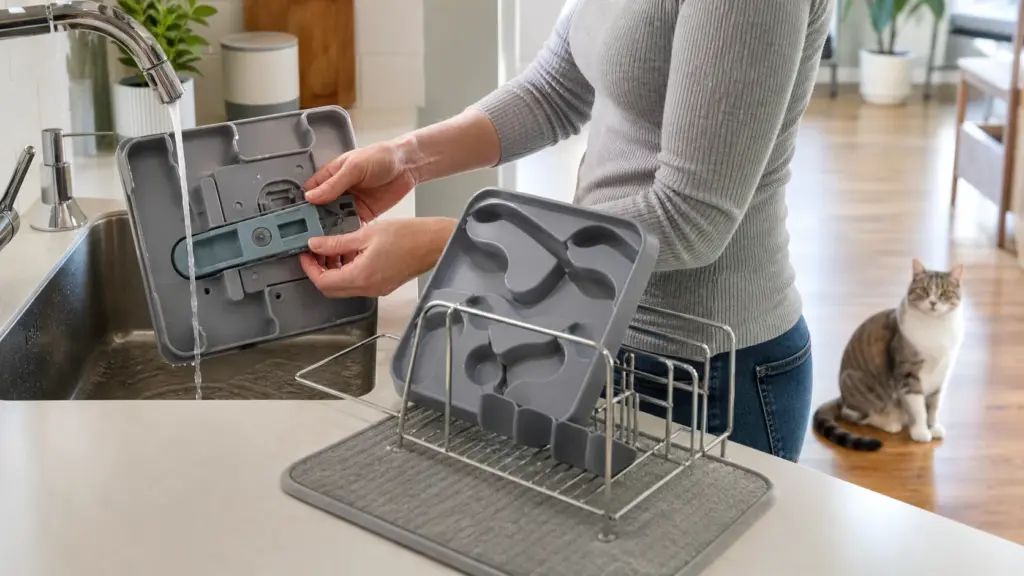
Before and after use, check the entire feeder rather than only the visible eating surface.
- Confirm that food-contact areas are intact and reachable for washing.
- Follow the exact manufacturer’s hand-wash or dishwasher instructions.
- Separate removable parts only as directed and count them before reuse.
- Remove trapped food from seams, tubes, and the underside of covers.
- Let all pieces dry fully before reassembly or storage.
- Replace cracked, warped, torn, chewed, sticky, or missing components.
- Keep the feeder away from stairs, balcony gaps, recliners, cords, and appliances.
- Supervise the first uses and any session involving a new difficulty level.
- Store the feeder when unsupervised if the cat chews nonfood materials.
- Recheck the daily ration so puzzle food does not become extra calories.
Homemade puzzles require special caution. Cardboard may be suitable for brief supervised dry-food use when it remains intact, but tape, staples, string, elastic, sharp cut edges, plastic fragments, and small detachable pieces can be hazardous. Discard a homemade feeder as soon as it becomes damp, torn, or chewed.
Frequently Asked Questions
How long does it take to teach a cat to use a puzzle feeder?
Some cats retrieve food during the first session; others need days or weeks of easy repetition. Progress depends on the mechanism, food motivation, prior experience, confidence, mobility, and training setup. There is no required timeline. Stay at the easiest successful level and change the design if the cat repeatedly opts out.
Should I put my cat’s whole meal in the puzzle?
Not at first. Use a small part of a measured meal for training and provide the remainder in an accessible dish. Increase the puzzle portion only after the cat completes it predictably and maintains normal total intake.
Can I use treats instead of normal food?
You can use a few familiar treats to introduce the mechanism, but count them within the daily calorie plan. For regular use, part of the cat’s complete and balanced food is usually easier to account for than adding frequent extras.
Do puzzle feeders help cats lose weight?
A puzzle may slow access or add feeding-related activity, but it does not create weight loss unless total calorie intake is appropriate. Weight plans should be individualized with a veterinarian, and cats should not undergo abrupt food restriction.
Is it okay if my cat never likes puzzle feeders?
Yes. Puzzle feeders are one enrichment option, not a requirement. Interactive play, climbing, scratching, scent exploration, window viewing, and hidden conventional food portions can support enrichment in other ways. Choose activities the individual cat can use safely and willingly.
Should I leave a puzzle feeder out while I am away?
Only after you have observed repeated safe use and the manufacturer permits unsupervised use. Do not leave out a feeder the cat chews, dismantles, flips dangerously, or pushes into inaccessible areas. Wet food also has time and temperature limits.
Final Takeaway
The safest way to teach a cat to use a puzzle feeder is to make the first experience easy enough to succeed immediately. Use familiar measured food, expose most rewards, stabilize the feeder, and ask for only one simple action. Repeat that setup until the cat approaches calmly, then increase one difficulty variable at a time.
If your cat walks away, bites the feeder, cannot physically reach the food, or stops eating, reduce the challenge or switch designs. A simple puzzle used willingly is better than a complicated one that creates frustration. Keep reliable food access, portion control, cleaning, and the cat’s individual health needs ahead of difficulty.
References
- Dantas LMS, Delgado MM, Johnson I, Buffington CAT. Food puzzles for cats: Feeding for physical and emotional wellbeing. Journal of Feline Medicine and Surgery. 2016;18(9):723–732.
- Feline Veterinary Medical Association. Feline Feeding Programs: Addressing Behavioral Needs to Improve Feline Health and Wellbeing. 2018.
- Delgado MM, Han BS, Bain MJ. Domestic cats prefer freely available food over food that requires effort. Animal Cognition. 2022;25:465–478.
- Ellis SLH, Rodan I, Carney HC, et al. AAFP and ISFM Feline Environmental Needs Guidelines. Journal of Feline Medicine and Surgery. 2013;15:219–230.