Is my cat overweight? The safest home check combines body condition with weight trends rather than relying on a single number on the scale. Look for ribs that are easy to feel beneath a light fat covering, a visible waist behind the ribs when viewed from above, and only a small abdominal fat pad from the side. Long hair, a large body frame, a primordial pouch, and age-related muscle loss can make appearance alone misleading.
A home check cannot diagnose obesity or establish a safe calorie target. Ask your veterinarian to assess both body condition and muscle condition, especially if your cat’s weight or shape changed quickly, movement or grooming declined, or appetite, thirst, urination, vomiting, or energy also changed. Do not sharply restrict food, because cats that stop eating or lose weight too rapidly can become seriously ill.
This guide explains five low-stress checks you can perform at home and shows when veterinary evaluation should come first.
Quick Answer
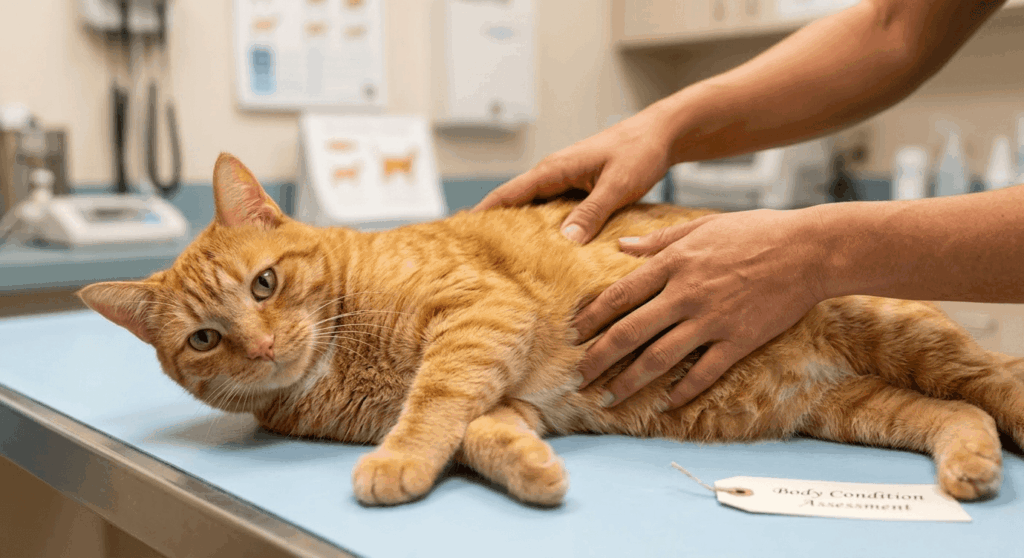
Your cat may be overweight if the ribs are difficult to feel beneath the fat covering, the waist is difficult to see from above, and the abdominal fat pad is more obvious from the side. Weight trends can support the assessment, but no single body weight proves that a cat is overweight because frame size and muscle condition vary.
Movement and grooming changes can occur with excess weight, but they can also reflect arthritis, pain, or illness. Ask your veterinarian to confirm your cat’s body condition score, muscle condition score, ideal weight, and calorie plan before beginning weight loss. If your cat is eating much less or has stopped eating, contact a veterinarian promptly rather than continuing a diet change at home.
Important Veterinary Note
This article explains home observation only. It cannot confirm obesity, diagnose the cause of a body-shape change, or provide an individual calorie prescription.
Contact your veterinarian promptly if weight or body shape changes quickly; the abdomen becomes swollen, firm, or painful; your cat eats much less or stops eating; or the change occurs with vomiting, weakness, breathing difficulty, increased thirst or urination, pain, or reduced mobility. These signs should not be managed as a routine weight problem at home.
Indoor Cat Expert articles are created by the Indoor Cat Expert Editorial Team and follow our Editorial Policy.
Table of Contents
5 Safe Ways to Tell at Home
Check 1: Feel the Ribs
With your cat standing or resting comfortably, place your fingertips gently over both sides of the rib cage. At an ideal body condition, the ribs should be easy to feel beneath a slight fat covering without pressing firmly. Ribs that are difficult to feel may indicate excess fat, while very prominent ribs can indicate low body fat or muscle loss.
Keep the check brief and stop if your cat becomes tense or tries to leave. Do not squeeze the chest or force handling. A veterinarian should confirm the finding with a full body condition and muscle condition assessment.
Check 2: Look for a Waist From Above
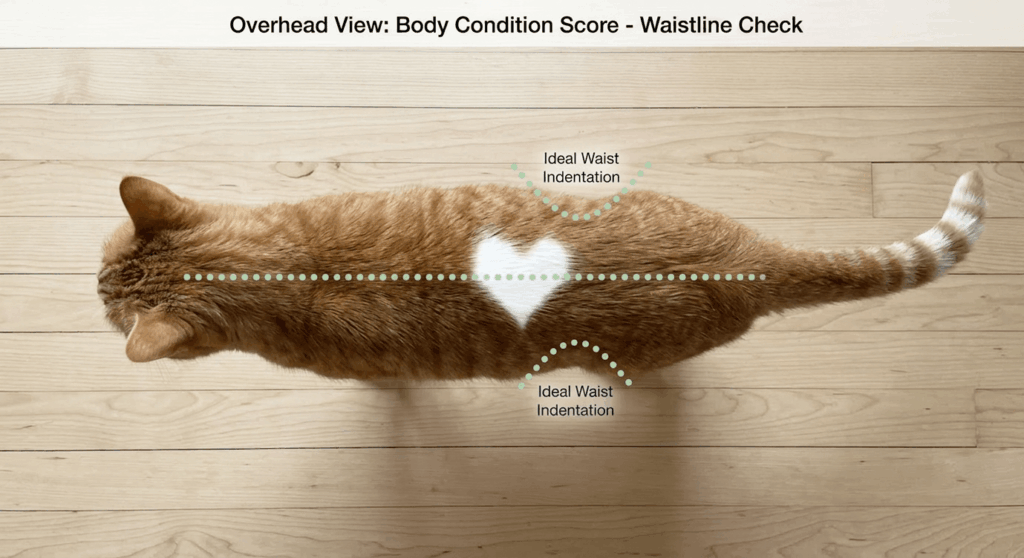
Stand above your cat and look down while they are standing. A healthy cat usually has a slight waist behind the ribs before the hips. The shape should not be dramatically hourglass, but there should be some narrowing.
An overweight cat may look more oval or rectangular from above, with little visible waist. The sides may curve outward instead of narrowing.
Long fur can make this harder. If your cat is fluffy, rely more on touch and weight trends than appearance alone.
Check 3: Check the Belly Shape
Look at your cat from the side. Many cats have a small loose skin flap under the belly called a primordial pouch. This is normal and does not automatically mean the cat is overweight.
The question is whether the belly looks heavy, round, or filled with fat. A normal pouch moves loosely and may swing slightly. Extra belly fat feels fuller and heavier.
If your cat’s belly is suddenly swollen, firm, painful, or changed quickly, contact your veterinarian. Sudden abdominal changes are not a normal weight issue.
Check 4: Watch Movement and Grooming
Weight affects daily behavior. An overweight cat may still seem happy, but movement can become harder.
Watch for signs such as:
- reduced jumping
- hesitation before climbing
- sleeping more
- less play
- difficulty grooming the back or rear
- matted fur
- less interest in chasing toys
- avoiding high resting spots
- heavy landing after jumps
These signs do not prove obesity by themselves. Arthritis, pain, age, dental disease, stress, and illness can also change movement. But if these signs appear with a rounded body shape and rising weight, extra weight may be part of the problem.
Check 5: Track Weight Trends
One weigh-in is useful, but trends are better. If your cat slowly gains weight over several months, the feeding routine may be providing more calories than your cat burns.
You can track weight by:
- using a pet scale
- weighing yourself, then weighing yourself holding the cat
- checking weight at vet visits
- writing down monthly body condition notes
Small changes matter because cats are small animals. A pound of weight gain can be significant for a cat.
Do not panic over a tiny fluctuation. Look for patterns.
At-Home Cat Weight Check Checklist
Use the same checklist at consistent intervals so changes are easier to compare. Record the date, weight if available, rib feel, waist shape, abdominal profile, movement, and grooming. Bring the record to veterinary visits, especially if you notice a steady upward trend or a sudden change.
| Check | What You Want to See | Possible Overweight Clue |
|---|---|---|
| Ribs | Easy to feel with light pressure | Hard to find without pressing |
| Waist | Slight narrowing behind ribs | Oval or blocky shape from above |
| Belly | Loose pouch may be present but not heavy | Round, full, or heavy belly |
| Movement | Jumps, climbs, turns, and plays normally | Hesitates, avoids jumping, tires quickly |
| Grooming | Reaches back and rear comfortably | Greasy coat, mats, missed grooming |
| Weight trend | Stable over time | Slow upward trend over months |
Do not turn the check into a stressful handling session. If your cat dislikes being touched, break the check into small moments: ribs during petting, waist from above while walking, movement during play, and weight during a calm routine.
Body Condition Score Explained
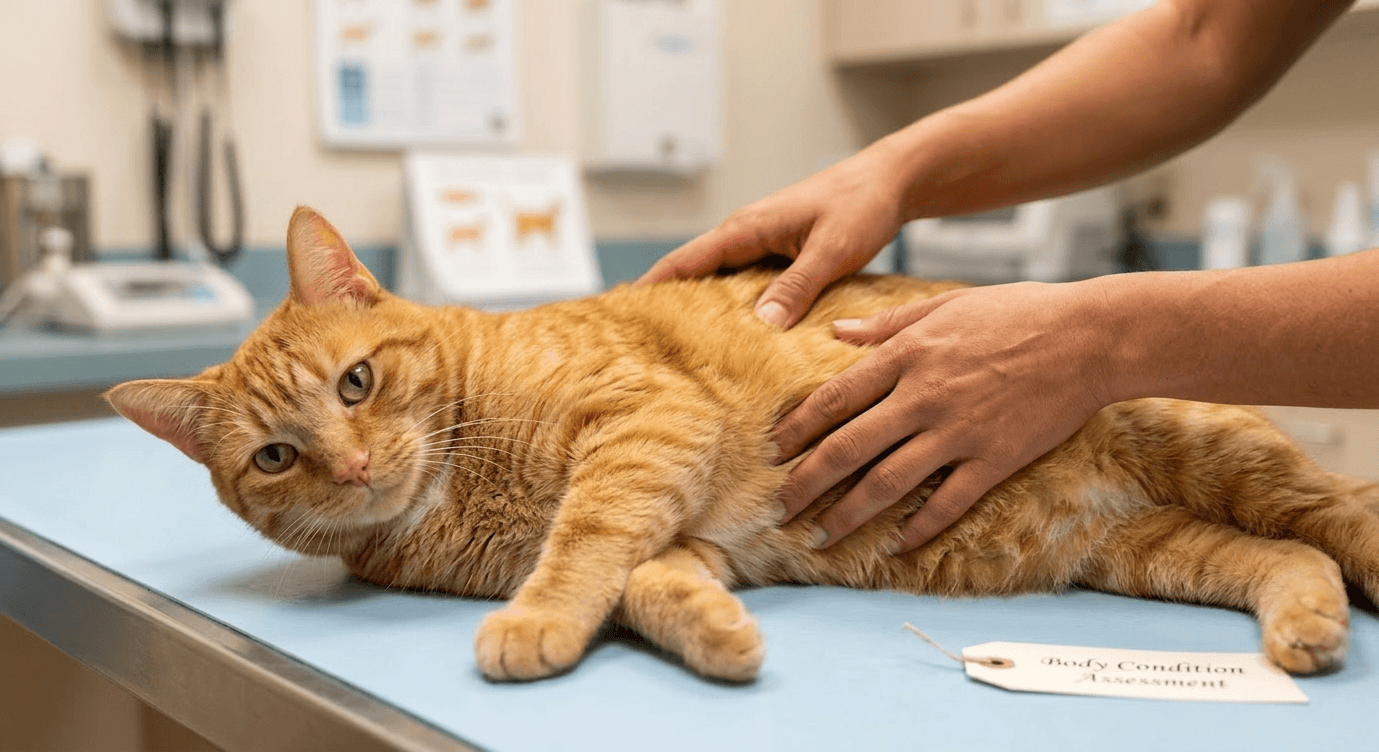
Veterinary teams commonly use a nine-point Body Condition Score, or BCS, together with a separate Muscle Condition Score, or MCS. BCS estimates fat cover, while MCS helps identify muscle loss that body weight alone can hide.
| Score | General interpretation | Typical findings |
|---|---|---|
| 1–3/9 | Under ideal | Ribs, spine, or pelvic bones may be prominent, with little fat covering and a marked waist or abdominal tuck. |
| 4–5/9 | Ideal range | Ribs are easy to feel with slight fat covering, a waist is visible behind the ribs, and the abdominal fat pad is minimal. |
| 6–7/9 | Overweight | Ribs are harder to feel, the waist is less obvious, and abdominal fat is more noticeable. |
| 8–9/9 | Obese | Ribs may be very difficult to feel, the waist may be absent, and fat deposits or a large abdominal fat pad are obvious. |
Do not assign a score from appearance alone when a cat has long hair, a large frame, age-related muscle loss, fluid accumulation, pregnancy, or a recent body-shape change. Ask your veterinarian to record both BCS and MCS and to explain the findings for your individual cat.
If your cat may be overweight, connect the assessment with measured food, treats, feeding access, activity, and veterinary care. Our feeding and weight control hub organizes these related topics.
Why Some Cats Are Hard to Judge
Some cats are genuinely hard to assess at home. Coat length, body frame, muscle loss, age, and posture can all change how weight looks.
Long-Haired Cats
Long-haired cats can look larger than they are. A fluffy coat may hide a lean body or make a healthy cat look overweight. For these cats, touch matters more than appearance. Feel for ribs, waist, spine, and hip coverage gently.
Large-Framed Cats
Some cats are naturally large. A large-framed cat may weigh more than an average cat without being overweight. This is why asking “is 10 pounds overweight?” or “is 12 pounds overweight?” does not work without body condition.
Senior Cats
Senior cats can lose muscle while still carrying belly fat. This can make them look heavy while their back and hips feel thin. If an older cat’s body shape changes, ask your veterinarian to check both weight and muscle condition.
Cats With a Primordial Pouch
A loose belly pouch can be normal. It may swing when the cat walks and does not always mean fat. The important question is whether the whole body shows extra fat: ribs hard to feel, waist missing, and movement reduced.
Recently Neutered Cats
Some cats gain weight after spaying or neutering because calorie needs can change. This does not mean weight gain is inevitable, but it does mean portions should be watched carefully after surgery and after kitten growth slows.
When to Call Your Veterinarian About Weight Changes
Arrange a veterinary assessment before treating a body-shape change as a simple feeding problem when:
- weight gain or loss is rapid or unexplained;
- the abdomen becomes swollen, firm, or painful;
- your cat eats much less, stops eating, or vomits repeatedly;
- thirst or urination increases;
- movement, jumping, grooming, or breathing changes;
- your cat seems weak, painful, or unusually lethargic;
- an older cat loses muscle over the back or hips while the abdomen still looks large; or
- your cat has diabetes, kidney disease, urinary disease, arthritis, or another condition that affects feeding or mobility.
A veterinarian can distinguish excess body fat from muscle loss, pain, fluid accumulation, or another medical problem. The veterinary team can also establish a target weight, choose an appropriate diet, and plan safe monitoring. If your cat stops eating, do not wait for a scheduled weight check.
What to Do If Your Cat Is Overweight
If your cat appears overweight, begin with a veterinary assessment rather than sharply cutting the current food. Ask the veterinary team to confirm body condition, muscle condition, current weight, target weight, and any health or mobility limitations.
Prepare a complete diet history that includes every dry and wet food, treats, toppers, supplements, table food, food used in puzzles, and food taken from other pets. Photograph the food labels and record the amount offered and the amount left behind. In a multi-cat home, note which cat can reach each bowl.
Once your veterinarian provides a plan, measure food by grams when possible and count all treats within the daily allowance. Do not reduce a maintenance food to a very small portion without guidance, because a weight-loss plan still needs to provide complete nutrition. Your veterinarian may recommend a diet formulated for weight management.
If you are comparing wet foods after receiving a calorie target, use our low calorie cat wet food label guide to check calories per container, calorie density, and the nutritional adequacy statement.
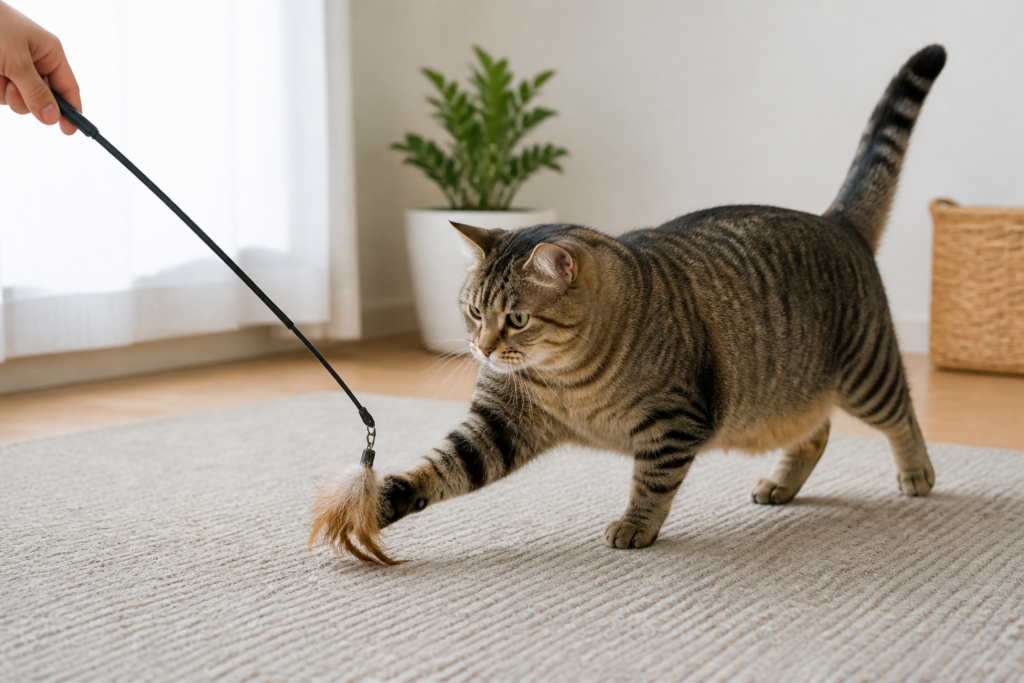
Add activity gradually and match it to your cat’s mobility. Short floor-level play, food puzzles, and multiple brief sessions may be safer than demanding high jumps from a cat that is heavy, painful, or deconditioned. Stop and contact your veterinarian if activity causes breathing difficulty, pain, weakness, or a marked decline in movement.
Weight checks work best when they connect to feeding portions, activity, veterinary care, and long-term prevention. For the full routine, see our indoor cat health prevention guide and our apartment cat feeding and weight control guide. For detailed portion planning, use our how much to feed an indoor cat guide.
What to Record Before the Vet Visit
Record several typical days of feeding and activity before the appointment. The goal is to show your veterinarian what your cat actually receives without delaying care when weight, appetite, or health changes suddenly.
Track:
- current food brand and flavor
- dry food amount per day
- wet food amount per day
- treats per day
- lickable treats
- table scraps
- who feeds the cat
- whether food is left out all day
- whether another pet shares food
- play time
- weight if available
- body condition notes
- stool and vomiting patterns
- calories per serving from each food label
Bring the record, food-label photos, current medications, and any recent weight measurements to the appointment. Do not make several major diet changes at once unless your veterinarian recommends them, because multiple simultaneous changes make intake and response harder to evaluate.
Common Mistakes When Judging Cat Weight
Mistake 1: Using Weight Alone
Weight is useful, but it is incomplete. Body frame, muscle, age, and shape matter. A large cat is not automatically overweight, and a smaller cat is not automatically lean.
Mistake 2: Calling the Belly Pouch “Fat” Every Time
The primordial pouch is normal. It is loose skin, not always fat. Look at ribs, waist, movement, and overall body condition before judging.
Mistake 3: Ignoring Slow Weight Gain
Gradual weight gain can be difficult to see from day to day. Consistent weight and body condition records help reveal a trend before appearance alone makes the change obvious.
Mistake 4: Assuming Begging Means Hunger
Begging does not establish how many calories a cat needs. Learned routines, attention seeking, feeding competition, and meal timing can influence food-seeking behavior. Use measured intake and veterinary guidance rather than begging alone to set portions.
Mistake 5: Starting a Crash Diet
Do not sharply restrict food or allow an overweight cat to stop eating. Rapid or poorly planned weight loss can be dangerous, and inadequate intake can contribute to hepatic lipidosis. Use a veterinary calorie target, an appropriate diet, and scheduled monitoring.
Mistake 6: Forgetting Multi-Cat Food Access
In multi-cat homes, one cat may eat more than their share while another eats less. Shared bowls can hide the real intake.
Simple Weight and Body Condition Log
A consistent log can show whether weight, body condition, movement, or grooming is changing. Use the schedule recommended by your veterinarian and measure under similar conditions when possible.
| Date | Weight and unit | Rib check | Waist check | Movement and grooming | Food or health notes |
|---|---|---|---|---|---|
| Easy / harder to feel | Visible / less visible | Normal / reduced | |||
| Easy / harder to feel | Visible / less visible | Normal / reduced | |||
| Easy / harder to feel | Visible / less visible | Normal / reduced |
Useful notes include food changes, treat changes, reduced activity, new medication, illness, moving homes, new pets, or changes in who feeds the cat.
Contact your veterinarian when the record shows a consistent upward trend, a rapid change, loss of muscle, reduced mobility, or a change in appetite or general health.
Frequently Asked Questions
1. How do I know if my cat is overweight?
Check whether you can feel the ribs with light pressure, see a waist from above, and notice normal movement and grooming. If the ribs are hard to feel, the waist is missing, the belly is heavy, and weight is rising, your cat may be overweight.
For the safest answer, ask your veterinarian for a body condition score and target weight.
2. Is 10 pounds overweight for a cat?
Not always. A 10-pound cat may be healthy, overweight, or even underweight depending on body frame, muscle, breed mix, and body condition. A small-framed 10-pound cat may be overweight, while a large-framed 10-pound cat may be lean.
Body condition matters more than the number alone.
3. Is my cat fat or just fluffy?
Long fur can make visual assessment unreliable. Gently feel the ribs and look for a waist behind the ribs, but do not rely on touch alone if you are uncertain. Ask your veterinarian to confirm body condition and muscle condition, particularly if your cat’s weight or shape has changed.
4. Is a hanging belly normal in cats?
A loose hanging flap called a primordial pouch can be normal. It does not automatically mean your cat is overweight.
However, if the belly feels heavy and full, the waist is missing, and the ribs are difficult to feel, extra fat may also be present.
5. How fast should an overweight cat lose weight?
The safe rate depends on the cat’s starting condition, health, diet, and veterinary plan. Do not use a generic internet target or sharply reduce food. Your veterinarian should set the calorie allowance and monitoring schedule. Contact the clinic promptly if your cat eats much less or stops eating.
6. Why is my indoor cat gaining weight?
Weight gain occurs when calorie intake repeatedly exceeds energy use, but the reasons vary. Free-choice feeding, treats, food from several people or pets, lower activity, age, neuter status, pain, and medical conditions can all affect the pattern. Do not assume that dry food alone is the cause.
For a deeper cause-by-cause breakdown, read our guide: Why Is My Indoor Cat Getting Fat?
7. What should I do if my cat is overweight?
Start by measuring food, counting treats, tracking weight, and asking your veterinarian for a target if your cat needs weight loss. Do not suddenly cut food.
For a step-by-step plan, use our guide: Help Indoor Cat Lose Weight
8. When should I call a vet about my cat’s weight?
Call your veterinarian if your cat gains weight quickly, loses weight unexpectedly, drinks more, urinates more, vomits, stops eating, becomes weak, has a swollen belly, or has reduced mobility.
Also call if your cat is obese or needs a structured weight loss plan.
Final Thoughts
If you are asking “is my cat overweight?”, use body condition and weight trends together rather than relying on the scale or appearance alone. Check rib feel, waist shape, abdominal profile, movement, grooming, and changes over time.
Home observations are useful for noticing a possible problem, but a veterinarian should confirm body condition, muscle condition, target weight, diet, and monitoring schedule. Do not crash diet, and contact the clinic promptly if your cat eats much less, stops eating, or develops a rapid body-shape or health change.
A measured, individualized plan protects nutrition while supporting safer movement and gradual progress.
References
- American Animal Hospital Association. 2021 AAHA Nutrition and Weight Management Guidelines for Dogs and Cats. https://www.aaha.org/resources/2021-aaha-nutrition-and-weight-management-guidelines/home/
- American Animal Hospital Association and American Association of Feline Practitioners. Nutrition and Weight: Young Adult Cats. https://www.aaha.org/resources/2021-aaha-aafp-feline-life-stage-guidelines/nutrition-and-weight-young-adult-cats/
- World Small Animal Veterinary Association. Body Condition Score Chart for Cats. https://wsava.org/wp-content/uploads/2020/08/Body-Condition-Score-cat-updated-August-2020.pdf
- Cornell Feline Health Center. Feeding Your Cat. https://www.vet.cornell.edu/departments-centers-and-institutes/cornell-feline-health-center/health-information/feline-health-topics/feeding-your-cat
- Cornell Feline Health Center. Obesity. https://www.vet.cornell.edu/departments-centers-and-institutes/cornell-feline-health-center/health-information/feline-health-topics/obesity