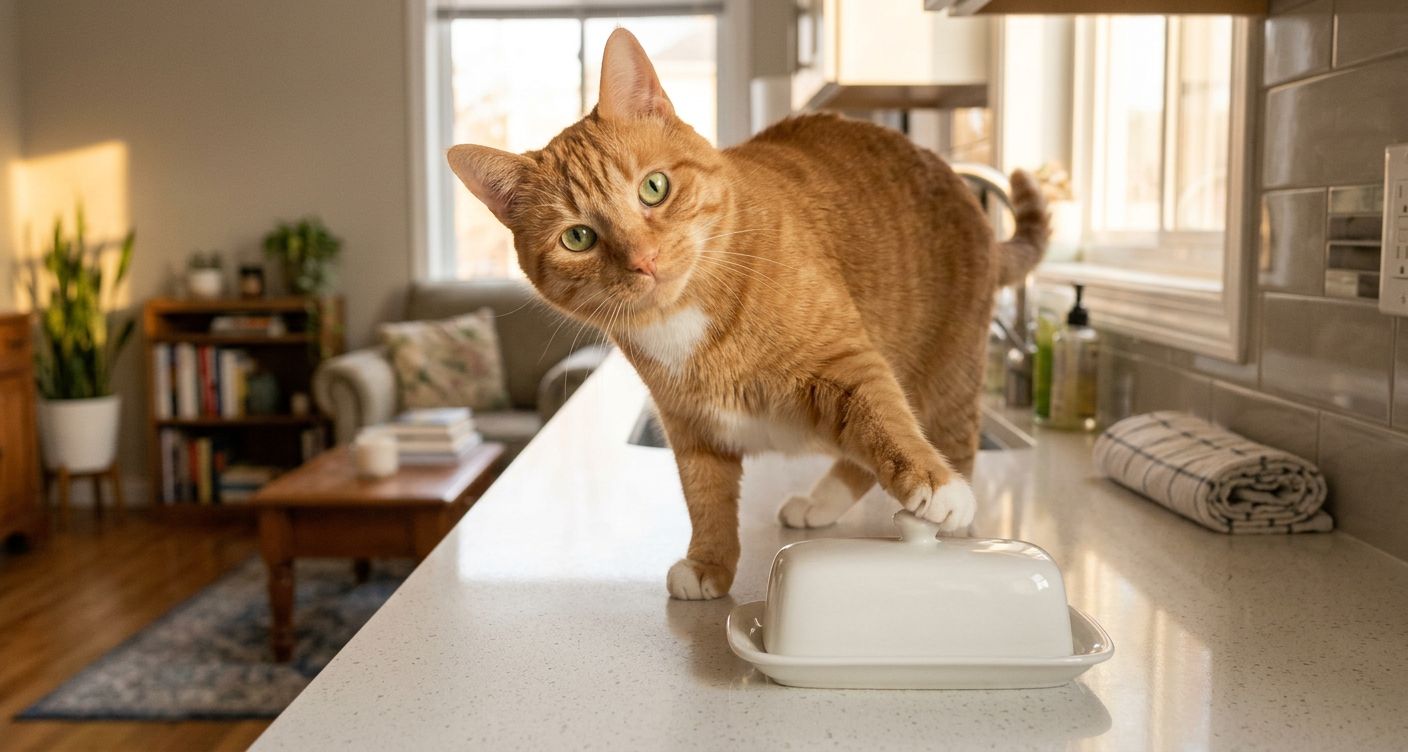
To keep a cat off kitchen counters, remove accessible food, provide a safe nearby perch that cannot be used to jump back onto the counter, and reward your cat for using that alternative. Counter access may be rewarding because of food, proximity to people, or a better vantage point. Avoid spraying, shouting, or startling your cat; first manage immediate hazards such as a hot stove or knives.
Watch when and why the jumping happens, then adjust one part of the setup at a time. If the behavior changes suddenly or comes with appetite, thirst, weight, mobility, vomiting, urinary, or other health changes, ask your veterinarian before treating it as only a training problem.
Quick Answer
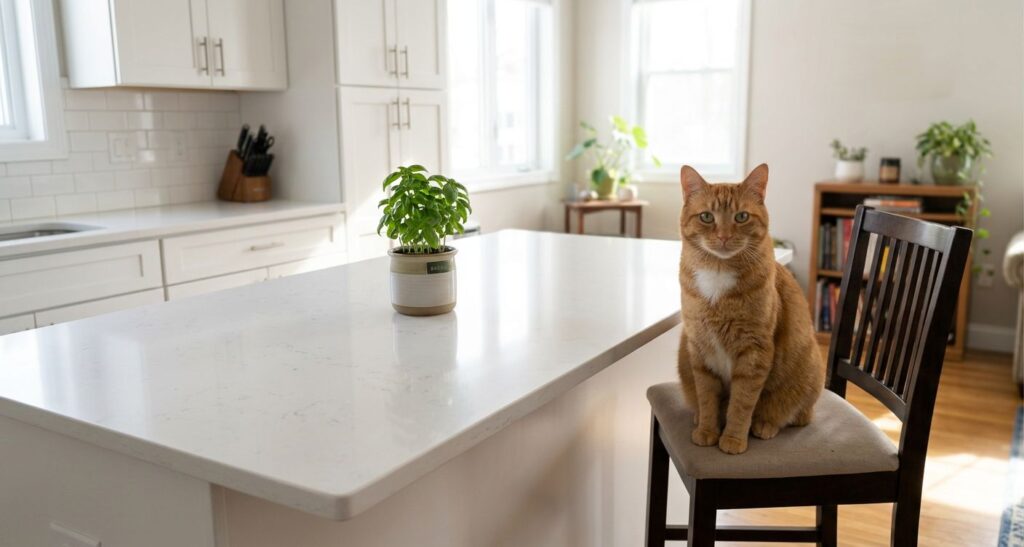
To keep a cat off counters, remove the reward, block food smells, provide a legal high place nearby, make the counter boring, and reward the alternative spot every day. Do not punish, spray, yell, or scare your cat. Those methods can create fear and may only teach the cat to jump up when you are not watching.
Most counter jumping happens because the counter offers something useful: food crumbs, water, attention, height, a window view, warmth, or a safe escape route. The best fix is not one deterrent. It is a system: clean the counter, remove access to food, offer a better perch, and keep the response consistent.
Important Kitchen Safety Note
Kitchen counters can expose cats to hot stoves, knives, glass, cleaning residues, toxic foods, raw dough, onions, garlic, chocolate, caffeine, and unsafe cookware. If your cat jumps near the stove, secure the area immediately and never leave hot burners, sharp tools, or food prep unattended.
Avoid harsh deterrents such as spraying water, shouting, shock mats, or frightening devices. These can increase stress and may damage trust. Use safe management, redirection, and environmental changes instead.
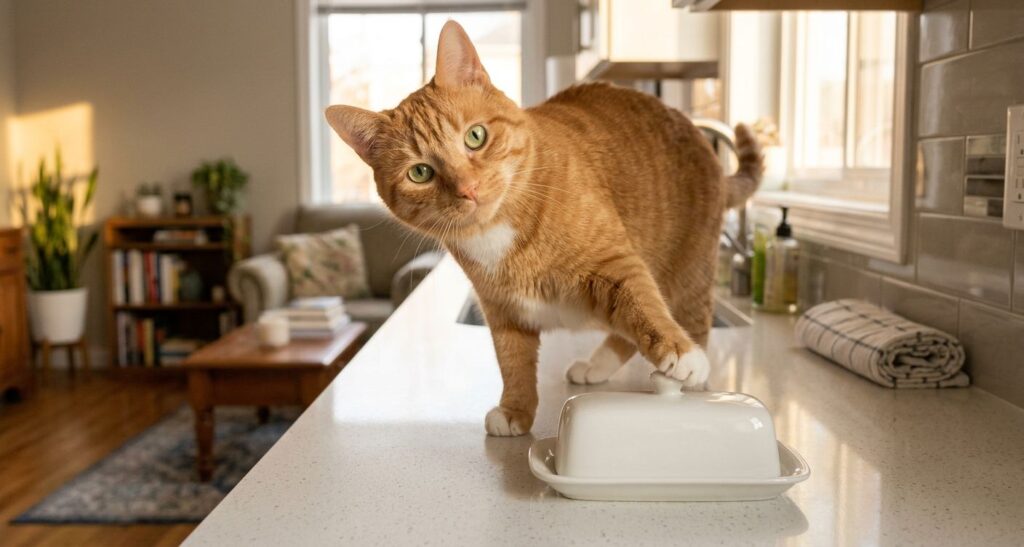
Table of Contents
Why Cats Jump on Kitchen Counters
Cats jump on counters because counters work. They are high, interesting, smell like food, and often get a human reaction. In a small apartment, the kitchen may also be close to the living room, dining area, window, or feeding station, which makes counter access part of the cat’s daily route.
Common rewards include:
- food crumbs
- dirty dishes
- running water
- attention
- high vantage point
- view from a window
- warmth from appliances
- escape from another pet
- curiosity during cooking
- access to plants or packaging
The key question is not “How do I stop the cat?” The better question is “What is the counter giving my cat that the rest of the apartment is not?”
Why Counter Jumping Is Harder in Apartments
In some apartments, the kitchen shares space with living or dining areas, so a cat may pass the counter many times a day. Notice whether food, a window view, or a route through the room makes that particular counter attractive.
If there are few safe high places such as a cat tree, shelf, or window perch, the counter may be an appealing vantage point. A nearby stable perch can give your cat a place to watch activity without entering the food-preparation area.
Food or trash smells may remain accessible near a kitchen even when the counter looks clear. Check dishes, containers, appliance edges, and nearby trash for rewards your cat could still reach.
That is why the solution has to be practical. You are not just teaching “no.” You are changing the kitchen so the counter stops being rewarding and the cat has a better legal option nearby.
7-Step Plan to Keep Cat Off Counters
Step 1: Remove Food Rewards Completely
Food is the strongest counter reward. Even one crumb, plate, butter wrapper, meat smell, or dirty pan can teach your cat that counters are worth checking.
Start by changing the kitchen routine:
- wipe counters after food prep
- put dishes in the sink or dishwasher
- store bread, snacks, and pet food away
- do not leave butter, meat, fish, or dairy out
- secure trash
- avoid feeding treats from the counter
- clean under appliances and cutting boards
If your cat has found food on the counter before, the learned habit may continue for a while. Track whether counter visits become less frequent instead of expecting a fixed timeline.
Step 2: Clean Scent Cues, Not Just Visible Mess
Cats may investigate food smells even when the counter looks clean. After food prep, choose a cleaner suitable for the surface, follow its label, and keep your cat away until any required rinsing is complete and the surface is dry. Do not use essential oils as a cat deterrent.
Focus on:
- cutting board area
- stove edges
- sink area
- trash area
- food prep corners
- small appliance bases
- places where crumbs fall
A clean counter should be boring. If the counter smells like yesterday’s chicken, fish, or butter, your cat has a reason to return.
Safe Cleaning Routine for Cat Counter Training
A clean counter should not smell like food, but it also should not smell like a chemical warning zone. Cats walk on surfaces, lick their paws, and groom after contact, so residue matters.
After cooking, remove food scraps, then clean the surface according to the product and countertop instructions. Rinse when directed and let the surface dry before your cat can reach it. Store the cleaner and used cloths out of reach.
Pay extra attention to invisible reward spots:
- the edge of the counter where food is prepared
- the area beside the sink
- the toaster or appliance base
- cutting board storage areas
- trash can lid and rim
- places where bread, meat, fish, dairy, or butter were handled
- the floor directly below the counter
Do not apply essential oils or startling scents to repel your cat. Cleaning products vary by formulation: follow the label, avoid access to wet or concentrated cleaner, and ask your veterinarian or the manufacturer if a product’s use around cats is unclear.
Step 3: Add a Legal High Place Nearby
Many cats jump on counters because the kitchen is the most interesting place in the apartment. If you only remove the counter without offering another vantage point, the cat may keep testing it.
Keep the alternative perch away from temporary hazards and objects it could turn into a launch point. During the holidays, follow our Christmas tree safety guide for cats before placing a tree near a counter, shelf, sofa, or perch.
Give your cat a legal place that satisfies the same need:
- cat tree near the kitchen entrance
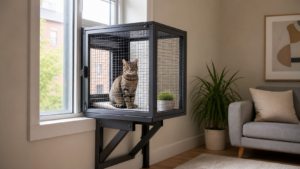
- window perch
- wall shelf
- stool or bench outside the food prep zone
- mat on a safe observation spot
- perch near but not on the counter
Reward your cat for using this spot while you cook or clean. The legal perch should let the cat watch without being in danger.
For vertical options, see our cat wall shelves guide or a cat window perch apartment setup.
How to Make the Legal Perch More Rewarding Than the Counter
A legal perch only works if your cat sees it as valuable. Simply buying a cat tree and placing it across the room may not compete with the kitchen counter.
Put the alternative near the action. If your cat jumps up while you cook, place the perch near the kitchen entrance or beside the dining area, not in a lonely corner. Your cat wants access to height, observation, and human activity.
Reward the perch before the counter happens. If your cat is already on the counter, you are reacting late. Instead, place a treat, toy, or attention on the legal perch before food prep begins. Over time, your cat learns that the perch predicts good things.
Make the perch comfortable. Add traction, a washable mat, a familiar blanket, or a small raised bed. If the surface is slippery, unstable, too low, or too far from the interesting area, the counter may still win.
For multi-cat homes, make sure the perch is not blocked by another cat. A quiet cat may use the counter because another cat controls the cat tree, window, or food area.
Step 4: Stop Rewarding Counter Attention
Many cats learn that jumping on the counter makes humans talk, rush over, pick them up, feed them, or chase them. Even negative attention can become rewarding.
When safe, keep your response calm and boring. Guide the cat down, redirect to the legal perch, and reward the perch. Do not create a dramatic event.
If the counter is unsafe because of heat, knives, or food, block access before cooking rather than waiting to react. Use closed doors, baby gates, temporary barriers, or a separate room during food prep if needed.
Step 5: Change Feeding Timing if Hunger Is Driving It
Some counter jumping is really food-seeking. If your cat jumps up before meals, while you cook, or early in the morning, review the feeding schedule.
If visits cluster around meals, review your cat’s existing feeding routine. Keep food off the counter and, if appropriate for the cat’s diet, offer part of the measured daily ration in a food puzzle away from food preparation. Do not increase the total ration or change a prescribed diet without veterinary advice.
If hunger patterns are part of the problem, review your indoor cat feeding schedule guide.
Food-Seeking vs. Curiosity: How to Tell the Difference
Not every counter jumper is hungry. Some cats are curious, some want attention, and some want height. But food-seeking has a pattern.
Food-driven counter jumping often happens:
- before meals
- while you cook
- after groceries are unpacked
- near the sink or stove
- around dirty dishes
- after you handle meat, fish, dairy, or butter
- early in the morning
- when the cat has learned food sometimes appears on the counter
Curiosity-driven jumping may happen even when the counter is clean. The cat may investigate objects, watch you, sit near a window, or use the counter as a route to another surface.
The fix depends on the motivation. A hungry cat needs better meal timing and food security. A curious cat needs a legal observation spot. A cat seeking attention needs calm redirection and rewards away from the counter.
If the reason is unclear, record counter attempts over several days: note the time, available food or objects, nearby people or pets, and what happened afterward. The record may reveal a pattern worth addressing.
Step 6: Use Safe Barriers When You Cannot Supervise
Training works best when the counter stops paying off. If your cat can explore the counter all night, they may keep finding small rewards.
Use safe management:
- clear counters before bed
- block access to dangerous zones
- cover the sink if needed
- store food and plants away
- keep dish towels, sponges, and wrappers out of reach
- close the kitchen if your layout allows it
Avoid adhesive traps, frightening devices, or unstable objects that could fall. The goal is to make the counter unavailable or boring, not scary.
If your cat is jumping up to chew herbs, flowers, or houseplants on the counter, solve the plant access problem directly with our guide on how to stop a cat from eating plants.
Step 7: Track Progress Without a Fixed Deadline
Counter habits do not disappear in one day. If your cat has been checking the counter for months, expect a transition period.
Track what happens:
- time of day
- what was on the counter
- whether food smell was present
- whether the cat used the legal perch
- how you responded
- whether the behavior happens when you are absent
If the behavior decreases in frequency, duration, or intensity, the plan is working. Keep going.
Counter Training Decision Table
| If Your Cat Wants… | Do This First | Avoid This |
|---|---|---|
| Food crumbs | Clean and store food completely | Leaving “just one plate” out |
| Height | Add a legal perch nearby | Removing height without replacement |
| Attention | Reward the floor or perch | Yelling or chasing |
| Water | Offer fresh water elsewhere | Letting sink access become the reward |
| Window view | Add a window perch | Blocking without enrichment |
| Escape from another pet | Create safe routes | Forcing shared spaces |
| Cooking curiosity | Give a pre-cooking routine | Reacting only after jumping |
Best Alternatives to Kitchen Counters
A good alternative should be close enough to satisfy curiosity but far enough to keep the cat out of food prep.
Good options include:
- window perch near the kitchen
- cat tree by the dining area
- wall shelf route
- stool with a washable mat
- feeding puzzle in another room
- cardboard box observation spot
- perch near the owner’s routine
The alternative must be rewarding. If the cat tree is in a boring corner and the counter has food smells, the counter will win.
Alternatives by Apartment Layout
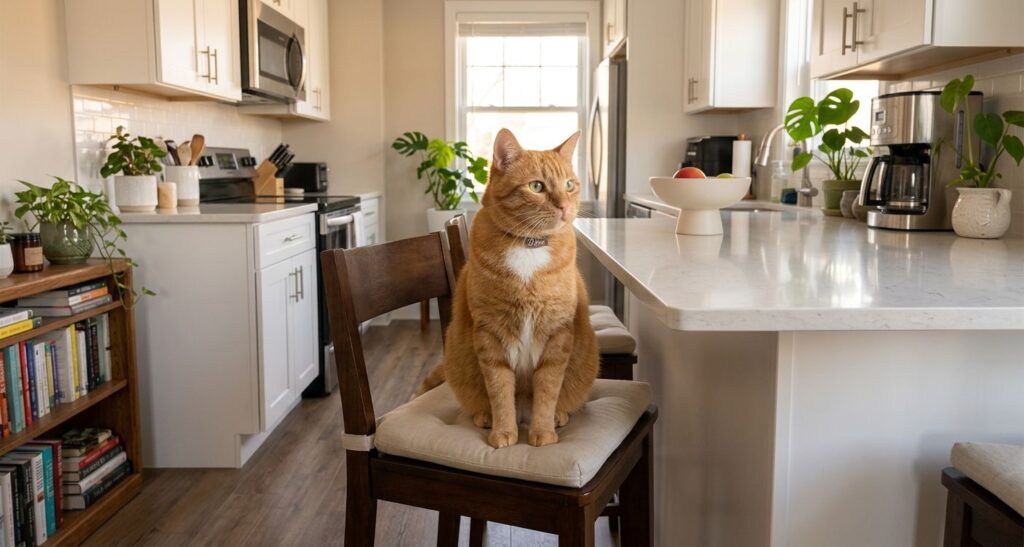
In a studio apartment, the legal perch should be close but not in the food prep zone. A window perch, shelf, or small cat tree near the kitchen edge can let your cat observe without stepping onto the counter.
In a one-bedroom apartment, use separation when needed. If cooking creates too much excitement, set up a comfortable observation spot just outside the kitchen and reward it before you start preparing food.
In a narrow galley kitchen, floor space may be limited. A wall shelf, stool, or doorway perch can help if it is stable and far enough from heat and knives. Avoid placing the alternative where you will trip over it while carrying hot food.
In a multi-cat apartment, counter jumping may be about access pressure. One cat may jump up to avoid another cat, reach food, or find a safe high route. In that case, the answer is not just counter training. The whole resource layout may need adjustment.
In renter apartments, avoid drilling unless allowed. Use existing furniture when possible: a sturdy bookcase, dining chair, window bench, or cat tree may work as the legal observation spot.
What Not to Do
Do not spray your cat with water. It may stop the behavior in front of you, but it can increase fear and does not teach the cat what to do instead.
Do not yell or chase. This can become attention or stress.
Do not use shock mats. They can create fear around the kitchen and may not address the reason the cat is jumping.
Do not leave food out “just this once.” Random rewards are powerful.
Do not assume the cat is being stubborn. The counter has a reward. Find it and remove it.
Common Mistakes
Mistake 1: Cleaning Only When Guests Come Over
If counters sometimes have food, the cat will keep checking. Clean every time food is prepared.
Mistake 2: Adding a Cat Tree Too Far Away
A legal perch has to compete with the counter. Put it near the action, not in a forgotten corner.
Mistake 3: Rewarding the Jump by Accident
Picking the cat up, talking dramatically, or feeding right after jumping can reinforce the behavior.
Mistake 4: Ignoring the Feeding Schedule
If counter visits cluster around meals, review the feeding routine and talk with your veterinarian about any sudden or unusually strong appetite change.
Mistake 5: Forgetting Nighttime Access
Many cats counter-surf when people sleep. Clear the kitchen before bed.
When Counter Jumping May Signal a Bigger Issue
Most counter jumping is normal curiosity, food-seeking, or height-seeking. But sudden changes deserve attention.
Call your veterinarian if counter jumping appears with:
- increased hunger
- weight loss
- increased thirst
- vomiting
- confusion
- sudden aggression
- weakness
- mobility changes
- unusual restlessness
- food stealing or frantic eating
A cat who suddenly becomes obsessed with food or water may need a health check.
7-Day Counter Setup Checklist
Use these seven days to set up and review the environment; this is not a promise that your cat will stop jumping within a week.
Day 1: Remove Obvious Rewards
Clear food, dishes, wrappers, bread bags, and trash access. Do not leave anything edible on the counter overnight.
Day 2: Deep Clean Scent Zones
Clean the food prep area, sink edge, stove edge, appliance bases, and trash area. Focus on scent, not just visible crumbs.
Day 3: Choose the Legal Perch
Pick one safe place near the kitchen where your cat is allowed to watch. Add traction or a washable mat.
Day 4: Reward Before Cooking
Before food prep begins, guide your cat to the legal perch and reward calm sitting or watching.
Day 5: Make the Counter Boring
If your cat jumps up and it is safe, calmly guide them down and redirect. Do not chase, yell, feed, or create a dramatic reaction.
Day 6: Review Night Access
Clear counters before bed. If your cat counter-surfs at night, block access or remove all possible rewards.
Day 7: Adjust One Thing
If the counter is still winning, ask why. Is there food smell? Is the perch too far away? Is another cat blocking the legal spot? Is the cat hungry? Adjust one variable, not everything at once.
How to Know the Training Is Working
Success does not always mean your cat never looks at the counter again. Early progress may be smaller.
Look for signs such as:
- fewer jumps per day
- shorter time on the counter
- more use of the legal perch
- less jumping during cooking
- less nighttime counter checking
- calmer behavior around food prep
- fewer attempts after counters are cleared
If your cat still jumps occasionally but responds more easily to redirection, the plan is moving in the right direction. Keep the routine consistent.
If repeated tracking shows no improvement, review whether food, water, attention, a view, or access pressure from another pet still makes the counter attractive. Ask your veterinarian or a qualified feline behavior professional for help if the cause remains unclear or the behavior is worsening.
Frequently Asked Questions
1. How long does it take to keep a cat off counters?
There is no reliable timetable for every cat. Track the number of jumps and use of the alternative perch, keep food inaccessible, and review the plan with your veterinarian or a qualified feline behavior professional if progress stalls.
2. Why does my cat jump on counters at night?
At night, a cat may find food, water, a view, or an easy route across the counter. Remove accessible rewards and hazards before bed; if needed, safely restrict access while providing food, water, litter, and resting space elsewhere.
3. Are kitchen counters dangerous for cats?
They can be. Hot stoves, knives, glass, cleaners, toxic foods, and raw ingredients can all create risk. Even if you tolerate counter sitting sometimes, food prep areas should be protected.
4. Should I use foil or tape to keep my cat off counters?
Do not rely on sticky tape, startling textures, or other aversive surfaces. Remove food rewards, offer a safe perch nearby that is not a launch point to the counter, and reward your cat for choosing it.
5. What if my cat ignores the cat tree?
Move the perch closer to the kitchen, reward it more clearly, and make sure it offers something useful: height, view, comfort, or attention.
6. Can I fix this without buying anything?
Often, yes. Clean food rewards, change feeding timing, close access during cooking, and reward a chair or existing perch. Buying a product only helps if it solves the actual reason your cat jumps.
Final Thoughts
To keep a cat off counters, make the counter boring and the alternative useful. Remove food rewards, clean scent cues, add a legal high place, stop rewarding dramatic attention, and stay consistent.
The goal is not to scare your cat away from the kitchen. The goal is to give your cat a safer routine that works even when you are not watching.
References
- FelineVMA. Training Techniques for Addressing Undesirable Behaviors. Specific guidance on cats getting on counters and positive reinforcement.
- ASPCA Animal Poison Control. People Foods to Avoid Feeding Your Pets. Relevant to Allium foods, chocolate, caffeine, and raw yeast dough.
- ASPCA Animal Poison Control. Pet Poisons: Household Products and Cleaning Agents. Cleaning-label, rinsing, drying, and essential-oil precautions.
- Cornell Feline Health Center. Hyperthyroidism in Cats. Signs that can include increased appetite, thirst, and weight loss.
- Cornell Feline Health Center. Feline Diabetes. Signs that can include weight loss despite appetite and increased thirst.
- Merck Veterinary Manual. Diagnosing Behavior Problems in Cats. Behavioral history and tracking changes over time.
- Herron ME, Buffington CAT. Environmental enrichment for indoor cats. Compend Contin Educ Vet. 2010;32(12):E4. General enrichment context, not a counter-training trial.
- Ellis SLH, et al. AAFP and ISFM feline environmental needs guidelines. J Feline Med Surg. 2013;15(3):219–230. doi:10.1177/1098612X13477537. General environmental needs, not a timed outcome study.