Introduction: The Morning the Kitchen Became a Warzone

The foster cat arrived on a Friday, and by Saturday morning my kitchen had become a complex diplomatic crisis that I was managing while still in my pajamas.

Her name was Noodle, she was four years old, she had survived what appeared to be a competitive multi-cat shelter environment, and she had developed the food acquisition strategy of a professional athlete: fast, aggressive, and completely indifferent to the feelings of anyone in her trajectory. Oliver, who had spent twelve years as an only cat, stood over his bowl for approximately three seconds before Noodle arrived, consumed his portion and hers, and then looked at him with an expression that communicated nothing resembling apology.

Understanding how to feed multiple cats separately became, in that moment, not a behavioral interest but a clinical emergency — because as a certified veterinary technician, I know exactly what the stress of Resource Scarcity during meals produces clinically. I have seen Feline Idiopathic Cystitis (FIC) presentations triggered by the chronic cortisol elevation of a cat who approaches every meal anticipating competition and potential food loss.

I have seen redirected aggression, house soiling, and behavioral deterioration that all trace back to a feeding environment that generates sustained territorial anxiety. How to feed multiple cats separately is not about convenience — it is about preventing the clinical cascade that food insecurity triggers in cats who did not evolve to share meals.

In a small apartment, separate feeding is not about having extra rooms; it is about using time, distance, height, visual barriers, and predictable routines so each cat can finish the right meal without pressure.


Quick Answer

To feed multiple cats separately in a small apartment, use scheduled meals, place bowls far apart, add visual barriers, and create short supervised feeding zones. If one cat steals food, eats a prescription diet, or needs weight control, a microchip feeder may be the most reliable way to protect each cat’s meal.

For the broader routine behind portions, schedules, wet food, feeders, and weight control, see our apartment cat feeding and weight control guide.

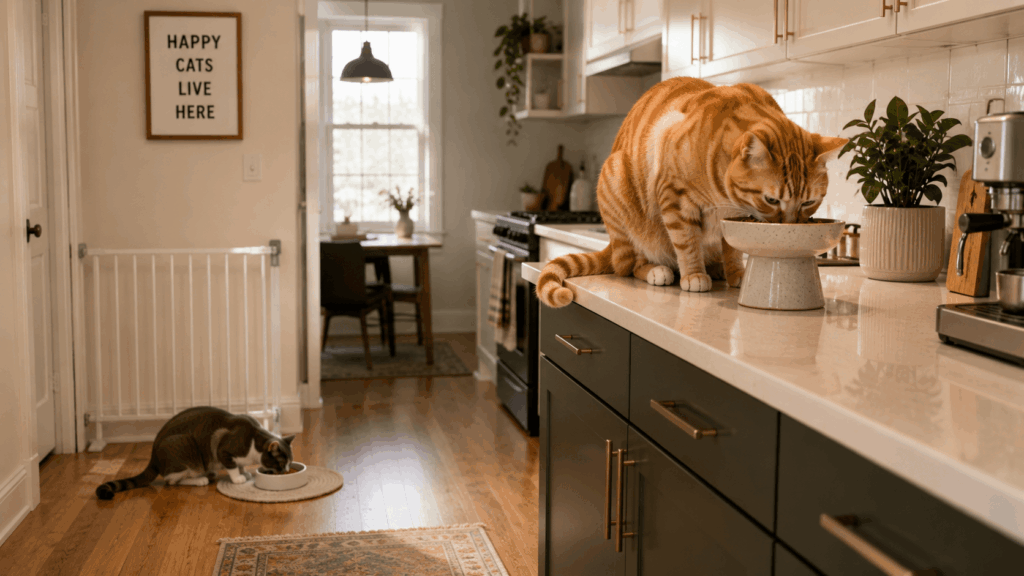
Oliver the orange tabby demonstrating how to feed multiple cats separately using vertical space

Separate feeding works best when the whole apartment is planned around safe resource access. For the full small-home setup, see our multi-cat apartment living guide.

Best Feeding Layouts for Small Apartments

A small apartment can still support separate feeding if you use time, height, and visual barriers instead of relying only on extra rooms.

Try these layouts:

  • One cat in the bathroom and one cat in the kitchen
  • One cat behind a folding screen and one cat near the main living area
  • One cat on a cat tree platform and one cat on the floor
  • One cat in a hallway feeding station and one cat in a bedroom
  • One cat using a microchip feeder while the other eats from a standard bowl

The goal is not perfect distance. The goal is reducing pressure enough that every cat can finish their own meal.

Separate feeding works best when the whole apartment supports it, not just the bowl area. For the full setup around feeding zones, litter access, resting spots, and resource pressure, see our multi-cat apartment living guide.

The Solitary Hunter Paradox: Why Communal Eating Is Stressful

The fundamental challenge of how to feed multiple cats separately is rooted in evolutionary biology that runs directly counter to the convenience of communal feeding.

The solitary hunter’s feeding ecology:
Domestic cats are descended from solitary hunters who consumed small, frequent prey meals alone — no sharing, no competition, no communal food source to defend or concede. The entire feline stress response system is calibrated for a feeding context where every meal is an individual achievement consumed in private. When we place two or more cats at adjacent feeding stations, we are imposing a communal feeding structure on a species whose nervous system does not have a “relaxed communal meal” behavioral category. ¹

The cortisol cost of meal competition:
Even low-level proximity competition — cats who are not overtly fighting but who are aware of another cat’s presence at an adjacent feeding station — produces measurable cortisol elevation that persists for hours after the meal. ¹ A cat who experiences this cortisol spike at every mealtime accumulates a chronic stress load that impairs immune function, increases susceptibility to stress-triggered illness (FIC, upper respiratory infections, dermatological conditions), and reduces overall behavioral stability.

The Resource Scarcity perception:
Cats assess food availability not by measuring it but by the social context surrounding it. A cat who approaches their bowl and observes another cat eating nearby registers this as Resource Scarcity — even if their bowl is full and unthreatened. The social signal of competition activates the stress response independently of actual food quantity. This is why how to feed multiple cats separately must address social perception, not just physical food access.

Resource guarding during meals is the primary driver of the inter-cat tension that disrupts the social harmony of a small apartment — the complete framework for managing resource guarding and multi-cat social dynamics is detailed in our resource guarding and multi-cat household guide.


5 Pro Secrets: How to Feed Multiple Cats Separately

Secret 1: The ‘Door-Closed’ Sanctuary (Temporal Separation)

The simplest and most reliably effective method for how to feed multiple cats separately in a small apartment is complete physical separation during the meal window — one cat in a room with the door closed, one cat in the remaining space.

Why closed-door separation works:
The closed door eliminates the social perception of competition entirely — the cat behind the door cannot see, smell (at the intensity of immediate proximity), or hear another cat consuming food. Their cortisol remains at baseline. Their eating behavior is relaxed and unhurried. They consume their complete portion without the stress-driven speed eating that accompanies competitive feeding environments.

The temporal separation protocol:

  1. Prepare both meals simultaneously — identical timing reduces the transition window during which one cat is eating and the other is not yet contained
  2. Place Cat A’s meal in the sanctuary space (bedroom, bathroom, any room with a door)
  3. Encourage Cat A to enter their meal space — use the meal itself as the lure rather than physical handling if possible
  4. Close the door completely
  5. Place Cat B’s meal in the primary feeding location
  6. Allow 20–25 minutes for relaxed eating — this is adequate time for most cats to complete their meal without rushing
  7. Retrieve Cat A’s bowl before opening the door — eliminating the meal stimulus before cats reunite prevents post-meal bowl investigation and secondary competition

The timing management:
Consistent meal timing converts this protocol from a daily management challenge into a routine both cats anticipate. Within one week of consistent implementation, most cats self-direct to their meal area at feeding time — Oliver now positions himself at the kitchen door and Noodle positions herself at the bedroom door at 7 AM and 6 PM with remarkable precision.

These techniques work best when integrated into a consistent, predictable indoor cat feeding schedule — the complete temporal structure for indoor cat meal timing is in our indoor cat feeding schedule guide .


Secret 2: Vertical Feeding (Using Countertops and Shelves)

Vertical feeding separation is the how to feed multiple cats separately strategy that leverages existing apartment architecture — and it is particularly effective when one cat is physically capable of elevation and one is not.

The behavioral principle:
Cats with access to elevated positions have a territorial and psychological advantage over cats at floor level — the elevated cat feels less threatened and less competitive, because height itself is a resource indicator of status security. By feeding the more anxious or threatened cat at elevation and the more confident food thief at floor level, you simultaneously use height to equalize the power dynamic and create physical separation without requiring any additional barriers.

The practical implementation:

  • Counter feeding: A cat who can jump to kitchen counter height has a feeding station that is physically inaccessible to floor-bound cats or cats who have been trained not to access counters
  • Cat tree platform feeding: Position a food bowl on a cat tree platform at 4–5 feet elevation — functional feeding station with complete line-of-sight separation from floor stations
  • Wall-mounted shelf feeding: A dedicated feeding shelf at 3–4 feet, sized for one cat, provides a permanent, furniture-integrated elevated station

The Territorial Anchor function:
An elevated feeding station becomes a Territorial Anchor — a specific location that the cat associates with resource access, safety, and positive feeding experience. A cat who has a reliable Territorial Anchor at elevation approaches mealtimes with reduced anxiety than a cat feeding at floor level in proximity to competitors.

The Oliver-Noodle vertical solution:
Oliver, being the established resident with higher elevation comfort, eats on the kitchen counter. Noodle eats on the floor mat at the kitchen’s far end. The physical separation is approximately 8 feet plus a full vertical dimension — sufficient that neither cat can directly access the other’s bowl without a deliberate cross-space journey that is observable and manageable.


Secret 3: The ‘Nose-to-Tail’ Geometry

The Nose-to-Tail positioning technique is the how to feed multiple cats separately approach for situations where physical separation is limited but simultaneous same-room feeding must occur — and it is based on specific research in feline social feeding behavior.

The behavioral science:
Cats in the same room can feed with reduced social tension when their orientation prevents direct eye contact between feeding cats. Direct eye contact during resource consumption is an agonistic signal — a potential challenge or assertion of competition. When cats are positioned nose-to-tail (facing away from each other at the same feeding area) or feeding with their backs to each other, the absence of frontal orientation reduces the social competition signal and allows simultaneous eating with lower cortisol activation than face-to-face or side-by-side positioning. ¹

The positioning protocol:

  • Position feeding stations at opposite ends of the same kitchen or feeding area — maximum available distance within the shared space
  • Orient both bowls against walls, so both cats face the wall while eating — their backs are to each other and to the room center
  • Ensure neither bowl position requires a cat to walk past the other cat’s feeding station to access their own food or to exit the feeding area

The minimum distance requirement:
Research in feline feeding behavior suggests that feeding stations must be a minimum of 3–4 feet apart to prevent social competition signaling between cats who are not bonded. For cats with active food guarding history (Noodle), I recommend minimum 6–8 feet — the distance at which most cats’ peripheral competitive awareness drops below the threshold for active stress response.

The Social Buffering element:
A physical object between feeding stations — even a non-barrier object like a chair leg, a low table, or a piece of furniture — provides Social Buffering that reduces competitive tension beyond the distance effect alone. The visual interruption of a direct sightline between cats reduces the agonistic communication that drives food competition.


Secret 4: Microchip Security (The Tech Fix)

The microchip-activated feeder is the technological solution for how to feed multiple cats separately that requires no owner presence, no timing management, and no physical barriers — and for households with medical dietary requirements, it is the gold standard.

How microchip feeders work:
Each cat’s microchip number (or an RFID collar tag) is programmed into a dedicated feeder unit. The feeder’s lid is normally closed and sealed — it only opens when the specific cat whose microchip is registered approaches within sensor range. A cat whose chip is not registered to that feeder cannot open it regardless of how long they sit in front of it.

If you need protected access rather than simple separation, compare options in our best microchip cat feeder guide.

The clinical applications:

This technology makes how to feed multiple cats separately medically manageable for:

  • One cat on a renal prescription diet and one on a standard maintenance diet
  • One diabetic cat on a strict calorie-controlled portion and one healthy cat on free access
  • One cat on a weight loss protocol and one cat maintaining ideal weight
  • One cat on a prescription hydrolyzed protein diet for food allergy management

If one cat needs medical food, prescription food, or a protected diet, see our guide to microchip cat feeder prescription diet setups.

The leading products:

ProductKey FeatureBest Use Case
SureFeed Microchip Pet FeederIndividual chip programming, sealed lidDiet separation, portion control
SureFeed ConnectApp-controlled, intake trackingMedical monitoring, weight management
PetSafe Electronic SmartFeedScheduled + chip-activatedTiming + identity control combined
Wireless Whiskers AutoDietMulti-cat household specificComplex household management

The investment justification:
A single SureFeed unit costs approximately $150–$180. The cost of managing FIC triggered by food competition stress, treating a cat who consumes another’s prescription medication, or managing the behavioral deterioration from chronic feeding anxiety consistently exceeds this investment within a single veterinary incident. For any household managing a cat on a prescription diet, a microchip feeder is not a luxury — it is clinical risk management.

Individualized feeding is a non-negotiable component of the feline weight management protocols we’ve analyzed — precise portion control is impossible without feeding separation, and the complete weight management framework is in our indoor cat weight management guide.


Secret 5: The ‘Active Eating’ Strategy (Puzzle Feeders)

The active eating strategy is the how to feed multiple cats separately technique that solves the food competition problem through a completely different mechanism — by extending the meal duration and cognitive engagement to the point where competition is no longer the primary behavioral driver.

The behavioral principle:
A cat consuming a meal from a puzzle feeder — a device that requires physical manipulation (batting, pawing, nosing) to release individual kibble pieces or access wet food portions — is cognitively occupied in a way that a cat eating from a standard bowl is not. The puzzle feeder converts eating from a social competition event into an individual cognitive challenge. A cat working a puzzle feeder has their behavioral attention fully committed to the puzzle — not to monitoring another cat’s bowl.

The meal duration effect:
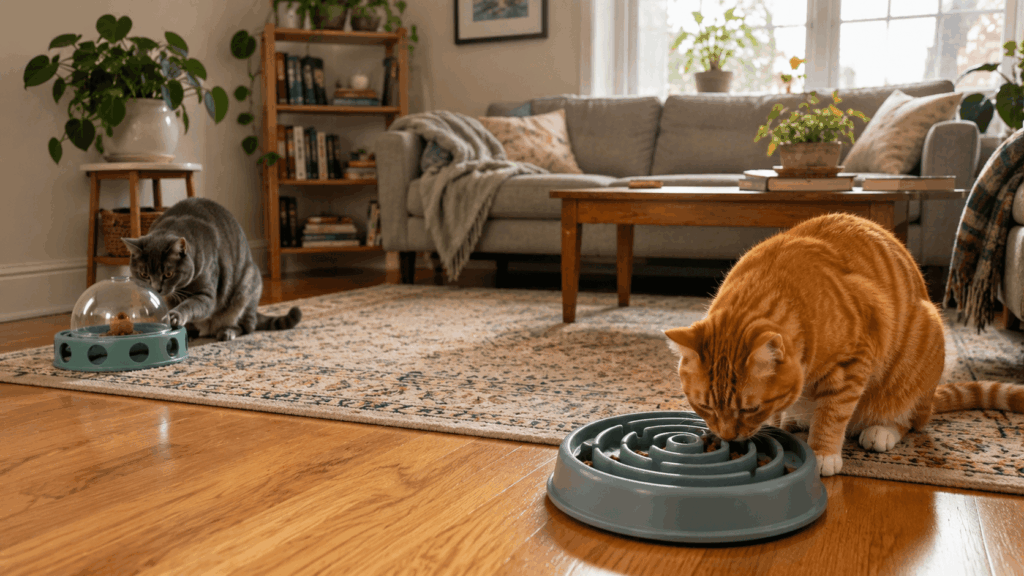
A standard 1/3 cup meal consumed from a flat bowl takes approximately 45–90 seconds. The same meal in a Level 2–3 puzzle feeder takes 8–15 minutes. The extended meal duration means that even in the same room, both cats are simultaneously occupied with their own individual food challenges for long enough that the typical “finish quickly and investigate the other cat’s bowl” sequence never initiates.

The puzzle feeder selection for multi-cat households:

  • Position feeders at maximum room distance — the 6–8 foot minimum distance applies regardless of feeder type
  • Match difficulty levels — a cat whose puzzle feeder is too easy will finish quickly and potentially investigate the other cat’s station; match difficulty to the cat’s problem-solving speed so both finish approximately simultaneously
  • Use different puzzle types — different visual and auditory profiles for each feeder reduce one cat’s interest in the other’s station

The Noodle solution:
Noodle’s food theft behavior was driven entirely by speed — she consumed her meal in under 60 seconds and then had Oliver’s bowl targeted within 90 seconds of mealtime initiation. Her SureFeed feeder with a slow-feed insert extended her meal time to approximately 8 minutes. Oliver’s bowl is now empty and removed before Noodle finishes. The problem resolved without any barrier management required during daytime feeding.


Vet Tech Hygiene: Sanitizing Multiple Stations in a Small Space

How to feed multiple cats separately creates a multiplication of feeding equipment that, in a small apartment, requires a deliberate hygiene management protocol to prevent the bacterial colonization that undermines both the cleanliness and the health value of the feeding system.

The clinical hygiene requirement:
Ceramic and stainless steel food bowls develop bacterial biofilm in microscopic surface imperfections within 24–48 hours of use. This biofilm is not visible and is not removed by standard rinsing — it requires dishwasher-level heat sanitization or chemical disinfection. In a multi-cat household where one cat’s bacterial load on their bowl can contaminate a shared feeding area surface or another cat’s bowl through splash, the hygiene stakes are higher than in a single-cat household.

The multi-station sanitation protocol:

Daily:

  •  All food bowls through the dishwasher on a high-heat cycle — no exceptions, including the microchip feeder’s bowl insert
  •  Feeding station surfaces (mats, counters, shelves) wiped with food-safe antibacterial solution and allowed to dry completely before the next meal
  •  Water bowls or fountain reservoir wiped with a dedicated cloth — do not use the same cloth for food and water surfaces

Weekly:

  •  Full disassembly and sanitization of all microchip feeder components
  •  Replacement of silicone mat inserts in feeders (if applicable)
  •  Washing of all fabric or soft-surface feeding mats at 60°C

The bowl number protocol:
The N+1 Rule applies to bowls as well as litter boxes — maintain N+1 bowls where N equals the number of cats. This ensures that daily dishwasher sanitization leaves a clean bowl available for each cat without requiring a dry-time wait between sanitization and the next meal.

The mat selection:
Use silicone feeding mats rather than fabric or rubber-backed fabric mats at all stations — silicone is non-porous, dishwasher-safe, and does not harbor bacterial biofilm in surface texture the way that fabric mats do. In a multi-cat household where multiple stations are generating daily splatter, the sanitizability of every surface contact point is clinically relevant.


Managing Picky vs. Vacuum Eaters

The most common individual cat characteristic that makes how to feed multiple cats separately challenging is the behavioral mismatch between cats who eat slowly and selectively and cats who consume their meal in seconds and immediately begin surveilling available alternatives.

The Vacuum Eater profile:
The vacuum eater — Noodle’s category — finishes their meal in under 2 minutes, has no interest in leaving any food unconsumed, and perceives remaining food in any bowl as a legitimate target regardless of whose bowl it is. Managing a vacuum eater in a multi-cat household requires:

  • Slow-feed inserts in all their eating vessels — maze plates, lick mats for wet food, multi-compartment dispensers for kibble
  • Microchip feeders for medical diet separation
  • Timed removal of all bowls immediately when meal duration completes — a bowl left unattended for 30 seconds is accessible

The Picky Eater profile:
The picky eater — closer to Oliver’s category — eats slowly, walks away mid-meal, returns to the bowl intermittently, and is at risk of having their partially consumed meal consumed by the vacuum eater during any away period. Managing a picky eater’s food security requires:

  • Raised or inaccessible feeding station — elevation that the vacuum eater cannot access
  • Microchip feeder with a sealed lid that closes when the picky eater walks away — the meal is protected during their away periods
  • Small, frequent portions — offering multiple small meals reduces the volume available for theft at any single feeding event

The medical diet management:
When one cat requires a prescription diet and the other does not, how to feed multiple cats separately becomes a medical necessity rather than a preference. A single episode of a healthy cat consuming a renal diet (lower protein, Phosphorus Restriction) is not harmful — but a single episode of a CKD cat consuming a healthy cat’s standard food can meaningfully increase phosphorus load during a critical management period. Microchip feeders are non-negotiable in this clinical context.


Frequently Asked Questions

How do I feed multiple cats separately in a small apartment?

Use scheduled meals, visual barriers, vertical feeding spots, and short supervised feeding sessions. Even a bathroom, hallway, closet, folding screen, or cat tree platform can create enough separation for a 15-minute meal. If one cat steals food or needs a prescription diet, a microchip feeder can help protect that cat’s meal.


How can I feed one cat wet food and the other dry?

This is one of the most common how to feed multiple cats separately challenges — and the solution depends on whether the diet difference is medical (requiring strict separation) or preferential (allowing some flexibility). For strict separation (prescription wet diet for one, standard dry for the other), the microchip feeder for the wet food cat is the most reliable solution — the sealed lid prevents the dry-food cat from accessing the wet food during unattended periods, and the wet food cat cannot access the other’s dry food station if that feeder is also microchip-activated.

For preferential separation (both cats are healthy, one simply prefers wet and one prefers dry), temporal separation using the door-closed sanctuary method works well — feed the wet food cat in the separate room for the 20–25 minute meal window, then retrieve the wet food bowl before releasing them. Remove the dry food feeder before feeding time if the wet food cat also eats dry kibble opportunistically.


What if one cat finishes their food too fast?

Speed eating in cats — particularly in former shelter or multi-cat household cats who learned to eat quickly under food competition pressure — is best managed through slow-feed equipment rather than behavioral correction. The SureFeed Microchip Feeder with a slow-feed insert, maze plates that require the cat to navigate food around barriers, lick mats for wet food that extend consumption time, and multi-compartment ball feeders that release kibble one piece at a time all address the speed eating pattern at its mechanical level.

Additionally, speed eating in cats who were not previously speed eaters can indicate medical causes — hyperthyroidism, intestinal parasites, or malabsorption conditions — that warrant veterinary investigation before assuming a purely behavioral cause. For the food theft aspect of speed eating in the context of how to feed multiple cats separately, the practical solution is ensuring the slower-eating cat’s food is removed from the environment (or secured in a microchip feeder) before the fast eater completes their meal.

For fast eaters, a slow feeder can buy time while the other cat finishes. See our best slow feeder cat bowl guide for options.


Is it okay to feed my cats in the same room — and is that really how to feed multiple cats separately?

Same-room feeding with adequate separation, strategic positioning, and slow-feed equipment can constitute appropriate how to feed multiple cats separately practice for cats who are compatible housemates without active food guarding history.

The critical variables are: physical distance (minimum 6–8 feet between stations for cats with any competition history), orientation (nose-to-tail or back-to-back positioning to eliminate direct eye contact during eating), simultaneous meal initiation (both cats starting at the same time reduces the monitoring of the other cat’s progress), and active meal removal (both bowls removed simultaneously at meal completion to prevent bowl investigation).

For cats with documented food guarding behavior, active food theft, or any medical dietary differences, same-room feeding is not appropriate regardless of distance or positioning — the Resource Scarcity perception and the medical contamination risk both require physical barrier or technological separation.


Final Thoughts: What Noodle Taught Me About Food Security

Noodle was with me for eight weeks before her adoption placement came through. By week two, the feeding system was fully implemented: her SureFeed feeder on the kitchen counter, Oliver’s bowl on his elevated shelf with automatic removal after 20 minutes, separate meal timing with a 5-minute stagger.

By week three, both cats were approaching mealtime without any observable tension indicators — no tail lashing, no dilated pupils, no speed-eating from Oliver, no surveillance behavior from Noodle. By week six, they occasionally sat in the same kitchen during each other’s mealtime with the studied indifference of cats who have decided the other cat’s food is not their business.

That behavioral shift — from morning warzone to peaceful parallel meal — did not happen because I wished for it. It happened because how to feed multiple cats separately was implemented with the clinical rigor that the behavioral and physiological stakes require.

Every cat in a multi-cat household deserves to approach their food bowl without anxiety. The equipment investment, the spatial management, and the routine consistency that delivers this experience is not optional enrichment.

It is basic welfare.

Feed them separately. All of them. Every time.

Oliver sends his regards. Noodle sends nothing — she’s already finished eating and moved on.


References

1. Crowell-Davis, S. L., Curtis, T. M., & Knowles, R. J. (2004). Social organization in the cat: A modern understandingJournal of Feline Medicine and Surgery, 6(1), 19–28. 

2. Ellis, S. L. H., Rodan, I., Carney, H. C., Heath, S., Rochlitz, I., Shearburn, L. D., Sundahl, E., & Westropp, J. L. (2013). AAFP and ISFM Feline Environmental Needs Guidelines. Journal of Feline Medicine and Surgery, 15(3), 219–230. 

Share this post

Subscribe to our newsletter

Keep up with the latest blog posts by staying updated. No spamming: we promise.
By clicking Sign Up you’re confirming that you agree with our Terms and Conditions.

Related posts