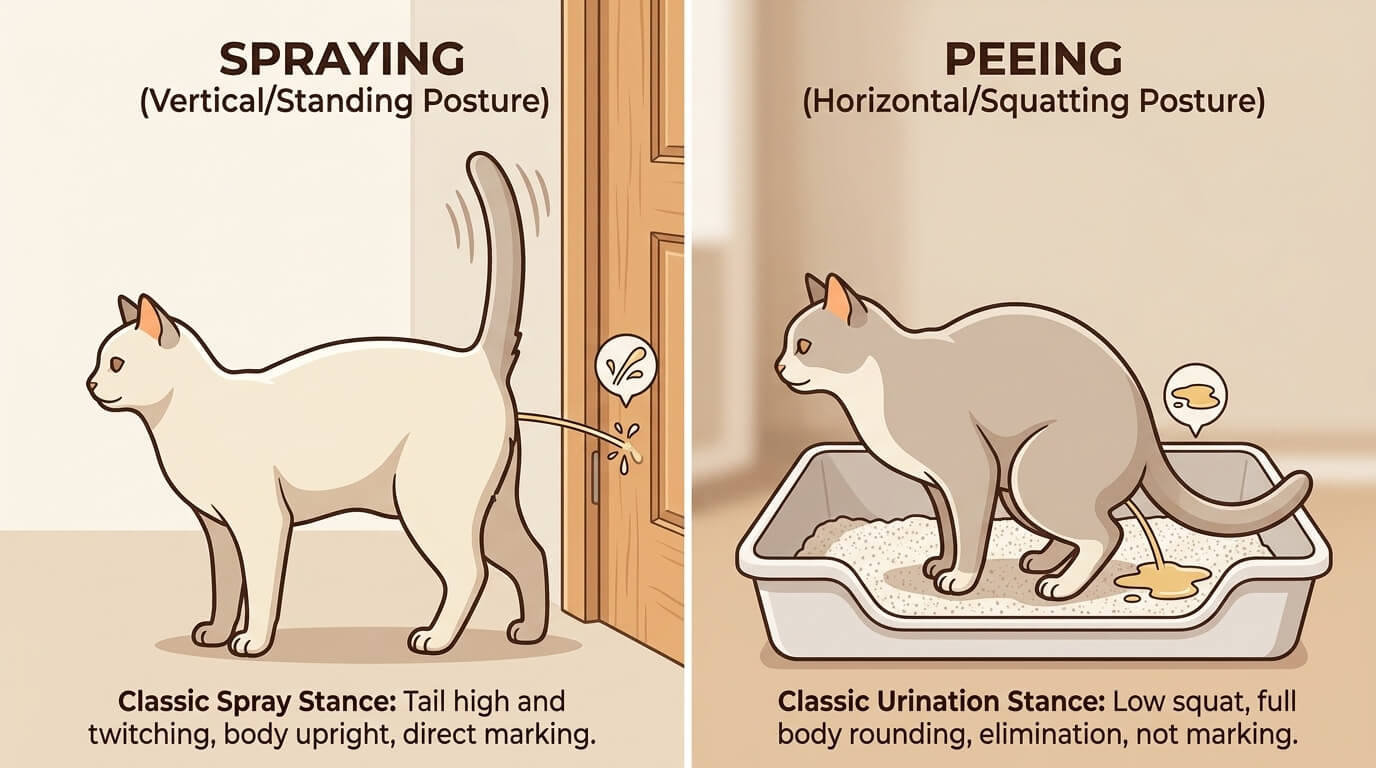
Cat spraying vs peeing can look similar at first, but the difference matters because the causes and next steps are not the same. Spraying is usually urine marking. Peeing outside the litter box is often an elimination problem, and it can be linked to pain, litter box avoidance, stress, or urinary disease.
A small vertical streak on a door frame can point toward urine marking, while a larger puddle on a horizontal surface more often reflects elimination. Neither pattern proves the cause, so note what you saw and consider medical, litter-box, and environmental factors together.
This guide shows you how to tell the difference by posture, surface, volume, location, and trigger pattern, plus when to stop treating it as a behavior problem and call your veterinarian.
Quick Answer: What is the Main Difference in Cat Spraying vs Peeing?
The main difference in cat spraying vs peeing is usually posture, surface, and amount. Spraying often happens while a cat is standing with the tail lifted or quivering, leaving a small streak or mark on a vertical surface like a wall, door frame, cabinet, curtain, or furniture leg. Peeing usually happens while squatting and leaves a larger puddle on a horizontal surface like the floor, rug, bed, laundry, or bath mat.
Still, do not treat every urine problem as behavioral. If your cat is straining, crying, producing only small drops, urinating more often, licking the urinary area, hiding, vomiting, losing appetite, or showing blood in the urine, call your veterinarian promptly.
The practical first step is simple: look before you clean. Is the urine high on a wall or pooled on the floor? Was there a recent trigger, like an outdoor cat, a new pet, visitors, a move, or conflict between cats? That pattern tells you whether to focus on spraying triggers, litter box problems, or medical help first.
Important Veterinary Note
This article is for educational purposes only and is not a substitute for veterinary diagnosis, treatment, or emergency care.
Indoor cats can hide pain and illness until symptoms become serious. Contact a veterinarian promptly if your cat has sudden behavior changes, repeated vomiting, appetite loss, weight loss, urination changes, blood in urine or stool, breathing difficulty, collapse, seizures, severe pain, poisoning risk, injury, or any rapid decline.
For ongoing prevention, pair home observation with regular veterinary exams. Indoor Cat Expert articles are created by the Indoor Cat Expert Editorial Team and follow our Editorial Policy.
Important urinary warning: cats who strain, cry in the litter box, produce little or no urine, vomit, hide, or act weak need urgent veterinary care because urinary blockage can become life-threatening quickly.
Table of Contents
How to Tell Cat Spraying vs Peeing Apart
Before you clean the spot, pause for a moment and look at the pattern. I know that sounds unappealing when you are already annoyed, but this is the easiest time to tell whether you are looking at spraying, ordinary peeing, or a possible medical problem.
Ask these questions before you wipe everything away:
Location First:
- Is it on a wall, door frame, cabinet front, or chair leg? → Likely spraying
- Is it on the floor, a rug, a laundry pile, or a horizontal surface? → Likely inappropriate urination
Streak Pattern:
- Is there a small vertical drip or streak running downward from a point? → Classic Vertical Marking signature
- Is there a pooled or spreading horizontal stain with no vertical component? → Classic elimination pattern
Volume Assessment:
- Small volume, concentrated, strong-smelling deposit? → Spraying
- Larger volume, more dilute, spread across a wider area? → Elimination (One-Piece Bladder Emptying)
Location Significance:
- Near windows, doors, or entry points? → Territory boundary marking
- Near another cat’s belongings, feeding station, or bed? → Social tension marking
- In random interior locations? → Often medical or litter box aversion
A small vertical mark near a doorway makes spraying more likely than ordinary elimination, but it is still only a clue. Record the surface, posture, amount, frequency, and recent household changes, then share that pattern with your veterinarian if the behavior is new or recurring.
That is the useful part of comparing cat spraying vs peeing: you stop guessing from emotion and start looking at posture, surface, volume, location, and recent changes.
Cat Spraying vs Peeing Quick Comparison Table
| Clue | Spraying | Peeing Outside the Box |
|---|---|---|
| Posture | Usually standing with tail raised | Usually squatting |
| Surface | Often vertical surfaces | Often horizontal surfaces |
| Amount | Usually small amount | Often larger puddle |
| Purpose | Scent marking or territorial signal | Elimination, discomfort, or box avoidance |
| Common trigger | Stress, territory, outdoor cats, multi-cat tension | Pain, urinary issues, dirty box, access problem |
| First step | Reduce trigger and clean scent | Rule out medical issues and check litter setup |
5 Signs That Help You Tell Cat Spraying vs Peeing Apart
These five observable clues can help you describe a cat spraying vs peeing event more accurately. Use them as a record for your veterinarian, not as a home diagnosis.
Sign 1: Posture — Standing vs. Squatting
Posture is one of the most useful observational clues when distinguishing cat spraying vs peeing, but it is not diagnostic by itself. If possible, record a short video without interrupting or frightening your cat.
Spraying Posture:
- Cat stands on all four legs, upright
- Tail is raised straight up and held vertically
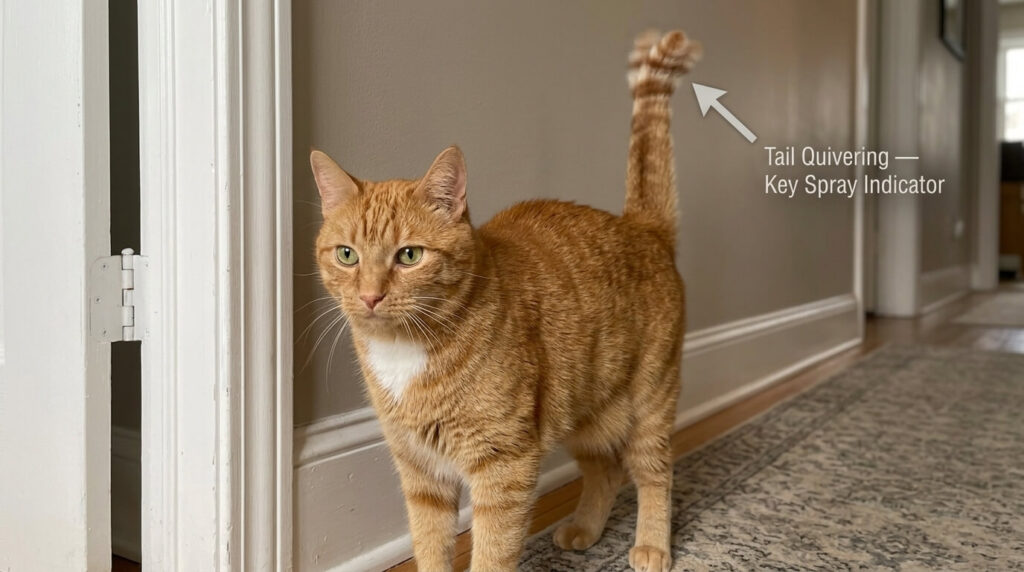
- Tail Quivering — the tail vibrates rapidly, almost trembling, at the tip or throughout its length
- Hindquarters may be backed slightly toward the target surface
- The cat often treads with the back feet in a rhythmic, alternating stepping motion
- Facial expression is typically forward-focused and alert, not distressed
Peeing Posture:
- Cat squats low to the ground
- Tail is typically low or held parallel to the floor
- All four paws are flat and grounded
- Body is rounded downward, weight distributed evenly
- Cat may look around or appear uncomfortable (especially if a medical issue is present)
- No treading or tail quivering
The tail clue: A raised or quivering tail often accompanies urine spraying, especially when the cat is standing and facing a vertical surface. It is not an exclusive or near-perfect diagnostic sign. Consider posture, surface, urine volume, location, and medical symptoms together.
Sign 2: Surface — Vertical vs. Horizontal
The target surface is another useful clue when comparing cat spraying vs peeing.
Spraying targets vertical surfaces:
- Door frames and doors (especially entry points to the home)
- Wall corners and baseboards
- Chair and table legs
- Sofa arms and furniture sides
- Windows and window sills
- The sides of litter boxes (a particularly confusing one for owners)
- Bags, backpacks, and shoes near entry points
Inappropriate urination targets horizontal surfaces:
- Area rugs and carpets
- Laundry (especially worn clothing)
- Bath mats
- Corners of rooms
- Sofas and beds (upper surface)
- Near — but notably not inside — the litter box
The key distinction: Spray is delivered backward and outward from a standing cat, so it naturally strikes vertical surfaces at tail height. Elimination comes downward from a squatting cat, so it naturally pools on horizontal surfaces.
One confusing exception: Some cats who have litter box aversion will squat to urinate on vertical surfaces like walls — usually low to the ground with a larger volume. This is why posture, surface, amount, and context should be considered together rather than relying on location alone.
Sign 3: Volume — Small Mark vs. Larger Puddle
Volume is a surprisingly useful differentiator in cat spraying vs peeing cases — and one that owners often don’t think to assess.
Spraying volume characteristics:
- Small — typically just a few milliliters
- Concentrated and very pungent (the scent is intentionally potent — it’s communication, not waste)
- Leaves a small, often elongated vertical mark
- Dries quickly due to small volume
- May be difficult to see on dark surfaces but unmistakable by smell
Inappropriate urination volume characteristics:
- Larger — a normal cat bladder holds 30–50ml and may empty fully
- This is what I call One-Piece Bladder Emptying — the full contents of the bladder deposited in one location
- Creates a wider, spreading stain
- May soak into carpet or fabric deeply
- Sometimes accompanied by straining, crying, or blood if medical issues are present
Why this matters: A large-volume deposit on or beside a wall may come from a cat that squatted close to the surface rather than sprayed. Volume and surface alone cannot establish pain or litter-box avoidance, so look for urinary warning signs and arrange veterinary assessment when the behavior is new or recurring.
Sign 4: Location — Territory Boundary vs. Elimination Spot
In cat spraying vs peeing, where the event occurred tells you almost as much as how it happened.
Classic spray locations follow territorial logic:
| Location | Possible factor to investigate |
|---|---|
| Front door or entry points | Outdoor animals, hallway activity, visitors, or other changes near the boundary |
| Windows facing outside | Sight or scent of unfamiliar cats outdoors |
| Near another pet’s belongings | Intercat tension or competition around important resources |
| New furniture, luggage, or bags | Unfamiliar odors or a recent change in the home |
| Bedding or frequently used belongings | Stress, substrate preference, litter-box access, or a medical problem; do not assume a social message |
Spraying locations can provide useful clues, but they do not reveal a cat’s motive with certainty. Mapping the sites may show patterns around:
- Entry and exit points (doors, windows)
- Social tension hotspots (multi-cat resource zones)
- Novel objects or disturbed territories
Inappropriate urination locations follow avoidance or medical logic:
- Soft surfaces (rugs, laundry) that mimic litter texture
- Secluded corners (pain during urination makes cats seek isolation)
- Areas far from the litter box (litter box is aversive)
- Areas near the litter box (can’t make it in time — urgency/pain)
If your cat is consistently squatting to eliminate outside the litter box on floor-level horizontal surfaces, that warrants immediate medical investigation. For the full medical and environmental breakdown, read our guide to cat peeing outside the litter box.
Sign 5: Triggers — What Changed Before It Happened?
The fifth secret to cracking cat spraying vs peeing is understanding the trigger event — what changed in your cat’s health, litter-box setup, social environment, or surroundings around the time the behavior began?
Common spraying triggers:
- A new cat visible through the window
- A new pet or person introduced to the household
- A change in routine (owner travel, schedule shift)
- Rearranged furniture that disrupts territorial landmarks
- A new bag, box, or object brought into the home
- Delivery workers, visitors, or unusual noises at entry points
- Seasonal changes that bring outdoor cats closer to windows
In multi-cat households, vertical marking can be associated with social tension. If the problem started after a new cat arrived, review our guide to introducing a second cat in a small apartment. Look for blocked pathways, guarded resources, staring, chasing, hiding, or changes in access to food, water, resting areas, and litter boxes.
Common inappropriate urination triggers:
- Urinary tract infection, crystals, or bladder inflammation
- Litter box cleanliness issue (even a single missed scoop for a fastidious cat)
- Litter type change
- Litter box location change
- New litter box added or an old one removed
- Chronic pain making the litter box journey difficult
Critical point: High-stress cats may also use scent marking as a coping mechanism for broader social anxiety or overstimulation — not just specific territorial triggers. High-stress cats may also use scent marking as a coping mechanism for broader social anxiety or overstimulation. If the urine marking appears alongside swatting, chasing, blocking, or sudden conflict, read our guide to why an indoor cat is suddenly aggressive. Chronic, whole-house spraying in the absence of an obvious external trigger should prompt a conversation with your vet about anxiety management strategies alongside environmental modifications.
The Medical Rule: Why Spraying Isn’t Always Just ‘Bad Behavior’
Spraying is often territorial, but I still do not like skipping the medical question. Pain, bladder inflammation, urinary urgency, and stress-related urinary problems can blur the line between marking and peeing outside the box.
If the behavior is sudden, frequent, painful, or paired with litter box changes, appetite changes, hiding, blood, or repeated trips to the box, call your veterinarian before treating it as a training problem.
Cystitis, Pain, and the Stress Connection
Feline Idiopathic Cystitis (FIC) — bladder inflammation with no identifiable bacterial cause — is strongly linked to psychological stress. The mechanism works like this:
- Stressor is perceived (outdoor cat, household conflict, routine disruption)
- HPA axis activates → cortisol and adrenaline surge
- Bladder wall becomes inflamed → urination becomes uncomfortable
- Cat begins to associate the litter box with pain → avoidance begins
- Or → stressed cat begins spraying as a territorial coping response
This is why cat spraying vs peeing sometimes becomes a blurred line in the context of medical illness. A cat with cystitis may:
- Begin inappropriate urination (squatting, small volumes, on horizontal surfaces)
- Begin spraying more frequently than usual (stress response amplified by physical discomfort)
- Do both simultaneously
Signs that your cat’s spraying or urination problem has a medical component:
- Frequent attempts to urinate with little output
- Crying or vocalizing during urination
- Blood visible in urine (pink or red tinge)
- Excessive genital licking after urination
- Straining in the litter box
- Lethargy or appetite changes accompanying the behavior
If urinary signs are part of the pattern, compare what you are seeing with our indoor cat urinary health guide before assuming the issue is only behavioral.
Emergency Note: A male cat who is straining to urinate with little or no output is a veterinary emergency. Urethral obstruction is life-threatening and requires immediate intervention. Do not wait. Go to an emergency vet now.
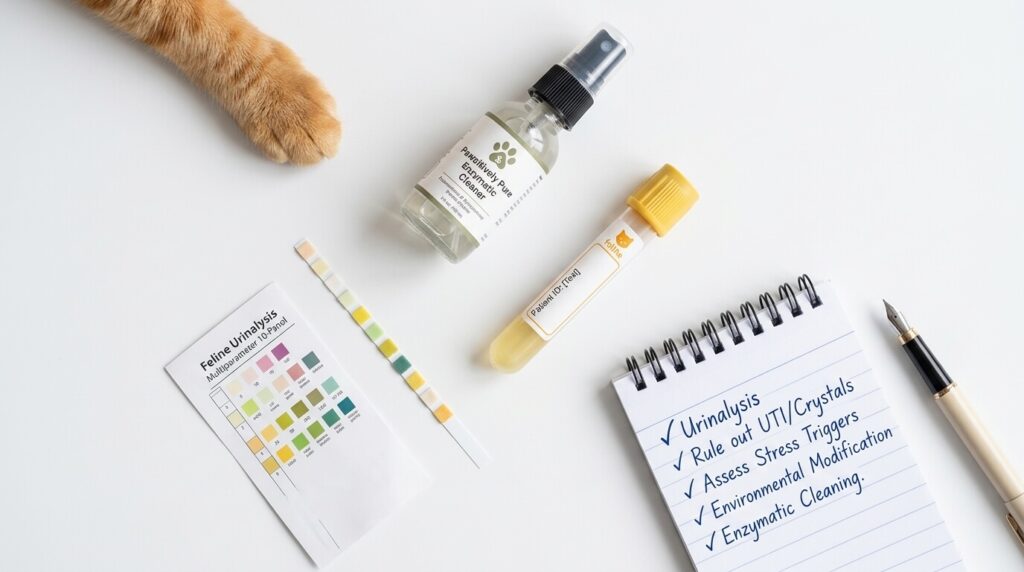
Medical evaluation comes first: New or recurring house-soiling warrants veterinary assessment because cystitis, urinary stones, infection, kidney disease, diabetes, arthritis, and other conditions can contribute. Your veterinarian will choose the appropriate examination and tests, which may include urinalysis and additional diagnostics based on the cat’s history and symptoms.
Spraying is often part of a broader behavior or territory pattern. For more indoor behavior guides on stress, hiding, aggression, and multi-cat tension, see our cat behavior guide hub.
How to Stop Cat Spraying Safely
Once medical causes are ruled out or treated, the safest plan is to lower the pressure around the place your cat is marking. Spraying usually means your cat feels the need to make a spot smell safer, more familiar, or more clearly “theirs.”
That does not mean you allow it. It means punishment will not solve it. The better goal is to remove the trigger, clean the scent properly, and make your cat feel less driven to mark the same place again.
Step 1: Identify and Block the Trigger
Do not try to fix every possible trigger on the same day. Start with the most obvious one. If the mark is near a window, think outdoor cats. If it is near the front door, think hallway noise, visitors, delivery smells, or shoes and bags. If it is near another cat’s favorite route, think social pressure.
For window-visible outdoor cats:
- Apply frosted window film to the lower third of windows (eliminates visual trigger while maintaining light)
- Use motion-activated deterrents in the garden to discourage outdoor cats from approaching
- Place a cat tree near the window at height — elevated security reduces ground-level territorial anxiety
For new objects or entry point anxiety:
- Rub a clean sock gently on your cat’s cheek (collecting facial pheromones) and then rub it on new objects or door frames
- Use synthetic facial pheromone diffusers (Feliway Classic) at entry points — plug in near the front door, not just randomly placed
- Maintain consistent routines around entry and exit to reduce unpredictability
For multi-cat household tension:
- Audit your resource distribution: the rule is N+1 (one more resource than the number of cats — food stations, water points, litter boxes, sleeping platforms)
- Ensure all cats have unobstructed escape routes in every room — no dead ends
- Consider temporary visual separation between cats if conflict has escalated
For a deeper multi-cat plan, use our cat resource guarding guide to separate food, water, litter, resting spots, and escape routes more safely.
Step 2: Increase Perceived Security
This is about making your cat feel territorially secure without needing to spray to achieve it.
- Vertical space: Cat trees, wall shelves, and elevated platforms give your cat a safer place to watch the room, which can reduce the urge to mark at ground level.
- Consistent scent landscape: Don’t rearrange furniture frequently — scent landmarks matter deeply to cats
- Predictable routine: Feed, play, and interact at consistent times — predictability = safety
- Designated safe zones: Ensure your cat has at least one retreat space (a box, an elevated perch, a quiet room) that is entirely their own
Step 3: Use Pheromones as Support, Not a Magic Fix
Pheromone diffusers and sprays can help some cats feel safer, but they work best when the trigger is also being handled. I would not use them as the only fix if an outdoor cat is still staring through the window or another cat is still blocking the hallway.
- Feliway Classic Diffuser: Mimics feline facial pheromones — associated with safety and familiarity. Place in the room(s) where spraying is occurring.
- Feliway MultiCat: Specifically formulated for multi-cat tension — mimics the “cat appeasing pheromone” produced by nursing mothers
- Feliway Spray: Apply directly to previously marked locations (after enzymatic cleaning) to overlay the territorial scent signal with a calming one
If you try a synthetic feline pheromone product, follow the label and track whether marking frequency changes. Treat it as an optional support alongside cleaning, resource changes, and veterinary assessment—not as a guaranteed fix. For product comparisons, see our guide to the best cat calming diffusers.
Step 4: Consider Medical Anxiety Support
For cats with chronic, whole-house, high-frequency spraying linked to anxiety — particularly where environmental modifications haven’t fully resolved the behavior — your veterinarian may discuss:
- Short-term anxiolytic medications during high-stress periods
- Long-term behavioral medications (fluoxetine, clomipramine) for severe cases
- Nutritional supplements (L-theanine, alpha-casozepine) as a lower-intervention starting point
Complex or long-standing cases may benefit from a referral to a board-certified veterinary behaviorist, particularly when medical treatment, environmental changes, and litter-box adjustments have not resolved the problem.
Cleaning the Scent Signal: Why Enzyme Cleaners Matter
Cleaning is not just about smell. If the old urine signal remains, the same spot can keep feeling like a place that needs to be marked again.
Why Regular Cleaners Don’t Work
A regular cleaner may make the area look clean and smell better to you, but cat urine can linger in tiny gaps, carpet backing, wood seams, fabric, and baseboards. Your cat’s nose may still detect the old message even when you cannot.
That is why enzyme cleaners matter. They are designed to break down pet urine residue instead of simply covering it with fragrance. This is especially important for repeat spray spots, door frames, curtains, rugs, and furniture legs.
For repeat marks or old urine odor, compare our guide to the best enzyme cleaners for cat urine before using scented sprays or harsh cleaners that may make the area more stressful.
How Enzyme Cleaners Help Reduce Repeat Marking
The only products that work on urine scent signals are enzyme-based cleaners — and specifically those formulated for pet urine. Here’s why:
Enzymatic Breakdown works by deploying biological enzymes (protease, lipase, amylase) that digest the urine proteins at a molecular level. The enzymes literally eat the compounds that carry the scent signal, breaking them down into odorless molecules (water and CO₂).
If the same spot keeps getting marked after cleaning, the cleaner may not have reached the full depth of the urine or remained long enough to work. Compare suitable products and surface-specific directions in our guide to the best enzyme cleaner for cat urine.
How to use enzymatic cleaners correctly:
- Blot first: Remove as much of the urine as possible with paper towels — press firmly, don’t rub (rubbing spreads the proteins deeper into the substrate)
- Saturate generously: The enzymatic cleaner needs to penetrate as deeply as the urine did — don’t spray lightly; soak the area
- Dwell time is critical: Most enzymatic cleaners require 10–15 minutes minimum of wet contact time to work. Many people spray and wipe immediately, which defeats the entire purpose.
- Do not use heat: Don’t use steam cleaners or hot water on urine stains before enzymatic treatment — heat permanently bonds urine proteins to fabric
- Air dry: Allow the treated area to air dry naturally — don’t accelerate drying with heat guns or hair dryers
- Repeat if needed: Old, set-in stains may require 2–3 applications
Products I use and recommend:
- Nature’s Miracle Urine Destroyer (specifically the “Urine Destroyer” formulation, not the standard version)
- Rocco & Roxie Professional Strength Stain & Odor Eliminator
- Angry Orange (enzyme-based formula)
- Simple Solution Extreme Pet Stain & Odor Remover
One more important step: After enzymatic cleaning and full drying, apply a small amount of Feliway Spray to the cleaned area. You’re replacing the territorial scent signal with a calming facial pheromone signal. For room-level support, compare our guide to the best cat calming diffusers, especially if spraying is linked to moving, outdoor cats, or multi-cat tension.
What to avoid:
- Ammonia-based cleaners (ammonia is a component of urine — it amplifies the scent signal)
- Bleach (toxic to cats and ineffective against organic compounds)
- Standard household disinfectants (kill bacteria but leave urine proteins intact)
- Vinegar alone (acidic, partially neutralizes odor to humans, but doesn’t break down felinine)
Frequently Asked Questions
1. Do neutered cats still spray?
Yes — and this surprises a lot of people.
Neutering or spaying can substantially reduce sexually related urine marking, but altered cats may still spray in response to environmental or social stressors.
Spraying is not only a sexual behavior. Neutered or spayed cats may also mark when outdoor cats, household conflict, unfamiliar odors, or other environmental changes affect their sense of security.
Female cats can also spray, though it is less common. An intact female cat may spray during estrus. A spayed female cat can spray in response to the same territorial and social triggers that affect males.
The bottom line on cat spraying vs peeing and neuter status: neutering is a critically important first line of prevention, but it is not a guarantee of zero spraying. Neutered cats who spray need the same environmental investigation and de-escalation approach as intact cats.
2. When should I call a vet for cat spraying vs peeing?
Call your veterinarian promptly if your cat is straining, crying in the litter box, urinating only small drops, licking the urinary area, hiding, vomiting, refusing food, or showing blood in the urine. These signs can point to pain, cystitis, crystals, infection, or urinary blockage. Even if the pattern looks like spraying, a sudden change in urine behavior deserves a medical check before you assume it is territorial.
3. Can stress cause both spraying and peeing outside the litter box?
Yes. Stress can contribute to urine marking, but it can also contribute to stress-related bladder inflammation and litter box avoidance. That is why cat spraying vs peeing is not always a clean either-or decision. Look at posture, surface, volume, and location, but also track recent changes such as new cats, moving, visitors, schedule changes, or conflict between cats.
4. Why is my cat spraying even though the litter box is clean?
This is one of the most common questions I get, and it reveals a key misunderstanding about cat spraying vs peeing: litter box cleanliness is relevant to inappropriate urination, not to spraying.
Spraying is territorial communication. It has nothing to do with the litter box.
If your litter box is clean and your cat is still spraying, that tells me:
- Your cat is feeling territorially insecure for a non-litter-related reason
- There is likely an external or social trigger (outdoor cats, household conflict, routine disruption)
- The litter box is not part of the equation
A clean litter box does not rule out urine marking, because marking and elimination can have different contributing factors. However, both medical problems and litter-box conditions should still be considered.
If your litter box is clean and your cat is consistently eliminating outside the litter box on the floor — that is a different conversation (inappropriate urination, likely medical or aversion-based) and warrants veterinary investigation.
5. Is cat spraying vs peeing common in female cats?
Female cats can spray, including after spaying. Do not rule out marking based on sex alone, and do not assume that a small urine deposit is behavioral without considering medical causes.
Female cats and spraying:
- Intact females may spray during estrus (heat cycles) as a sexual advertisement behavior
- Spayed females can spray in response to territorial or social stressors — the same triggers that affect neutered males
- Small deposits can be missed or confused with an elimination accident, so document posture, surface, and amount when possible
- In multi-cat households, urine marking may occur alongside intercat tension or restricted access to important resources
The same five observational clues—posture, surface orientation, volume, location, and possible triggers—are useful regardless of sex or neuter status. However, the underlying cause and treatment plan must still be assessed for the individual cat.
Spaying prevents heat cycles and can reduce sexually related marking, but it does not guarantee that urine marking will stop. A spayed female that sprays needs the same medical, litter-box, social, and environmental assessment as any other cat.
Final Thoughts
Cat spraying vs peeing is easier to handle when you separate the clue from the emotion. A vertical streak near a door or window tells a different story than a large puddle on a rug. One usually points toward marking pressure. The other may point toward litter box avoidance, discomfort, urgency, or a medical issue.
A small vertical mark near an entry area can become easier to investigate once you document the pattern and recent changes. Do not scold the cat. Clean the area thoroughly, reduce identifiable triggers, improve litter-box access and environmental security, and involve your veterinarian when the behavior is new, repeated, or accompanied by urinary signs.
If your cat is straining, producing little urine, crying, hiding, vomiting, showing blood, or acting weak, skip the behavior detective work and call a veterinarian. Urinary problems can move quickly.
If your cat is medically stable, start with the basics: identify the surface, clean the urine with an enzyme cleaner, reduce the trigger, add security, and keep a dated record of the pattern over time.
Your cat is not trying to ruin your home. They are telling you something about safety, stress, territory, or discomfort. The sooner you read the pattern calmly, the easier it is to help them stop.
References
- Crowell-Davis, S. L., Curtis, T. M., & Knowles, R. J. (2004). Social organization in the cat: A modern understanding. Journal of Feline Medicine and Surgery, 6(1), 19–28.
https://doi.org/10.1016/j.jfms.2003.09.013 - Pageat, P., & Gaultier, E. (2003). Current research in canine and feline pheromones. Veterinary Clinics of North America: Small Animal Practice, 33(2), 187–211.
https://doi.org/10.1016/S0195-5616(02)00128-6 - Cornell Feline Health Center. Feline Behavior Problems: House Soiling. Cornell University College of Veterinary Medicine.
- VCA Animal Hospitals. Cat Behavior Problems: Marking and Spraying Behavior.
- Feline Veterinary Medical Association. 2014 AAFP/ISFM Guidelines for Diagnosing and Solving House-Soiling Behavior in Cats.
- Feline Veterinary Medical Association. Feline House-soiling: Useful Information for Cat Caregivers. Updated 2026.