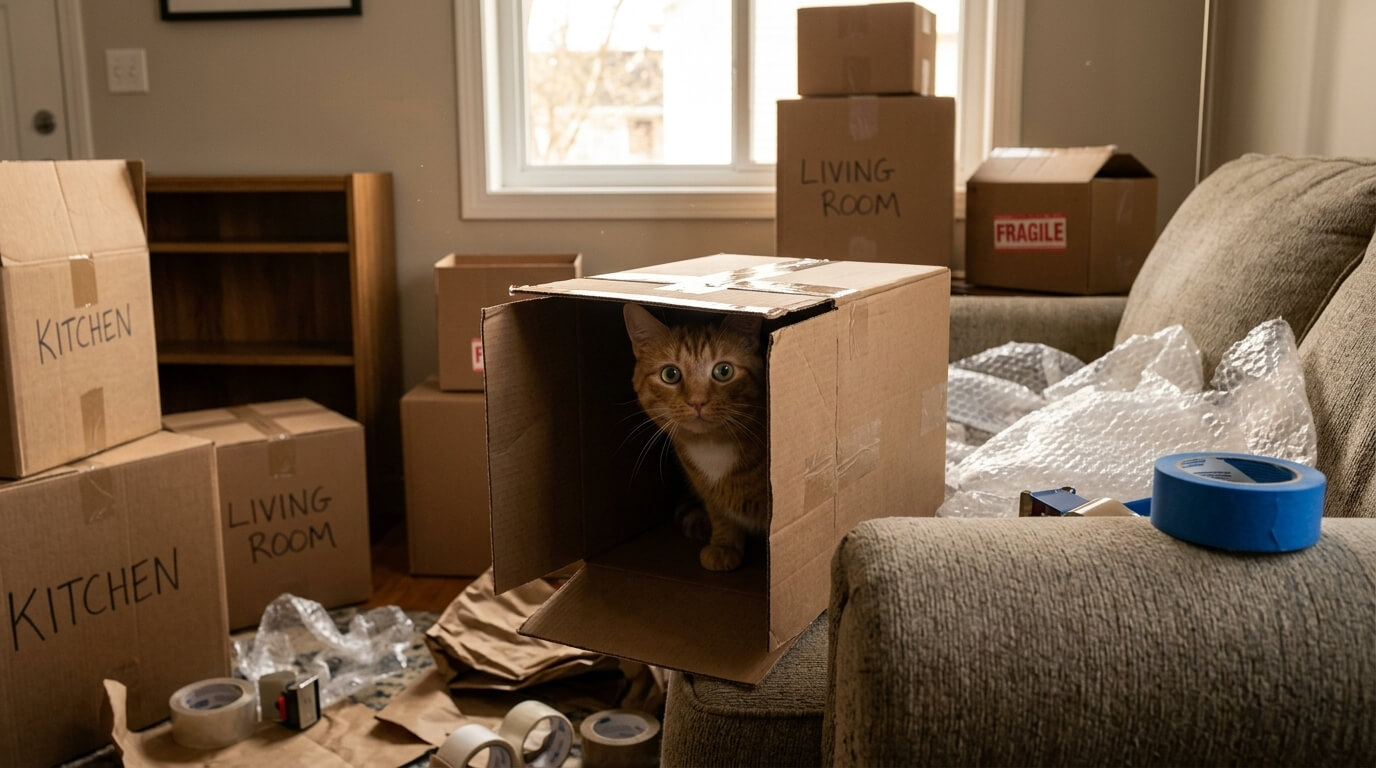
The last morning in my old studio, I was taping the final boxes when I turned around and could not find Oliver. The bed frame was already gone. The windowsill was bare. The familiar corners of the room no longer smelled or looked like his territory.
I found him twenty minutes later inside a half-taped box of kitchen items, pressed against a stack of wrapped plates, pupils wide and body low. He was not being dramatic. His whole map of the apartment had disappeared over three days.
Moving with a cat to new apartment settings is not just a transportation problem. It is a safety, stress, scent, and routine problem. The goal is to prevent escape, reduce panic, protect appetite and litter box habits, and give your cat one small secure room before asking them to handle the rest of the new home.
This guide shows the exact moving-day system I would use for an indoor cat: carrier preparation, a first-in-last-out safety room, scent anchors, car-ride precautions, gradual exploration, and post-move monitoring.
Quick Answer: How Do You Safely Move a Cat to a New Apartment?
The safest way to move a cat to a new apartment is to set up one closed safety room before the cat arrives, keep the cat in a secure carrier during transport, and let them adjust to the new home gradually.
Use the first-in-last-out method: prepare the safety room first, move your cat into that room before doors and movers are active, keep the door clearly closed, and only allow exploration after the main space is quiet. Bring familiar bedding, a litter box, food, water, hiding space, and one or two scent-heavy items from the old home. For most cats, one room for the first 24 to 72 hours is safer than immediate access to the whole apartment.
Important Safety Note
This guide is for general moving preparation, not veterinary diagnosis or treatment. If your cat has a history of urinary blockage, feline idiopathic cystitis, severe anxiety, heart disease, breathing problems, seizures, diabetes, kidney disease, or medication needs, ask your veterinarian before moving day. Contact a veterinarian promptly if your cat does not urinate, strains in the litter box, refuses food for more than 24 hours, hides with signs of illness, pants, collapses, vomits repeatedly, or seems painful after the move.
Table of Contents
The Feline Map: Why Moving Shatters a Cat’s World
To understand why moving with a cat to new apartment spaces requires such careful management, you need to understand how cats actually experience their home — because it is fundamentally different from how humans do.
The Olfactory Territory
A cat’s home is not defined by its visual appearance. It is defined by its scent map — a complex, layered landscape of pheromone deposits, scent marks, and familiar chemical signatures that have been built up over months or years of occupation.
Every surface Oliver has chin-rubbed contains his facial pheromone signature. Every patch of carpet he’s walked across contains his interdigital gland deposits. The corners of furniture, the edges of doorways, the specific spot by the window — all of it is chemically annotated with “I live here, I am safe here, this is mine.”
When you move, you leave that entire scent map behind. The new apartment has zero of Oliver’s scent and potentially significant amounts of a previous animal resident’s scent — a chemical landscape that reads as “unknown territory, possibly occupied, threat status unknown.”
The Spatial Memory System
Beyond scent, cats maintain detailed spatial memory maps of their territory — they know every escape route, every elevated platform, every hiding spot, every corridor. This spatial knowledge is a component of their felt safety: a cat who knows their environment knows where to go when something frightens them.
In a new apartment, that spatial knowledge doesn’t exist yet. Every sound, every unexpected movement, every unfamiliar visual feature has to be assessed against a background of zero established safety information. This is the neurological equivalent of being dropped into an unknown building in the dark.
The Stress and Health Risk
Moving with a cat to new apartment environments can be a major stress trigger, and stress is one factor that may contribute to urinary flare-ups in susceptible cats.If a cat is prone to urinary problems, watch closely for straining, frequent litter box trips, blood in the urine, crying in the box, or no urine output. Male cats who cannot urinate need emergency veterinary care.
Environmental changes can also contribute to litter box setbacks after a move. If your cat starts urinating outside the box, compare the pattern with our guide on moving apartment with cat stress before assuming it is only a behavior problem.— and understanding this connection is why the protocols below are not optional extras but genuine veterinary recommendations.
The ‘Safety Room’ Blueprint: First-In, Last-Out
The Safety Room is the single most important infrastructure decision in moving with a cat to new apartment management — and it must be prepared before anything else happens in the new space.
What the Safety Room Is
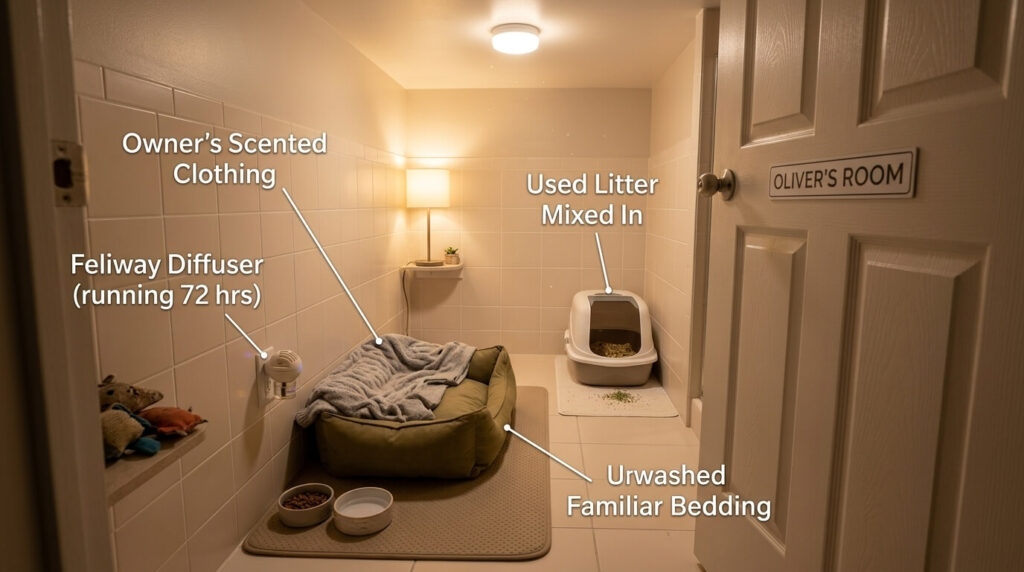
The Safety Room is a small, interior room (bathroom is ideal) in the new apartment that you set up completely before moving day — before any boxes arrive, before any movers enter, before any of the chaos of moving day begins.
It is the first room prepared in the new apartment and the last room your cat leaves.
Why a Bathroom Specifically
- No exterior windows: A bathroom has no window-level visual exposure to the unfamiliar outside environment — this eliminates a significant source of new-territory stress
- Small and manageable: The spatial scale of a bathroom allows a cat to investigate and scent-mark the entire space quickly — reducing the “unknown territory” cognitive load
- Door that closes firmly: Essential for keeping the cat safely contained during moving day when the front door may be open for extended periods
Setting Up the Safety Room
Three to five days before moving day, take the following items to the new apartment and set up the Safety Room:
- Oliver’s unwashed bed or blanket — the most important single item; this is his primary Olfactory Anchor in an unknown space
- His food and water bowls (unwashed, retaining his scent from recent use)
- A clean litter box with a small amount of used litter from the old apartment mixed into fresh litter
- A Feliway Classic diffuser plugged in and running — allowing pheromone saturation of the room before Oliver ever enters it
- A worn item of your own clothing — your scent is a secondary Olfactory Anchor that signals safety
The “running” period: The pheromone diffuser needs 24–48 hours minimum to begin producing meaningful ambient pheromone levels. If you can set up the Safety Room 72 hours before moving day, the pheromone environment will be substantially more effective than if it’s plugged in the morning of.
New Apartment Safety Room Checklist
The safety room is the most important part of moving with a cat to new apartment spaces. It gives your cat one small, controlled territory before the rest of the home becomes available. In a studio or one-bedroom apartment, this room may be a bathroom, bedroom, office, walk-in closet, or quiet corner room with a door.
The goal is not to make the room perfect. The goal is to make it predictable, quiet, and easy for your cat to understand.
A good new apartment safety room should include:
- a familiar litter box
- the same litter your cat used before the move
- food in the usual bowl if possible
- water placed away from the litter box
- one familiar bed or blanket
- one hiding option
- one scratching option
- one familiar toy
- a carrier left open
- a towel or blanket that smells like the old apartment
- minimal boxes or clutter
- no open windows
- no exposed cords
- no strong cleaners or air fresheners
Do not place the safety room beside the loudest part of the apartment if you have a choice. Hallway doors, elevators, laundry rooms, shared walls, and street-facing windows can all make the first night harder. A small quiet room is better than a larger room full of noise and movement.
If the only available room is a bathroom, make it warmer and softer with a familiar towel, non-slip mat, and covered hiding space. Many cats adjust well in a bathroom because it is easy to clean, easy to close, and less visually overwhelming than a room full of half-unpacked furniture.
7 Expert Tips for Moving with a Cat to a New Apartment
Tip 1: Olfactory Anchors — The Scent Migration Strategy
The Olfactory Anchor strategy is the behavioral cornerstone of moving with a cat to new apartment management — and it begins two weeks before moving day, not on moving day itself.
The pre-move scent migration protocol:
- Two weeks before the move, begin rubbing a clean sock along Oliver’s cheeks, chin, and forehead daily — collecting his facial pheromones
- Apply the scented sock to surfaces in the new apartment during any pre-move access visits — doorframes, wall corners, the sofa (if it’s already delivered)
- Bring Oliver’s used blanket to the new apartment on a pre-move visit and leave it in the Safety Room for 24 hours, then return it to Oliver in the old apartment — it now carries both his scent and the new apartment’s ambient scent
- In the week before the move, begin introducing moving boxes as environmental features in your current apartment — Oliver investigates and marks them, so the boxes that arrive in the new apartment carry familiar scent
The logic: You are creating a scent bridge between the old environment and the new — so that when Oliver arrives, he is not encountering a completely alien scent landscape. Elements of his own chemical signature are already present, and the new apartment’s smell has already been incorporated into objects he considers safe.
Tip 2: Pheromone Pre-Loading — The 72-Hour Foundation
I addressed this in the Safety Room section, but pheromone pre-loading deserves its own tip because the timing is what makes it work — and most people get the timing wrong.
The complete pheromone protocol for moving with a cat to new apartment:
72 hours before move:
- Feliway Classic diffuser plugged in to the Safety Room
- Feliway Spray applied to the carrier interior (allow to dry completely — wet spray is counterproductive)
24 hours before move:
- Second Feliway diffuser installed in the main living area of the new apartment — not just the Safety Room
Moving day:
- Feliway Spray applied to the car seat or carrier placement area 30 minutes before transport
- Spray reapplication to Safety Room surfaces (doorframe, bedding edge) — allow to dry before Oliver enters
Week one in the new apartment:
- Add a third diffuser if the new apartment is larger than your previous space or has multiple rooms
- Replace all diffusers at 30-day intervals — a diffuser that has run out is providing zero benefit
Why three diffusers: Feliway diffusers are effective within approximately 50–70 square meters of their placement. A 600-square-foot apartment may require two to three units for genuine environmental saturation — one per primary room rather than one for the whole apartment. If you are deciding between Classic, Multicat, or a multi-room pack, compare our guide to the best cat calming diffusers before moving day.
Tip 3: The Silent Moving Day — Minimizing Chaos Exposure
Moving day is the highest-stress single day in the moving with a cat to new apartment process — and the most important thing you can do for your cat is ensure they experience as little of it as possible. Moving day is also one of the highest-risk moments for door escapes. If your cat has ever rushed an entryway, use our guide on how to stop a cat from running out the door before the move begins.
The silent moving day protocol:
Before the movers arrive at the old apartment:
- Oliver goes into his carrier with familiar bedding and a piece of your worn clothing
- The carrier goes into the quietest available room with the door closed
- A sign on the door: “CAT INSIDE — DO NOT OPEN”
During transport:
- Oliver travels in the carrier — never loose in a moving vehicle
- The carrier is secured with a seatbelt loop or wedged between fixed objects so it cannot slide
- Cover the carrier with a familiar blanket — reducing visual stimulation during transport
At the new apartment:
- Oliver goes directly into the Safety Room before movers begin unloading
- Oliver does not exit the Safety Room until all movers have left and the main space is quiet
- Do not check on Oliver repeatedly during the moving process — each door opening reactivates the stress response
The critical rule: The front door of the new apartment will be open for extended periods during unloading. A stressed cat who escapes during this window into an unknown building corridor or stairwell is a genuine emergency. The Safety Room protocol prevents this — but only if the door stays closed throughout.
Moving day is also a good time to prepare for unexpected alarms or building issues. Keep a cat emergency evacuation go-bag packed and ready before the movers arrive.
Tip 4: Carrier Habituation — The Transport Stress Reducer
For most cats, the carrier appears only in the context of stressful events — vet visits, moves, emergencies. The carrier itself becomes a conditioned stress trigger. Moving with a cat to new apartment environments while the carrier is already a negative stimulus compounds an already difficult experience.
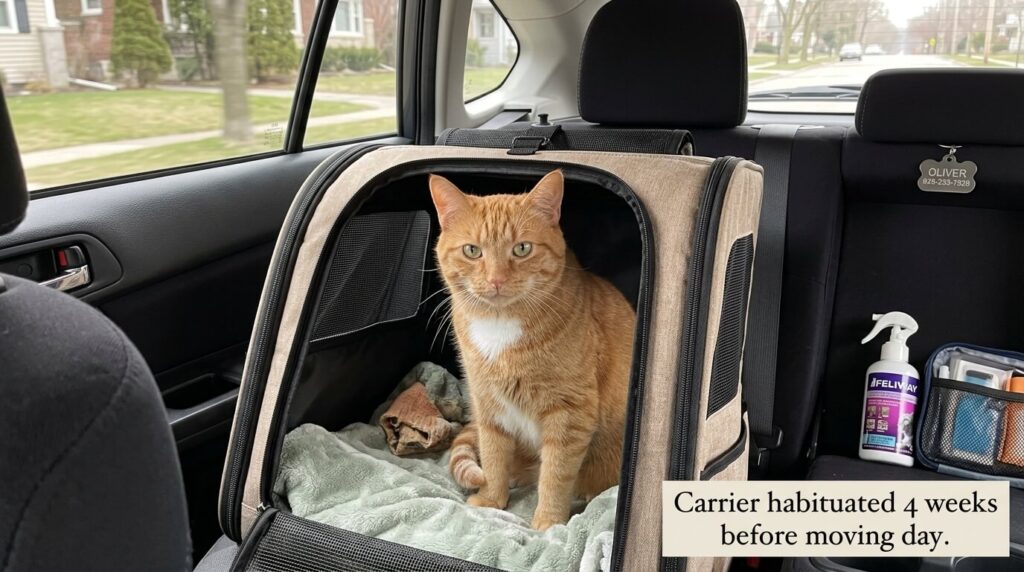
The pre-move carrier habituation protocol (begin 4–6 weeks before moving day):
- Leave the carrier open on the floor in Oliver’s primary living space
- Feed daily meals inside the carrier — building a positive food association with the enclosed space
- Place familiar bedding inside — the carrier becomes a secondary sleeping spot
- Practice carrier entries with high-value treats: “carrier” cue → Oliver enters voluntarily → jackpot treat
- Practice carrier closing for 2-minute periods, extending gradually to 10-minute, 20-minute, 30-minute closed periods with rewards throughout
By moving day: A carrier-habituated cat enters voluntarily when asked, rests calmly inside with the door closed, and has a positive rather than negative association with the enclosed space. The transport experience is fundamentally different.
On moving day specifically: Place a familiar, unwashed item of your clothing in the carrier before Oliver enters — your scent throughout the transport period provides co-regulatory calm even when you are focused on managing the move.
For a longer drive, taxi ride, or multi-stop moving route, follow our full guide to traveling with a cat in a car so the carrier, temperature, parking stops, and door-opening moments are handled safely.
Tip 5: Calming Support — Ask Your Veterinarian First
Some cats need more than scent anchors and a quiet room, especially if they have a history of severe travel stress, panic hiding, stress-related urinary signs, or appetite shutdown after change. Before using calming supplements, sedatives, or anti-anxiety medication, talk with your veterinarian. The safest option depends on your cat’s age, health history, current medications, and the length of the move.
Evidence-supported calming supplements for move-related stress:
Zylkene (alpha-casozepine):
- Derived from a casein protein in milk; produces anxiolytic effects without sedation
- Begin 48 hours before moving day for maximum effect during peak stress
- Available in capsule form (open and mix into food); palatable for most cats
Solliquin (L-theanine + magnolia/phellodendron extract):
- L-theanine promotes alpha brain wave activity (calm alertness without sedation)
- Begin 5–7 days before moving day for optimal effect
Rescue Remedy for Pets:
- Bach flower remedy; less evidence-based than the above but anecdotally effective for mild situational anxiety
- Can be added to water or applied to skin on ears
What to discuss with your veterinarian:
For cats with severe stress responses to environmental change — particularly cats with a history of stress-induced cystitis — your veterinarian may recommend short-term Gabapentin (1–2 days) or Trazodone for the peak moving day window. This is a conversation worth having before moving day, not on it.
Moving with a cat to new apartment settings can be especially difficult for senior cats, who may become more disoriented when routines, smells, and room layouts change. If your cat also shows hiding, appetite changes, irritability, or restlessness, compare the pattern with our guide to signs your indoor cat is stressed and ask your veterinarian whether extra support is needed.
Tip 6: Paced Exploration — The Gradual Expansion Protocol
Territorial Reset — the process of a cat re-establishing their scent territory in a new space — takes time and must happen at the cat’s pace, not the owner’s. Moving with a cat to new apartment environments fails when owners release their cat into the full apartment immediately, expecting the cat to simply “get used to it.”
As you open new rooms, think about layout as part of stress prevention. Our cat friendly interior design guide explains how to place beds, shelves, litter zones, scratching surfaces, and hiding spots so the new apartment feels organized instead of overwhelming.
The Gradual Expansion protocol:
Days 1–3: Safety Room only
Oliver remains in the Safety Room. You visit him here — sitting quietly, not forcing interaction, providing meals and play sessions within this space. He is investigating, scent-marking, and beginning to establish this room as a known, safe zone.
Days 4–5: Safety Room + adjacent corridor
Open the Safety Room door for supervised exploration periods of 15–30 minutes, with the rest of the apartment doors closed. Allow Oliver to investigate the corridor on his terms — following smells, investigating corners, scent-marking surfaces. Return him to the Safety Room before his stress indicators rise.
Days 6–7: One additional room added
Expand access by one room — the room adjacent to the Safety Room that has been furnished with familiar items. Close off the remaining rooms. Allow supervised exploration for increasing periods.
Week two: Progressive full-apartment access
Add one room per 1–2 days, always allowing retreat back to the Safety Room which remains set up throughout this process.
The behavioral indicators that expansion is proceeding at the right pace:
- Cat is eating normally in the Safety Room → safe to begin corridor access
- Cat is scent-marking (chin-rubbing) new surfaces → territorial establishment proceeding normally
- Cat is using the litter box normally → stress response is manageable
- Cat is sleeping in a relaxed meatloaf posture (not hunched) → threshold is not being exceeded
Tip 7: Maintaining Rituals — The Temporal Anchor
While scent is the primary Olfactory Anchor for cats, temporal rhythm is a secondary but genuinely important stabilizing factor. The specific timing and sequence of daily events — feeding, play, sleep, human interaction — represents a predictable structure that persists through the chaos of moving with a cat to new apartment disruption.
The ritual maintenance protocol:
- Feed at exactly the same times in the new apartment as you did in the old one — before you do anything else in the morning if that was Oliver’s pattern, at the same evening time regardless of moving exhaustion
- Conduct a play session at the usual play time — even a 10-minute abbreviated wand toy session on day one is worth prioritizing
- Sleep in proximity to Oliver’s Safety Room on the first night — your presence through the door provides co-regulatory calm even without direct contact
- Maintain your normal vocal pattern — talk to Oliver in your normal tone and rhythm during the moving period; your voice is itself a familiar temporal cue
What disrupts temporal anchoring:
- Feeding at random times during moving chaos — “I’ll do it when I get a chance”
- Skipping play entirely during the move week
- Sleeping in a hotel the first night and leaving Oliver alone in the new apartment
- Using an anxious, elevated voice when interacting with Oliver during the move
The rituals communicate: the things that matter most haven’t changed. Only the walls have.
The First 7 Days After Moving With a Cat to New Apartment Spaces
The first week matters because your cat is rebuilding a territory map from scratch. They are learning where food is, where the litter box is, which sounds are normal, where people sleep, and which hiding spots feel safe.
Do not judge the move by the first few hours. A quiet, hiding cat is not automatically failing. A cat that explores too fast is not automatically comfortable either. The better question is whether your cat is eating, drinking, using the litter box, resting, and gradually returning to normal behavior.
Day 1: Keep the World Small
On the first day, keep your cat in the safety room. Let them come out of the carrier on their own. Some cats walk out quickly. Others stay inside for hours. Both can be normal.
Do not force exploration. Do not carry your cat from room to room. Do not introduce every closet, balcony door, window, and hallway on the first night. Your cat does not need a tour. They need a safe base.
Check for:
- normal breathing
- access to water
- litter box use
- hiding that still allows monitoring
- no open doors or windows
- no unreachable hiding spots
If your cat eats a little, uses the litter box, and rests, the first day is successful.
Day 2: Add Routine Before Space
On the second day, keep meals predictable. Feed at the usual time if possible. Sit quietly in the room without forcing interaction. Let your cat decide whether to approach, hide, sniff, or rest.
If your cat is still frozen, not eating, or hiding intensely, do not expand access yet. If your cat is eating, using the litter box, and moving around the safety room, you can briefly open one additional quiet area.
The mistake is giving the whole apartment too soon. More space can feel like more safety to humans, but to a cat it can feel like more unknown territory to defend, inspect, and escape from.
Day 3: Open One Area at a Time
If your cat is stable, open one new room or section at a time. Keep the safety room available as the home base. Your cat should be able to return to food, litter, bedding, and hiding space at any time.
Watch your cat’s body language. A cautiously curious cat may sniff, pause, retreat, and return. That is normal. A cat who crouches low, pants, vocalizes intensely, refuses food, or hides without improvement may need a slower plan.
If your cat tries to bolt through doors during this stage, review our guide on how to stop a cat from running out the door.
Days 4 to 7: Build the New Map
By the end of the first week, many cats begin forming a new routine. They may choose a favorite resting spot, start using windows, scratch normal surfaces, ask for food at normal times, and sleep more deeply.
This is when you can begin arranging the apartment for long-term life:
- move the litter box gradually if needed
- set up a window perch
- place scratching options near resting areas
- create feeding and water stations
- block unsafe gaps behind appliances
- secure balcony doors and windows
- remove packing clutter
- keep one familiar scent item in the main room
If your cat still seems tense after the first week, compare the behavior with our guide to signs your indoor cat is stressed.
Common New Apartment Moving Mistakes
Mistake 1: Washing Every Familiar Item
Clean bedding looks better to humans, but familiar scent helps cats feel grounded. Do not wash every blanket, bed, towel, carrier pad, and toy before the move. Bring at least a few scent-heavy items from the old apartment.
A familiar blanket in the safety room can matter more than a new bed. Your cat is not looking for perfect decor. They are looking for proof that some part of their old world still exists.
Mistake 2: Changing Food or Litter During the Move
Moving is already a major change. Do not add a new food, new litter, new bowl, new box style, or new feeding schedule unless there is a medical reason.
A cat who refuses food after a move may already be stressed. If the food also smells different, the bowl is different, and the eating location is unfamiliar, you have created several problems at once.
Keep food and litter stable until your cat is eating, drinking, and using the litter box normally again.
Mistake 3: Opening the Whole Apartment Too Soon
Some cats explore quickly, but fast exploration does not always mean comfort. It may be stress scanning. A cat may rush through rooms because they are trying to find exits, hiding spots, or familiar smells.
The better approach is gradual access. One room first. Then one new area. Then the rest of the apartment when the cat is ready.
Mistake 4: Ignoring Litter Box Location
A new apartment can change litter box behavior. The box may be too close to noise, too far from the safety room, too exposed, or too near a scary appliance.
If your cat has an accident after moving, do not punish them. Check whether the box is easy to find, easy to enter, quiet, clean, and not blocked by boxes or furniture.
If accidents continue, use our guide on cat peeing outside the litter box and contact your veterinarian if there are signs of pain, straining, blood, frequent urination, or sudden behavior change.
Mistake 5: Assuming Hiding Means Failure
Hiding is often part of normal adjustment. The problem is not hiding itself. The problem is hiding combined with not eating, not drinking, not using the litter box, breathing changes, collapse, or signs of pain.
Give your cat safe hiding options, but avoid unreachable hiding spots. A covered bed, cardboard box, open carrier, or blanket-covered chair is better than access behind appliances or inside unfinished storage spaces.
Vet Tech Emergency Check: Monitoring Appetite and Urination Post-Move
This section is the one I include in every moving with a cat to new apartment conversation with clients — because the 72 hours post-move is when stress-related medical emergencies develop, and early detection is the difference between a same-day vet visit and an emergency clinic at midnight.
The Post-Move Monitoring Checklist
Monitor three times daily for the first 72 hours:
Appetite:
- Eating a normal portion at each meal → normal
- Eating less than 50% of normal → monitor closely, offer more enticing food
- Complete food refusal for 24+ hours → veterinary contact required
Water intake:
- Normal drinking behavior
- Significantly increased drinking → monitor for urinary symptoms
- No visible drinking for 24 hours → encourage with a water fountain or tuna water addition
Litter box behavior — the most critical monitoring point:
- Normal urination (2–3 times daily, normal volume, yellow color) → normal
- Reduced urination (1 time daily, small volume) → monitor every 4 hours
- Straining in the litter box with little or no output → same-day veterinary emergency, particularly in male cats
- No urination in 24 hours → emergency veterinary visit immediately
- Pink or red-tinged urine → same-day veterinary contact
Why urination monitoring is the priority:
Feline Idiopathic Cystitis triggered by moving stress can progress to urethral obstruction in male cats within 24–48 hours. A male cat who is straining to urinate with little or no output is experiencing a life-threatening emergency — the urethra can be completely obstructed within hours, and bladder rupture or systemic toxicity can follow. This is not an “observe and wait” situation.
Behavioral Post-Move Monitoring
Beyond the physical parameters, monitor for behavioral signs that the stress response is exceeding manageable levels:
- Hiding for more than 48 hours continuously without emerging for food or water
- Vocalization — particularly in cats who don’t normally vocalize; a new-environment distress cry is distinct from their normal communication
- Aggression toward you that is new or escalating — redirected arousal from an overwhelmed nervous system
- Compulsive grooming creating bald patches — a stress-response behavior that can develop within days of an overwhelming environmental change
Signs Your Cat Is Settling Into the New Apartment
Look for small signs rather than dramatic confidence. A cat who is adjusting well may:
- eat closer to normal amounts
- drink normally
- use the litter box
- groom
- sleep in open areas
- rub cheeks on furniture
- scratch approved surfaces
- explore in short sessions
- return to familiar people
- play briefly
- watch windows calmly
- rest with a looser body posture
The timeline varies. Some cats settle within days. Others need two or three weeks. Senior cats, anxious cats, cats with medical issues, and cats who have moved multiple times may need longer.
When to Call a Veterinarian After Moving
Call your veterinarian promptly if your cat refuses food, cannot urinate, strains in the litter box, vomits repeatedly, has diarrhea that continues, breathes abnormally, collapses, hides without improvement, shows sudden aggression, or seems painful.
Moving stress can affect appetite and behavior, but it should not be used to explain away serious medical signs. Cats with urinary history, diabetes, kidney disease, heart disease, respiratory problems, senior mobility issues, or prescription diets need extra caution.
If you are unsure whether a change is stress or illness, treat it as a health question first.
Frequently Asked Questions
1. How long should a cat stay in one room after moving?
The honest answer is: as long as they need to — and that timeline is dictated by behavioral indicators, not by a fixed number of days.
The minimum Safety Room period I recommend for moving with a cat to new apartment settings is three full days (72 hours) regardless of how well the cat appears to be adapting. The neurological stress of the move continues to produce cortisol elevation even when the cat looks calm, and premature expansion before the baseline is stabilized frequently triggers setbacks that extend the overall adaptation timeline.
After 72 hours, use the Gradual Expansion protocol behavioral indicators to guide progression: eating normally, using the litter box normally, and showing scent-marking behavior (chin-rubbing on surfaces) in the Safety Room are the three signals that indicate readiness for the first expansion step.
For a cat who is not eating, not using the litter box normally, or showing sustained hiding with no voluntary emergence — keep the Safety Room as the only accessible space and contact your veterinarian if this persists beyond 48 hours.
For context: Oliver’s full adaptation to the new apartment — where he would voluntarily explore every room, sleep in non-Safety-Room locations, and show his normal level of relaxation — took eleven days. Some cats adapt in five days. Some take three weeks. The timeline is the cat’s, not yours.
2. What should I put in the cat safety room before moving day?
A cat safety room should include a litter box, water, a small amount of familiar food, a hiding place, familiar bedding, one scratching option, and at least one item that smells like the old apartment. Choose a room with a door that closes securely, ideally a bathroom or quiet bedroom. Add a sign on the door that says the cat is inside and the door must stay closed. Do not use a room that movers need to enter repeatedly.
3. When should I call a vet after moving with a cat to a new apartment?
Call a veterinarian promptly if your cat does not urinate, strains in the litter box, cries while trying to urinate, refuses food for more than 24 hours, pants, collapses, vomits repeatedly, or hides with signs of pain or illness. Some stress after moving is normal, but urinary changes, appetite loss, and severe lethargy should not be treated as simple adjustment behavior.
4. How do I calm my cat during the car ride to the new apartment?
The car ride is a secondary stress event — significant, but brief relative to the broader moving stress arc. These are the specific interventions that reduce car transport stress:
The carrier environment: Spray Feliway Classic in the carrier interior 30 minutes before Oliver enters and allow it to dry completely before he’s placed inside. Line the carrier floor with his most-used, unwashed blanket. A piece of your worn clothing pressed against the carrier’s inner wall provides olfactory comfort.
The carrier covering: Cover the carrier completely with a thin blanket during transport. The reduced visual stimulation of a moving environment (passing cars, changing light, unfamiliar visual input) dramatically reduces arousal during transport. Uncover only when the carrier is stationary and you want Oliver to see you.
Your driving behavior: Drive smoothly — minimize hard braking and sharp turns. Play soft music rather than silence (silence amplifies every car sound) but avoid music with heavy bass that vibrates through the car body. Speak calmly to Oliver throughout — not anxiously, not repeatedly, just occasional quiet verbal check-ins.
What not to do: Do not open the carrier during transport to “comfort” Oliver — a stressed cat who exits a moving vehicle carrier is a genuine emergency. Comfort Oliver through the carrier mesh with a finger if needed, but do not open the carrier until you are inside the Safety Room of the new apartment with the door fully closed.
5. Should I wash my cat’s bedding before the move?
No — and this is one of the most common well-intentioned mistakes owners make before moving with a cat to new apartment transitions.
Washing Oliver’s bedding immediately before a move removes the accumulated scent signature that makes the bedding an effective Olfactory Anchor in the new space. The bedding should arrive in the new apartment smelling as strongly as possible of Oliver — which means unwashed, or washed only if hygienically necessary (soiling, parasites) and then re-scented by allowing Oliver to sleep on it for at least a week before the move.
The same principle applies to food bowls, the litter box (leave traces of used litter in the bottom of the clean litter), and any fabric items you’re bringing. The transition from old environment to new is easier when the familiar objects smell familiar — and “familiar” means Oliver’s own scent, not laundry detergent.
Your own clothing, by contrast, should be recently worn and not laundered before you provide it as an olfactory anchor — your scent is most concentrated and most soothing when the garment is worn rather than washed.
Final Thoughts
Oliver’s full adjustment to the new apartment took eleven days. On day twelve, I found him asleep in the middle of the living room floor, not under the bed, not in the safety room, not pressed into a corner.
That was when I knew the move was over.
Moving with a cat to new apartment settings works best when you do less at once: one secure carrier, one prepared safety room, familiar scent anchors, a quiet first day, and gradual access to the rest of the home. Your cat does not need to understand the move. They need a small, safe place where the new world can become familiar one piece at a time.
References
- Amat, M., Camps, T., & Manteca, X. (2016). Stress in owned cats: Behavioural changes and welfare implications. Journal of Feline Medicine and Surgery, 18(8), 577–586.
- Buffington, C. A. T., Westropp, J. L., Chew, D. J., & Bolus, R. R. (2006). Clinical evaluation of multimodal environmental modification (MEMO) in the management of cats with idiopathic cystitis. Journal of Feline Medicine and Surgery, 8(4), 261–268.
- International Cat Care. Moving house with your cat. https://icatcare.org/advice/moving-house-with-your-cat/
- Cats Protection. Moving home with your cat. https://www.cats.org.uk/help-and-advice/home-and-environment/moving-home-with-your-cat
-300x169.png)
-300x169.png)
-300x169.png)